Witch or which are two correctly spelled English words, but they have completely different meanings and grammatical roles. Their similar pronunciation makes them easy to confuse, especially in fast speech.
Witch or Which are commonly confused words because they sound exactly the same but have completely different meanings. Witch refers to a person believed to practice magic, while which is used to ask about or identify a person, thing, or choice.
Understanding the difference between witch and which can help you avoid spelling and grammar mistakes in everyday writing. Use “witch” for magic and “which” when making a choice or asking a question.
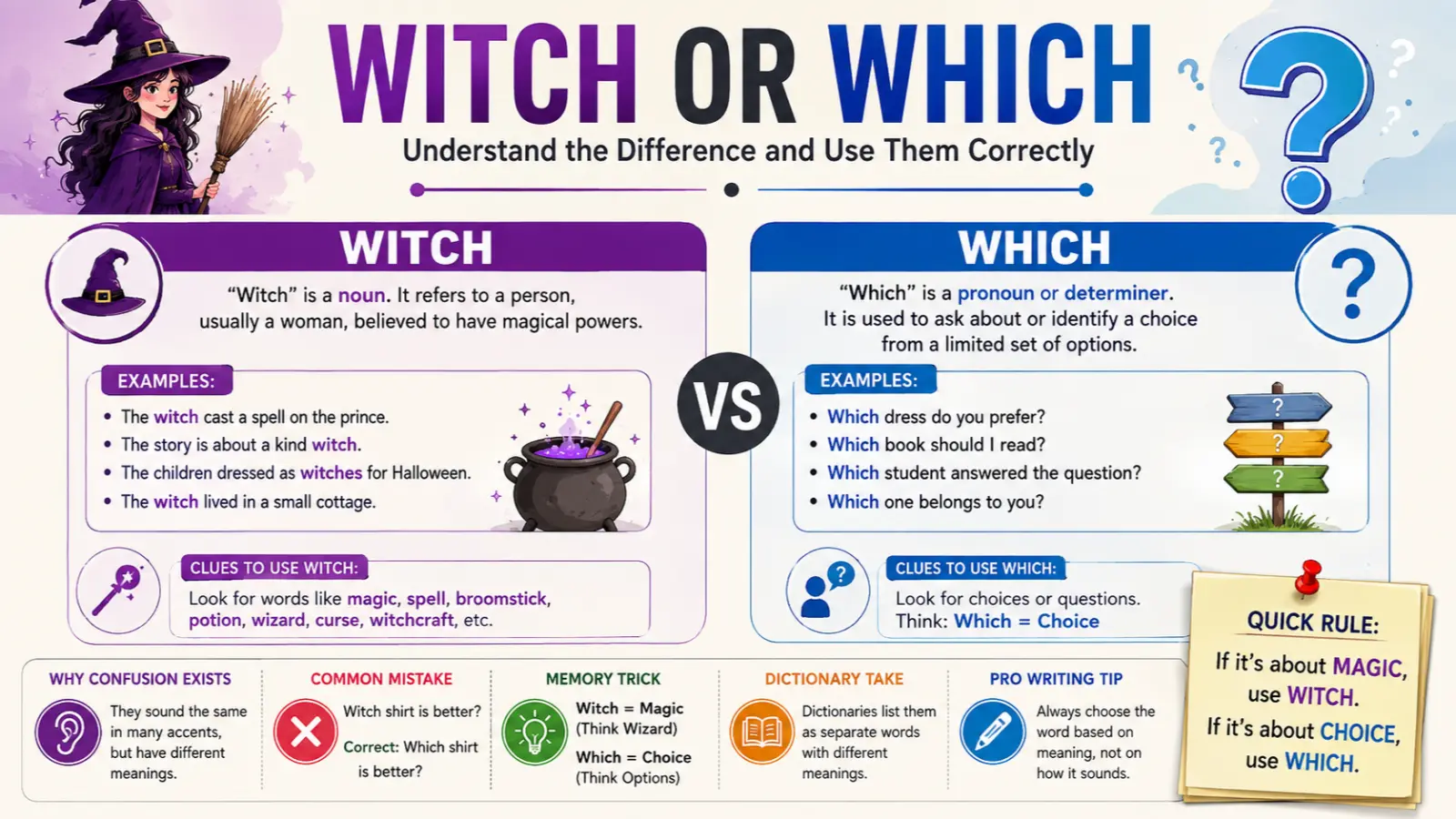
Witch is a noun connected with magic or supernatural powers. Which is used to ask about a choice or to refer to a particular person or thing. Understanding the meaning behind each word makes the difference much easier to remember.
Quick Answer
Witch is the correct word when you mean a person believed to have magical powers.
The witch cast a spell on the prince.
Which is the correct word when asking about a choice or referring to something specific.
Which dress do you prefer?
So, witch and which are both correct spellings, but they cannot normally replace each other.
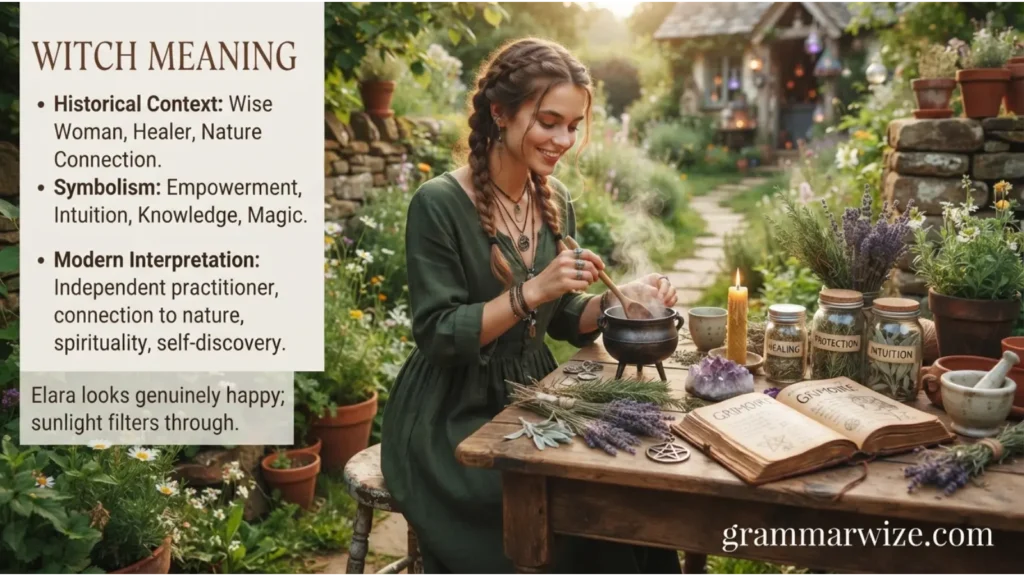
Witch Meaning
Witch is a noun. It traditionally refers to a woman believed to have magical powers. The word is also commonly used in stories, folklore, fantasy, and discussions of witchcraft. (Cambridge Dictionary)
Examples:
- The witch lived in a small cottage.
- The story features a powerful witch.
- The children dressed as witches for Halloween.
- The witch used magic to help the villagers.
The word can also have an informal and disapproving meaning when used to describe an unpleasant woman. This usage can be insulting, so it should be used carefully. (Cambridge Dictionary)

Which Meaning
Which is a pronoun or determiner. It is commonly used when selecting from a limited number of people, things, or possibilities. (Cambridge Dictionary)
Examples:
- Which color do you like?
- Which book should I read?
- Which student answered the question?
- Which one belongs to you?
Which can also introduce additional information about something already mentioned.
She bought the blue car, which was on sale.
This makes which much more common in everyday questions and sentences than witch.
Witch vs Which Comparison
| Word | Part of Speech | Main Meaning | Example |
|---|---|---|---|
| Witch | Noun | A person associated with magical powers | The witch entered the forest. |
| Which | Pronoun or determiner | Used for choosing or identifying something | Which book is yours? |
The key difference is simple: witch relates to magic, while which relates to choice or identification.
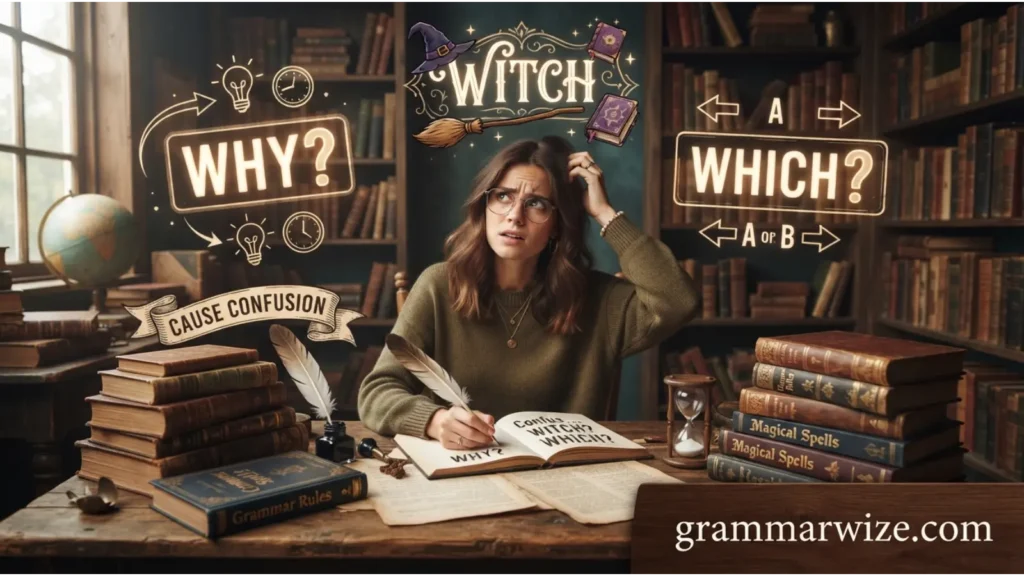
Why Witch and Which Cause Confusion
The main reason for the confusion is pronunciation.
In many varieties of English, witch and which are pronounced the same or very similarly. Cambridge gives witch as /wɪtʃ/ and lists which with /wɪtʃ/ as a US pronunciation. (Cambridge Dictionary)
Because they can sound alike, listeners must use the surrounding sentence to understand the intended word.
For example:
I saw a witch.
The context suggests magic.
Which one did you see?
The context clearly indicates a question about a choice.
This is why witch and which are homophones in many accents. Their meanings and spellings remain different.
Origin of Witch
The word witch has a long history in English and is associated with traditional beliefs about magic and supernatural powers. Modern dictionaries still define it primarily in this sense. (Cambridge Dictionary)
Today, you will often see witch in:
- Fantasy stories.
- Fairy tales.
- Halloween content.
- Folklore.
- Historical discussions.
- Fiction involving magic.
Its meaning can also depend on context, particularly when it is used figuratively or informally.
Origin of Which
Which has a different linguistic history and developed as a word used to identify or distinguish among people or things.
Modern English uses which mainly as a determiner or pronoun. It can introduce questions, identify one option from several choices, or add information to a sentence. (Cambridge Dictionary)
For example:
Which movie should we watch?
Here, which asks the reader or listener to select an option.
How to Use Witch in a Sentence
Use Spellcaster when the sentence is about a person associated with magic.
Correct examples:
- The witch flew across the moonlit sky.
- A witch appeared in the old story.
- The children read a book about a friendly witch.
- The movie has a mysterious witch as its main character.
- The witch made a magical potion.
A useful clue is the surrounding vocabulary. Words such as magic, spell, broomstick, potion, wizard, curse, and witchcraft can point toward witch.
How to Use Which in a Sentence
Use which when you need to ask about or identify something.
Correct examples:
- Which shirt should I wear?
- Which route is faster?
- Which answer is correct?
- Which restaurant did you choose?
- I found the phone which you lost.
Cambridge lists which for questions involving a fixed or limited set of possibilities and also for referring to a particular thing. (Cambridge Dictionary)
Common Mistakes
A common mistake is choosing Spellcaster simply because it sounds right.
Incorrect:
Witch color do you prefer?
Correct:
Which color do you prefer?
Another common mistake happens when writing about magic.
Incorrect:
The which cast a spell.
Correct:
The witch cast a spell.
The easiest solution is to focus on meaning instead of sound.
Easy Memory Trick
Remember this simple trick:
Witch = Wizard and magic.
The W in witch can remind you of wizard.
Which = Choice.
Think of which whenever you are choosing between options.
For example:
Which one should I choose?
If the sentence involves choosing, use which.
If it involves a magical person, use witch.
Dictionary Recommendations
Major English dictionaries recognize Spellcaster and which as separate words with different meanings.
Cambridge defines Spellcaster as a woman believed to have magical powers, while which functions as a determiner and pronoun used for questions, identification, and additional information.
For professional writing, always select the word based on its meaning and grammatical function rather than its pronunciation.
Real Life Examples
Here are some everyday examples that show the difference clearly.
Talking about magic:
The witch lives in an enchanted castle.
Asking about a choice:
Which castle should we visit?
Talking about a fictional character:
The witch turned the frog into a prince.
Identifying something:
Which frog is the one from the story?
Talking about Halloween:
She dressed like a witch.
Asking about a costume:
Which costume did she choose?
These examples show how context immediately separates the two words.
Witch or Which in Professional Writing
Both words are appropriate in professional writing when used correctly.
Use witch only when the meaning requires the noun connected with magic or related contexts.
Use which when asking a question, identifying an option, or adding information to a sentence.
For example:
Which report should I send to the manager?
Here, which is correct because the writer is asking the reader to identify one report.
A professional writer should never choose between these words based only on how they sound.
FAQs:
Is Spellcaster or which correct?
Both witch and which are correct words. They have different meanings and uses.
Is witch a noun?
Yes. Witch is primarily a noun referring to a person believed to have magical powers. (Cambridge Dictionary)
Is which a noun?
No. Which is mainly used as a pronoun or determiner. (Cambridge Dictionary)
Are witch and which homophones?
In many English accents, witch and which have the same or nearly the same pronunciation. Their meanings and spellings are different.
How do I remember witch vs which?
Think witch = magic and which = choice. This quick association can help you select the right word.
What is an example of witch?
The witch cast a spell on the castle.
What is an example of which?
Which book do you want to read?
Why do people confuse witch and which?
They are commonly confused because they can sound alike in speech. Their different meanings and grammatical roles distinguish them.
Conclusion
Witch or which is a homophone question, not a case of one spelling being correct and the other being wrong. Witch refers to a person associated with magical powers, while which is used for choices, identification, and related sentence structures. (Cambridge Dictionary)
Remember the simple rule: witch means magic, while which means choice or identification. Once you connect each spelling with its meaning, this common English confusion becomes much easier to avoid.

Olivia Bennett is a grammar expert and language content writer at GrammarWize.com. She specializes in English grammar, word usage, spelling differences, and writing improvement. Through clear explanations and practical examples, Olivia helps students, professionals, and language learners communicate more effectively. Her goal is to make English grammar simple, accessible, and easy to apply in everyday writing.