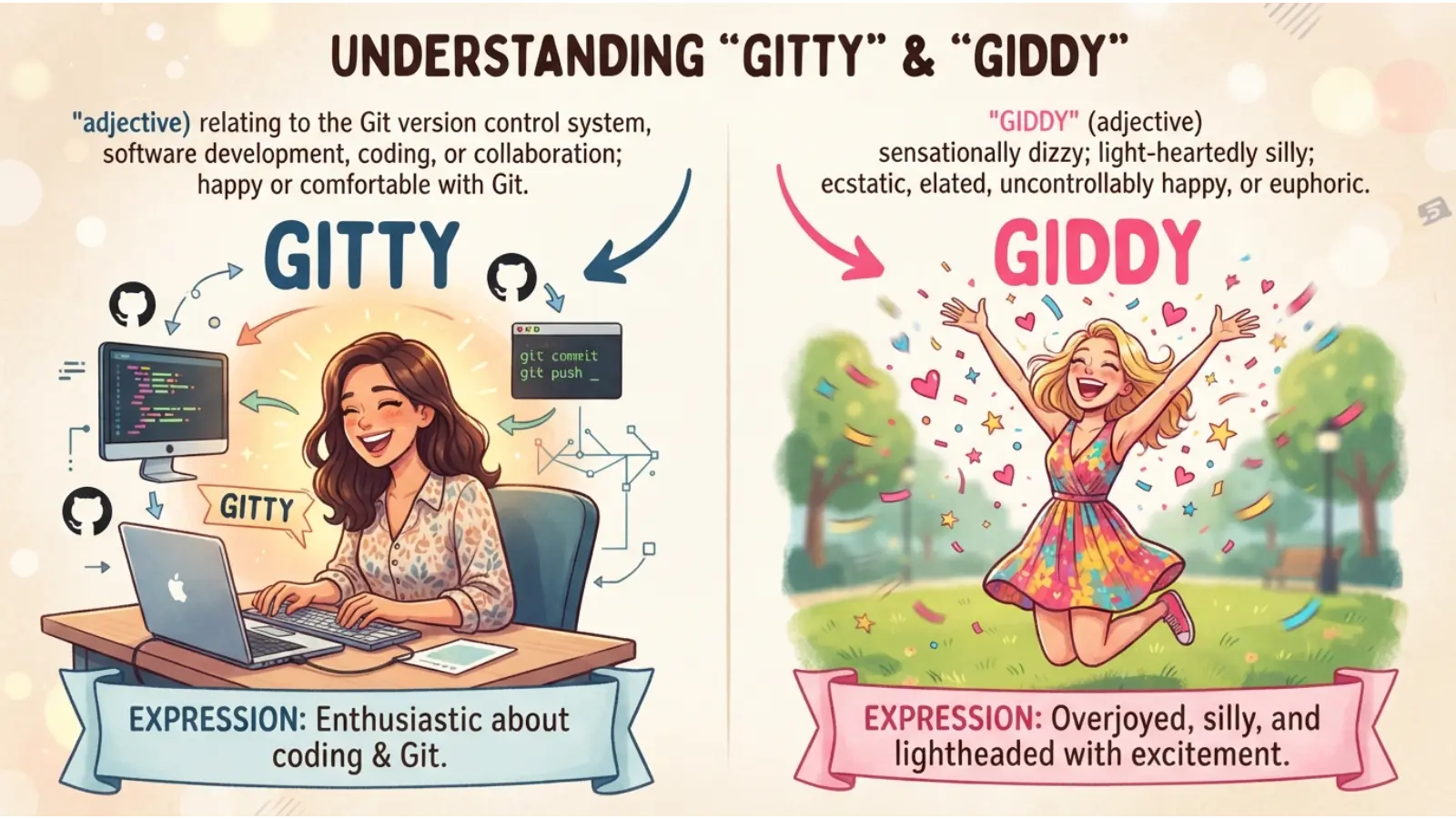
Gitty or Giddy can be confusing because both spellings look natural at first glance. If you want to describe someone as excited, cheerful, or unable to stay calm, giddy is the correct spelling.
Gitty or Giddy can be confusing because these words look and sound quite similar. However, giddy is the correct and commonly used spelling when you mean feeling excited, cheerful, or lightheaded. “Gitty” is generally considered a misspelling.
In this guide, you will learn the difference between Gitty or Giddy, their meanings, correct usage, and easy examples. You can also use the copy button to quickly save useful examples and share them with others.
The word giddy is a standard English adjective used in everyday and professional writing. Gitty is generally a misspelling when this meaning is intended. In this guide, you will learn the difference, see clear examples, and discover an easy way to remember the correct form.
Quick Answer
Giddy is the correct spelling when you mean extremely excited, cheerful, or slightly silly because of excitement.
Gitty is not the standard spelling for this meaning.
Correct: She felt giddy after hearing the good news.
Incorrect: She felt gitty after hearing the good news.

What Does Giddy Mean?
Giddy is an adjective that describes a person who feels very excited, happy, or lightheaded.
It can describe strong excitement that makes someone behave in a playful or slightly silly way.
Examples:
- The children were giddy with excitement.
- He felt giddy after winning the competition.
- She became giddy when she received the surprise gift.
- The announcement left everyone giddy with joy.
The word can also describe a feeling of dizziness or lightheadedness.
Example:
I felt giddy after standing up too quickly.

Why Is Gitty Confusing?
The confusion comes mainly from pronunciation and spelling patterns.
When people hear giddy, they may assume that the word should contain tt. This can lead to the incorrect form gitty.
English contains many words where similar sounds do not follow simple spelling patterns. As a result, people sometimes write a word based on how they think it sounds.
For standard English, use giddy when you mean excited, cheerful, or dizzy.
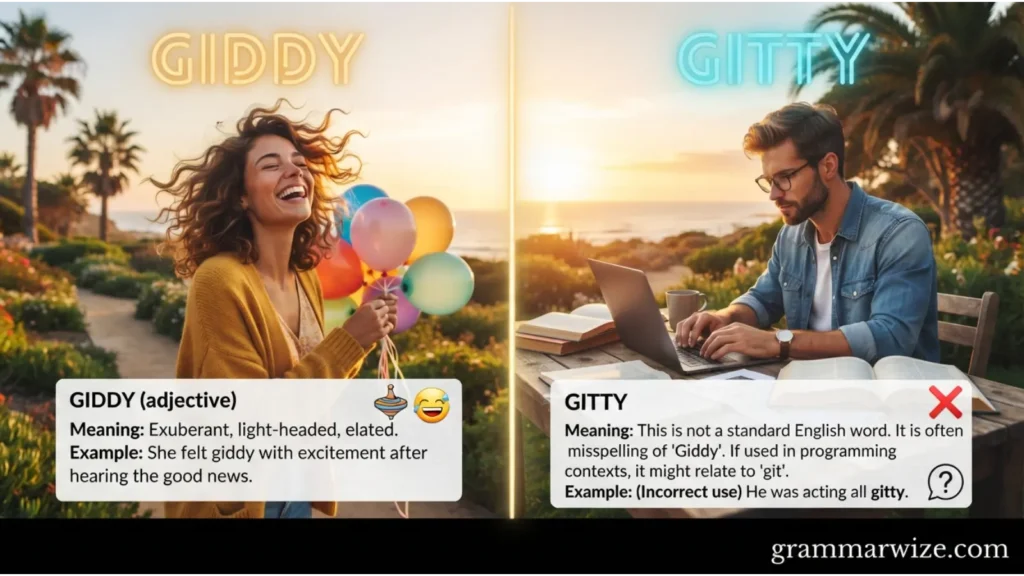
Giddy vs Gitty Comparison
| Word | Correct spelling | Standard English word | Meaning |
|---|---|---|---|
| Giddy | Yes | Yes | Excited, cheerful, silly, or lightheaded |
| Gitty | No | No, for this meaning | Usually a misspelling of giddy |
The safest choice in formal and professional writing is giddy.
Where Does Giddy Come From?
Giddy is an old English word with roots in Old English. It is related to an older word that carried the sense of being insane, mad, or foolish.
Over time, its meaning developed. Modern English commonly uses giddy for intense excitement, playful happiness, or a feeling of dizziness.
This history also explains why the word has more than one related sense today.
When Should You Use Giddy?
Use giddy when someone is extremely excited or happy.
It works well in casual conversations, stories, articles, and other forms of writing.
Examples:
- I was giddy about the upcoming concert.
- The kids were giddy before the trip.
- She was giddy after getting the job.
- He sounded giddy during the phone call.
You can also use it for physical lightheadedness.
Example:
The spinning ride made me feel giddy.
Common Mistakes With Giddy
One common mistake is adding t to create gitty.
Incorrect:
She was gitty about her birthday.
Correct:
She was giddy about her birthday.
Another mistake is assuming that giddy always means happy. The word can also describe dizziness or a lack of steady balance.
Example:
I felt giddy after the amusement park ride.
Understanding the context helps you choose the right interpretation.
Easy Memory Trick
Remember Giddy with the phrase:
Giddy = Great excitement.
Both Giddy and Great begin with G.
When you feel great excitement, think Giddy, not Gitty.
Another simple trick is to remember that giddy has only one t and two d letters.
G I D D Y
Professional Writing Recommendation
Use giddy in emails, articles, reports, academic writing, and other standard English contexts when the meaning fits.
Avoid gitty unless you are reproducing a specific name, username, brand, or other proper term that intentionally uses that spelling.
For general English writing, giddy is the clear and reliable choice.
Frequently Asked Questions
Is Gitty a word?
Gitty is not the standard spelling for the adjective meaning excited, cheerful, or dizzy. In that context, use giddy.
Is Giddy correct?
Yes. Giddy is the correct standard spelling.
What does giddy mean?
Giddy can mean extremely excited, cheerful, playful, or slightly silly. It can also mean lightheaded or dizzy.
How do you spell giddy?
The correct spelling is G I D D Y.
Why do people spell giddy as gitty?
The mistake usually comes from pronunciation and uncertainty about how the middle sounds should be represented in writing.
What is the opposite of giddy?
The opposite depends on the context. For excitement, words such as calm, serious, or composed can work. For dizziness, steady may be appropriate.
Conclusion
When choosing between Gitty or Giddy, use giddy for the standard English adjective. It describes strong excitement, cheerful energy, playful behavior, or sometimes a feeling of dizziness.
Gitty is generally a spelling mistake when you intend this meaning. Remember Giddy = Great excitement, and you will have an easy way to choose the correct spelling.

Olivia Bennett is a grammar expert and language content writer at GrammarWize.com. She specializes in English grammar, word usage, spelling differences, and writing improvement. Through clear explanations and practical examples, Olivia helps students, professionals, and language learners communicate more effectively. Her goal is to make English grammar simple, accessible, and easy to apply in everyday writing.