Lasagne or lasagna can look like two different words, but they refer to the same popular Italian pasta dish. The main difference is regional English usage.
Lasagna is the usual American English spelling, while lasagne is mainly used in British English. Both forms are accepted in English dictionaries, so neither spelling is simply wrong. Cambridge specifically identifies lasagne as mainly British and lasagna as mainly American.
Lasagne or Lasagna can be confusing when you see both spellings used for this popular Italian dish. The main difference comes from regional English usage. Lasagna is the common American English spelling, while lasagne is widely used in British English and Italy.
If you are writing a recipe, menu, or food article, choosing the right spelling can make your content look polished and natural. Keep reading to learn the difference between lasagne and lasagna, their meanings, usage, and which spelling is best for your audience.
If you are writing for a US audience, lasagna is usually the better choice. For British English, lasagne is the more familiar form. This guide explains the difference, origin, pronunciation, examples, dictionary usage, and the best spelling for different types of writing.
Lasagne or Lasagna Quick Answer
Both lasagne and lasagna are correct English spellings.
- Lasagna is preferred in American English.
- Lasagne is mainly preferred in British English.
- Both refer to an Italian pasta dish.
- Both forms appear in major English dictionaries.
- The difference is mainly regional rather than grammatical.
Cambridge gives lasagna as the US form and notes that lasagne is mainly used in the UK. Oxford also lists both forms in its dictionaries.
Lasagna in American English
Lasagna is the standard spelling most American readers expect.
American dictionaries commonly use lasagna for the dish made from layers of pasta, sauce, cheese, meat, or vegetables. Oxford’s American dictionary lists lasagna as the main form and also recognizes lasagne.
Examples include:
- I made lasagna for dinner.
- This restaurant serves homemade lasagna.
- She shared her favorite lasagna recipe.
- The cheese makes the lasagna taste delicious.
For content aimed at readers in the United States, lasagna is normally the safest spelling.
Lasagne in British English
Lasagne is the form most commonly associated with British English.
Cambridge labels lasagne as mainly UK and gives lasagna as the usual US alternative.
Examples include:
- We had vegetable lasagne for dinner.
- The restaurant serves homemade lasagne.
- She prepared a traditional lasagne.
- This lasagne contains spinach and cheese.
British publications, menus, recipes, and other forms of writing commonly use lasagne.

What Is the Difference Between Lasagne and Lasagna
The main difference is regional spelling.
| English variety | Common spelling |
|---|---|
| American English | Lasagna |
| British English | Lasagne |
| Australian English | Lasagne is common |
| International English | Both may appear |
The words do not represent two completely different dishes. In modern English, both can describe the layered Italian pasta dish.
Oxford also recognizes both lasagne and lasagna, showing that the two forms have established English usage.
Where the Words Come From
Both forms come from Italian.
The Italian word lasagna can refer to an individual sheet or type of pasta, while lasagne is the plural form. English adopted the Italian terms and developed regional preferences over time.
Oxford traces lasagne to Italian and ultimately connects the word with the Latin lasanum, associated with a cooking vessel.
The history also helps explain why British and American English developed different preferences.
American English commonly settled on lasagna, while British English retained lasagne more often.
Italian Usage Explained
Italian usage is more complicated than the English distinction.
In Italian, lasagna is traditionally the singular form, while lasagne is the plural. However, regional Italian usage can vary, particularly when referring to the prepared dish.
English does not always preserve the original grammatical system of borrowed words. That is why English speakers can use lasagna or lasagne as the name of the dish.
The important point for English writers is simple:
Do not assume that Italian grammar determines which English spelling you must use.
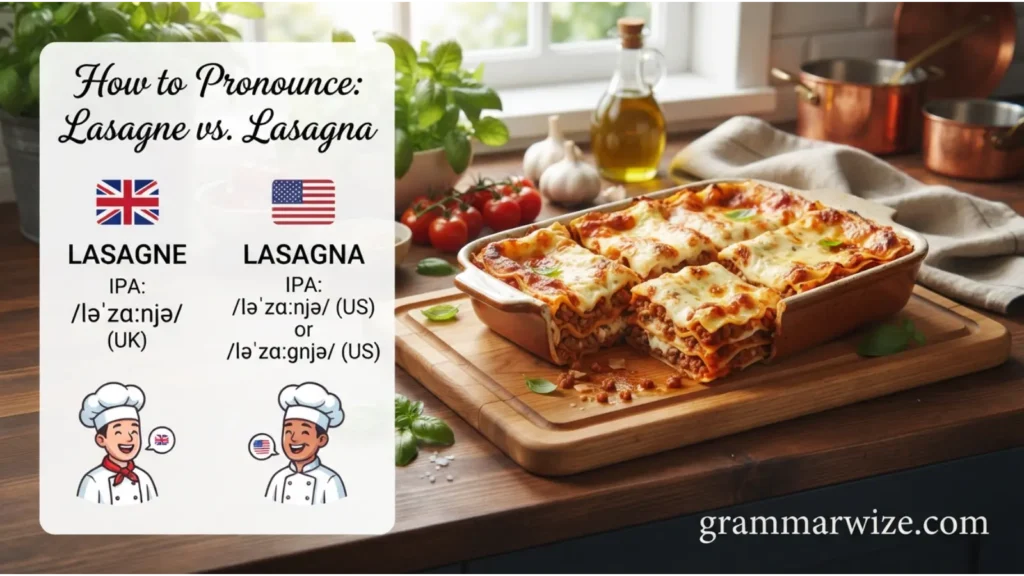
How to Pronounce Lasagne and Lasagna
In English, lasagne and lasagna are generally pronounced in very similar ways.
A common English pronunciation is approximately:
luh ZAHN yuh
Cambridge provides pronunciation information for both forms and shows differences between US and UK pronunciation patterns.
The spelling can change from lasagne to lasagna, but most English speakers will understand both immediately.
Dictionary Recommendations
Major dictionaries recognize both spellings.
Cambridge Dictionary identifies lasagna as a US form and lasagne as mainly UK.
Oxford Learner’s Dictionaries lists lasagne and notes lasagna as an alternative. Its American English dictionary lists lasagna and also gives lasagne as another form.
This means writers do not need to treat either spelling as a misspelling.
Which Spelling Should You Use
Choose the spelling that matches your audience.
For American Readers
Use lasagna.
This is the spelling most US readers expect in recipes, menus, articles, school assignments, and general writing.
For British Readers
Use lasagne.
This form fits standard British usage and is widely recognized in UK food writing.
For International Readers
Either form can work. However, consistency is important.
If your website mainly uses American English, choose lasagna. If it follows British English, choose lasagne.
Lasagne or Lasagna in Formal Writing
Both forms can appear in formal writing because both are recognized English words.
The key is to follow the spelling convention used throughout your document.
For example, a US publication should normally write:
The restaurant offers a classic lasagna recipe.
A British publication might write:
The restaurant offers a classic lasagne recipe.
Do not switch between the two forms without a reason.
Academic Writing and Publishing
Academic writers should follow the style guide required by their institution or publisher.
If the publication uses American English, lasagna will usually fit the house style.
If it follows British English, lasagne will generally be appropriate.
Style guides often establish broader spelling preferences for an entire publication. Following one consistent variety makes academic writing clearer and more professional.
Business and Professional Writing
Businesses should choose the spelling based on their target market.
An American restaurant might advertise:
Homemade Lasagna With Fresh Cheese
A British restaurant might advertise:
Homemade Lasagne With Fresh Cheese
Both are understandable internationally.
For menus, food packaging, websites, and advertising, matching the language style of the intended customers is the most practical approach.

Lasagne or Lasagna for SEO
SEO writers should consider the audience behind the search.
For a US focused website, lasagna is usually the stronger primary spelling.
For a UK focused website, lasagne is more natural.
You can still mention both terms when the article explains the spelling difference. This helps readers searching for phrases such as:
- lasagne or lasagna
- lasagna or lasagne
- lasagne vs lasagna
- is lasagne correct
- is lasagna correct
- British spelling of lasagna
- American spelling of lasagne
- lasagna UK or US
- how do you spell lasagna
- how do you spell lasagne
Avoid forcing these phrases into every paragraph. Natural language and useful explanations are more important than repeating the keyword.
Common Spelling Mistakes
People sometimes create incorrect forms because they are unsure which ending to use.
Common mistakes include:
- Lasange
- Lasagnee
- Lasagnia
- Lasagnae
- Lasangna
The two established English forms are lasagna and lasagne.
If you are unsure, check the spelling against a reputable dictionary rather than relying on how the word sounds.
Lasagna Examples in American English
Here are some natural examples using the American spelling.
- My family makes lasagna every Sunday.
- I found an easy lasagna recipe online.
- The lasagna needs another ten minutes in the oven.
- We ordered vegetable lasagna for dinner.
- She added extra cheese to the lasagna.
- This lasagna has several layers of pasta.
- The restaurant is famous for its lasagna.
- He prepared a meat lasagna for the party.
These examples fit standard American English usage.
Lasagne Examples in British English
Here are examples using the British spelling.
- We had lasagne for dinner.
- She cooked a vegetable lasagne.
- The café serves homemade lasagne.
- I ordered a portion of beef lasagne.
- This lasagne contains fresh vegetables.
- The recipe makes enough lasagne for six people.
- They served lasagne with a green salad.
- The family enjoyed the homemade lasagne.
These examples fit common British English usage.
Is Lasagne Wrong in American English
No.
Lasagne is not an incorrect word in American English.
American English generally prefers lasagna, but dictionaries recognize lasagne as an alternative. Cambridge’s American dictionary entry explicitly lists lasagna and notes lasagne as another form.
A US reader will normally understand lasagne without difficulty.
Is Lasagna Wrong in British English
No.
Lasagna is also recognized in British English, although lasagne is the more typical British form.
Cambridge identifies lasagne as mainly UK and lasagna as the usual US form.
Therefore, calling lasagna a spelling mistake in British English would be too strong.
Lasagne or Lasagna on Menus
Both spellings can appear on restaurant menus.
American restaurants commonly use lasagna.
British restaurants commonly use lasagne.
International restaurants may use either spelling, especially when their menu has been written for a broad audience.
The spelling does not normally tell you that the recipe itself is different. It usually reflects the language convention followed by the restaurant.
Current English Usage
Both forms remain established in modern English.
Cambridge continues to distinguish the regional preference, while Oxford includes both forms in its dictionary resources.
Digital publishing has also made both spellings easy to encounter. Readers may see lasagna on an American website and lasagne on a British website without either being an error.
The best practice is to identify your audience and remain consistent.
A Simple Memory Trick
Use this easy association:
America → Lasagna
Britain → Lasagne
The American spelling ends with a, while the British form commonly ends with e.
This is not a universal rule for English spelling. It is simply a useful way to remember this particular regional difference.
Lasagne or Lasagna Which One Is Correct
The correct answer is both.
Use lasagna when following American English.
Use lasagne when following British English.
The difference comes from regional English usage and the history of this Italian loanword. Major dictionaries support both forms.
For professional writing, the most important rule is consistency. Choose the form that matches your publication, audience, or style guide.
Frequently Asked Questions
Is lasagne or lasagna correct
Both are correct. Lasagna is the usual American English spelling, while lasagne is mainly used in British English.
Is lasagna American or British
Lasagna is mainly the American English form. British English generally prefers lasagne.
Is lasagne British English
Yes. Cambridge identifies lasagne as mainly UK usage.
Is lasagna spelled with an A or E
In American English, it is usually spelled lasagna with an A. In British English, lasagne with an E is more common.
Are lasagna and lasagne the same thing
In modern English, both words can refer to the same Italian layered pasta dish.
Which spelling should I use in the USA
Use lasagna for standard American English.
Which spelling should I use in the UK
Use lasagne for standard British English.
How do you pronounce lasagna
A common English pronunciation is approximately luh ZAHN yuh. Exact pronunciation can vary by accent.
How do you pronounce lasagne
English speakers commonly pronounce lasagne similarly to lasagna, although pronunciation varies between accents.
Does lasagne mean plural in Italian
Traditionally, lasagne is the plural form of Italian lasagna. English usage has developed its own conventions.
Should I use both spellings in an article
You can mention both when explaining the regional difference. For the main text, choose the spelling that matches your target audience and keep it consistent.
Conclusion
Lasagne and lasagna are both correct English spellings. The main difference is regional usage rather than meaning.
American English generally prefers lasagna, while British English mainly uses lasagne. Major dictionaries such as Cambridge and Oxford recognize both forms.
For US readers, choose lasagna. For UK readers, choose lasagne. If you are writing for an international audience, either form can work as long as your usage stays consistent.

Olivia Bennett is a grammar expert and language content writer at GrammarWize.com. She specializes in English grammar, word usage, spelling differences, and writing improvement. Through clear explanations and practical examples, Olivia helps students, professionals, and language learners communicate more effectively. Her goal is to make English grammar simple, accessible, and easy to apply in everyday writing.