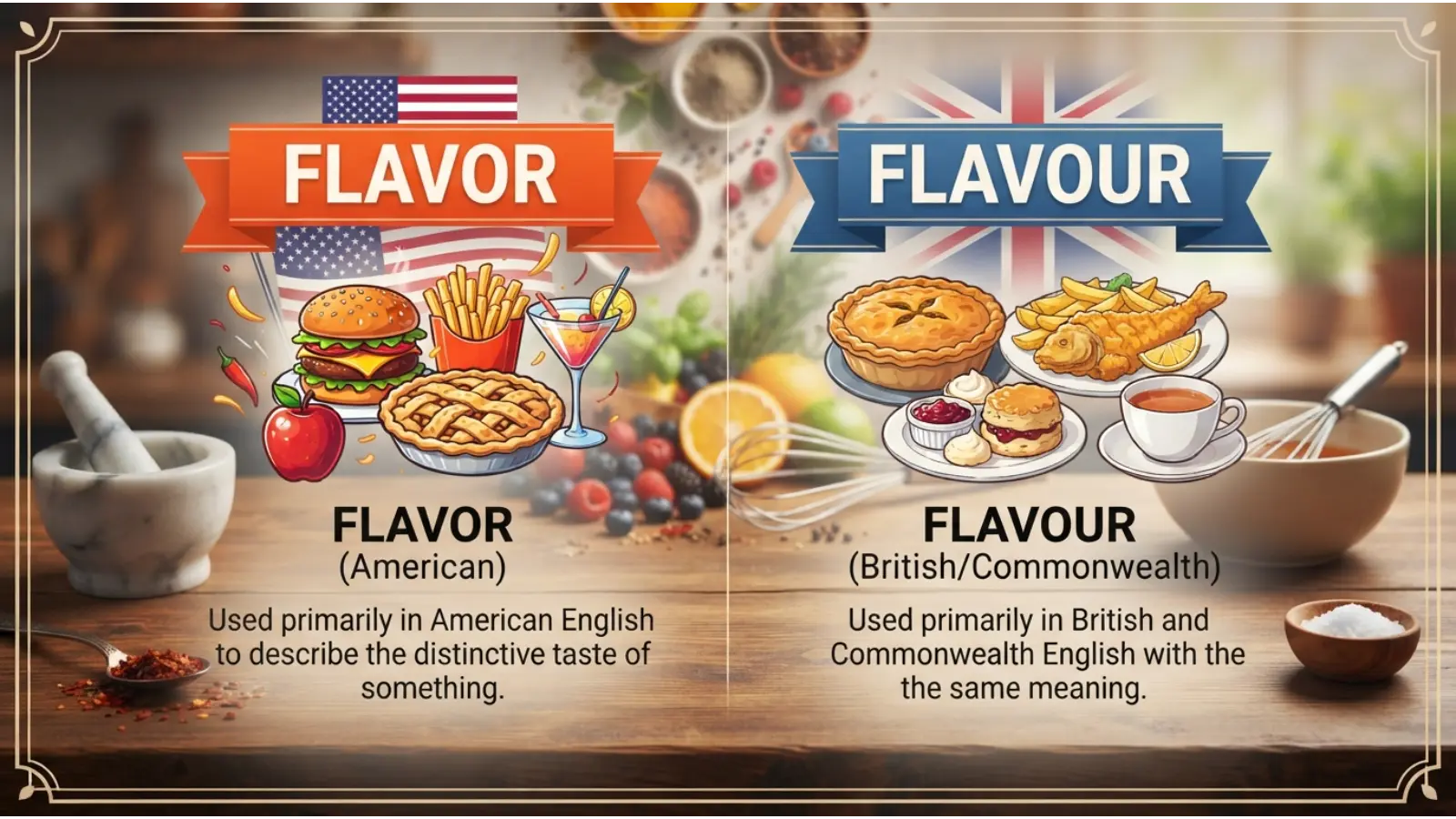
Flavor or flavour are two accepted spellings of the same English word. The main difference is regional spelling. Flavor is preferred in American English, while flavour is used in British English. Both forms describe the taste of food or drink and can also describe a distinctive quality or character.
Flavor or Flavour are both correct spellings, but the choice depends on the type of English you use. Flavor is the standard American English spelling, while Flavour is commonly used in British English and other varieties, including Canadian and Australian English. Both words refer to the taste or distinctive quality of food and drinks.
If you often confuse Flavor or Flavour, this guide will help you understand the difference quickly. You’ll learn which spelling fits American and British English, see simple examples, and discover an easy way to remember the correct form for your writing.
If you are writing for a specific audience, the easiest rule is simple: use flavor for American English and flavour for British English. Keeping your spelling consistent also makes academic, business, and online writing look more polished.
Flavor or Flavour at a Glance
| American English | British English |
|---|---|
| Flavor | Flavour |
| flavoring | flavouring |
| flavored | flavoured |
| flavors | flavours |
| flavorful | flavourful |
The meaning does not change between the two forms. The difference is mainly the spelling convention used by the English variety.
Is Flavor or Flavour Correct?
Both flavor and flavour are correct.
The choice depends on the English variety you are following.
- Flavor is the standard American English spelling.
- Flavour is the standard British English spelling.
- Both forms have the same basic meaning.
- The spelling difference does not create a different word.
Cambridge lists flavor as the US spelling of flavour. Merriam Webster also identifies flavour as a chiefly British spelling of flavor.
Simple Examples
American English:
This ice cream has a rich chocolate flavor.
British English:
This ice cream has a rich chocolate flavour.
Both sentences mean exactly the same thing.
What Does Flavor or Flavour Mean?
The word describes the taste of something, especially food or drink. It can also describe a particular quality, character, or style.
Merriam Webster defines flavor as the quality that affects the sense of taste and also uses the word for a distinctive quality or version.
Taste and Food
- The soup has a strong garlic flavor.
- The soup has a strong garlic flavour.
- Vanilla is my favorite ice cream flavor.
- Vanilla is my favourite ice cream flavour.
Character or Quality
The word can also have a figurative meaning.
- The old building has a traditional flavor.
- The old building has a traditional flavour.
Here, the word refers to a distinctive quality rather than physical taste.
Flavor in American English
Flavor is the standard spelling in American English.
You will commonly see it in American recipes, food packaging, restaurant descriptions, product information, and general writing.
Examples include:
- chocolate flavor
- natural flavor
- artificial flavor
- flavor profile
- favorite flavor
- flavored water
- different flavors
American English commonly removes the u from this group of words. This creates the familiar -or ending.
For example:
| American English | British English |
|---|---|
| flavor | flavour |
| color | colour |
| honor | honour |
| favor | favour |
| behavior | behaviour |
| labor | labour |
This is a broader spelling pattern rather than a special rule created only for flavor.
Flavour in British English
Flavour is the standard British English spelling.
You will commonly find it in British books, newspapers, recipes, educational materials, and other publications that follow British spelling conventions.
Examples include:
- chocolate flavour
- natural flavour
- artificial flavour
- flavour profile
- favourite flavour
- flavoured water
- different flavours
British English generally keeps the u in this group of words.
For example:
The curry has a rich and spicy flavour.
That spelling is appropriate for British English.
Flavor vs Flavour Meaning
There is no major difference in meaning between flavor and flavour.
Both can refer to:
- The taste of food or drink.
- A particular type of taste.
- A distinctive quality or character.
- A particular version or variety in some contexts.
Cambridge gives examples involving the taste of food and the character or quality of something.
So you should not choose one spelling because you think it has a different definition. Choose it because of the English variety you are using.
Flavor vs Flavour Pronunciation
The spelling changes, but the pronunciation is broadly similar.
Cambridge gives the American pronunciation as approximately /ˈfleɪ.vɚ/ and the British pronunciation as /ˈfleɪ.və(r)/.
For an easy pronunciation guide, think:
FLAY-vur
The exact final sound can vary with accent. The spelling difference itself does not create a major pronunciation difference.
Why Does American English Use Flavor?
The difference is part of a wider history of English spelling.
The word entered English centuries ago, and spelling conventions developed differently across regions. American spelling later adopted a number of simplified forms, including many -or spellings.
The same pattern can be seen in:
- color and colour
- honor and honour
- favor and favour
- labor and labour
- neighbor and neighbour
Merriam Webster traces flavor to Middle English flavour and records its first known use in the 14th century.
This history explains why the two forms exist today. Neither spelling is a modern misspelling of the other.
Flavor and Flavour in Other English Varieties
The British and American forms are the clearest distinction, but English usage around the world is not completely uniform.
Canadian English, for example, uses a mixture of British and American spelling conventions. Cambridge lists flavour as the Canadian British form while listing flavor as the US form.
In countries where British English conventions are widely taught or followed, flavour is often the expected spelling.
The safest approach for international writing is to identify your target audience and follow the style guide used by your organization or publication.

Flavor or Flavour in Academic Writing
Academic writing values consistency.
If your institution follows American English, use flavor. If it follows British English, use flavour.
For example:
American style:
The study examined how flavor influences consumer preferences.
British style:
The study examined how flavour influences consumer preferences.
Do not switch between the two forms without a reason. Consistency is more important than choosing one form as universally correct.
Flavor or Flavour in Business Writing
Businesses should usually match their spelling to their target market.
An American food company may write:
Our new product delivers a bold chocolate flavor.
A British company may write:
Our new product delivers a bold chocolate flavour.
Both are professional. The important point is to maintain the same spelling throughout the website, packaging, advertisements, and supporting content.
Flavor or Flavour in International Communication
International writers often encounter both forms.
You may read flavour on a British website and flavor on an American website. This does not mean one source is making a spelling mistake.
For global communication, choose one style and apply it consistently. If you are writing for an international company, follow its official editorial or brand style guide.
Common Related Spellings
The difference continues when flavor is used as a verb or in related forms.
American English
- flavor
- flavors
- flavored
- flavoring
British English
- flavour
- flavours
- flavoured
- flavouring
For example:
American:
The chef flavored the sauce with fresh herbs.
British:
The chef flavoured the sauce with fresh herbs.
The same regional spelling pattern remains throughout the word family.

Common Mistakes With Flavor and Flavour
Thinking One Form Is Wrong
Both spellings are standard. The problem is usually choosing a form that does not match the style of your writing.
Mixing Regional Styles
Avoid switching randomly between flavor and flavour in the same article.
Using American Spelling in British Content
If your publication follows British English, flavour is the natural choice.
Using British Spelling in American Content
For US focused writing, flavor is the standard choice.
Changing the Spelling Without Checking the Style Guide
Professional publications may have their own language standards. Always follow the required editorial style.
Which Spelling Should You Use?
Use this simple guide:
| Audience | Recommended spelling |
|---|---|
| United States | Flavor |
| United Kingdom | Flavour |
| American English | Flavor |
| British English | Flavour |
| International audience | Follow the chosen style guide |
| Academic work | Follow your institution’s style |
| Business content | Follow the brand or regional style |
The best choice is the one that matches your audience and remains consistent throughout the document.

Flavor or Flavour for SEO
For SEO content, spelling should match the audience you want to reach.
If your website primarily targets readers in the United States, flavor is the natural American spelling.
If your content targets readers in the United Kingdom, flavour fits British English.
Do not use both forms repeatedly just to capture search variations. Write naturally and use the appropriate spelling for your target audience.
A well written article can mention the alternate spelling once when explaining the difference.
Real World Examples
American English
- I love the vanilla flavor of this cake.
- This drink comes in several flavors.
- The sauce has a smoky flavor.
- Add more seasoning for extra flavor.
British English
- I love the vanilla flavour of this cake.
- This drink comes in several flavours.
- The sauce has a smoky flavour.
- Add more seasoning for extra flavour.
The meaning remains the same in every example.
Dictionary Guidance
Reliable dictionaries support the regional distinction.
Cambridge Dictionary identifies flavor as the US spelling of flavour.
Merriam Webster lists flavour as a chiefly British spelling of flavor.
These references confirm that both spellings are established English forms rather than one correct spelling and one error.
Frequently Asked Questions
Is flavor or flavour correct?
Both are correct. Flavor is the standard American English spelling, while flavour is the standard British English spelling.
Is flavor American or British?
Flavor is the American English spelling. Cambridge identifies it as the US spelling of flavour.
Is flavour British English?
Yes. Flavour is the standard British English spelling.
Do flavor and flavour mean the same thing?
Yes. Both words have the same core meaning and can describe the taste of food or drink.
Is flavour spelled with a U?
Yes. British English spells the word flavour, with a u before the final r.
Is flavor spelled without a U?
Yes. American English spells the word flavor, without the u.
Which spelling should I use in the USA?
Use flavor for standard American English writing.
Which spelling should I use in the UK?
Use flavour for standard British English writing.
Are flavored and flavoured also different?
Yes. Flavored is the American spelling, while flavoured is the British spelling.
Conclusion
Flavor and flavour are both correct spellings. The difference comes from regional English conventions rather than meaning.
Use flavor when writing in American English. Use flavour when following British English. The most important rule is to choose the spelling that fits your audience and remain consistent throughout your writing.
For academic, business, publishing, and online content, following the appropriate regional style makes your writing clearer and more professional.

Olivia Bennett is a grammar expert and language content writer at GrammarWize.com. She specializes in English grammar, word usage, spelling differences, and writing improvement. Through clear explanations and practical examples, Olivia helps students, professionals, and language learners communicate more effectively. Her goal is to make English grammar simple, accessible, and easy to apply in everyday writing.