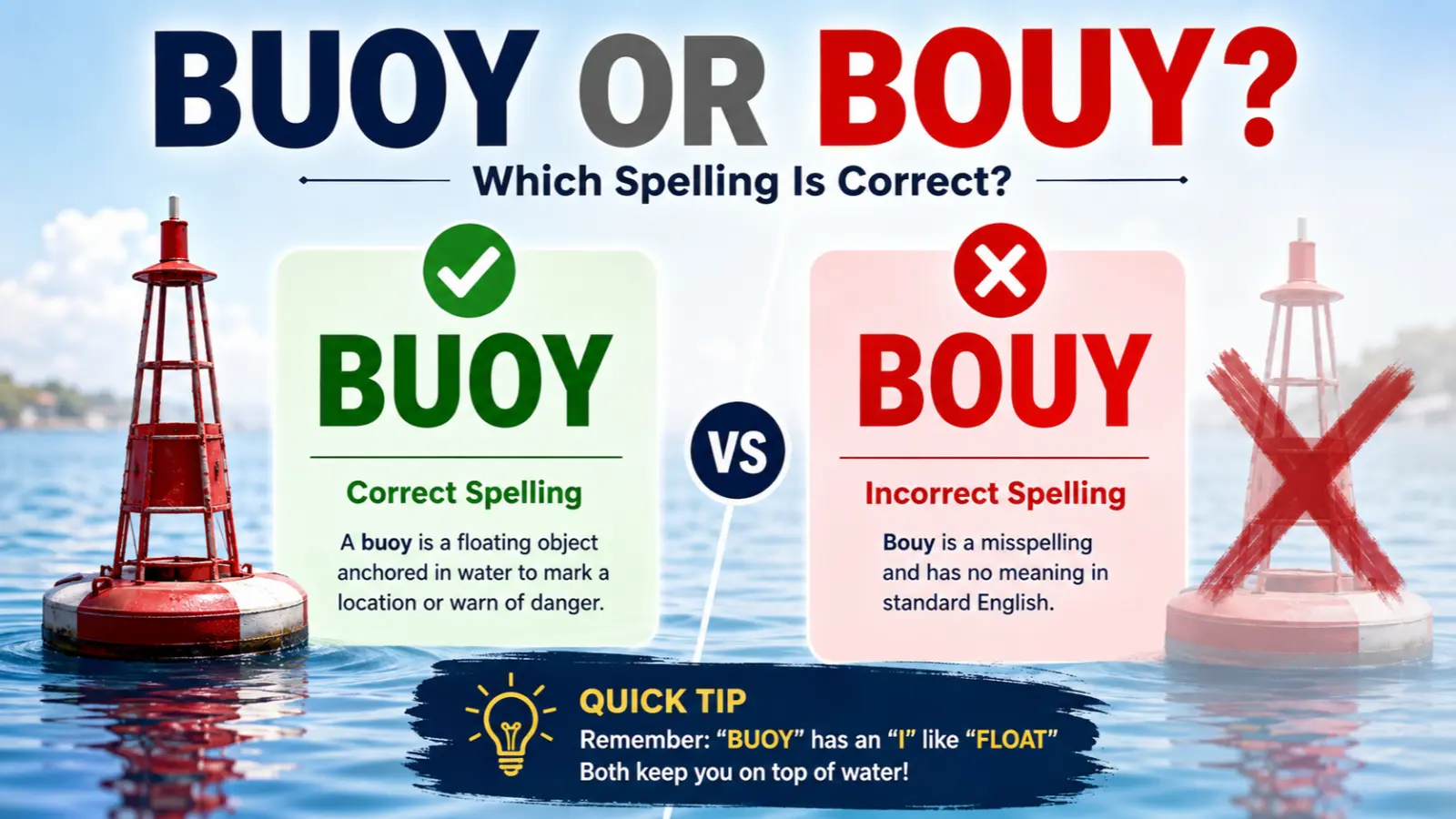
Buoy or Bouy is a common spelling question because the correct word does not look the way it sounds. The correct spelling is buoy, while bouy is a misspelling. A buoy is a floating object used to guide boats, mark areas, or warn about danger in water. (Cambridge Dictionary)
Buoy or Bouy is a common spelling confusion, especially when you are writing about boats, oceans, or water safety. The correct spelling is buoy, while bouy is a misspelling.
A buoy is a floating object used to mark locations, guide boats, or provide important information on the water. If you often mix up these spellings, this guide will explain the correct usage, meaning, pronunciation, and examples of buoy or bouy in simple English.
The unusual spelling can make bouy seem reasonable at first glance. However, professional and academic writing should always use buoy. This guide explains its meaning, pronunciation, history, examples, and a simple memory trick.
Quick Answer
Buoy is the correct spelling.
Bouy is incorrect.
Correct: The boat passed the red buoy.
Incorrect: The boat passed the red bouy.
Cambridge Dictionary recognizes buoy as both a noun and a verb. (Cambridge Dictionary)
What Does Buoy Mean?
Buoy is a noun for a floating object placed in water. It can help direct ships, identify a channel, mark a hazard, or show where boats should travel. (Cambridge Dictionary)
The word also works as a verb. To buoy something means to keep it afloat or support it. It can also mean to make someone feel happier or more confident.
For example:
- The sailors spotted a buoy near the harbor.
- The orange buoy marked the swimming area.
- The encouraging news buoyed her spirits.
- The life jacket helped buoy the swimmer.
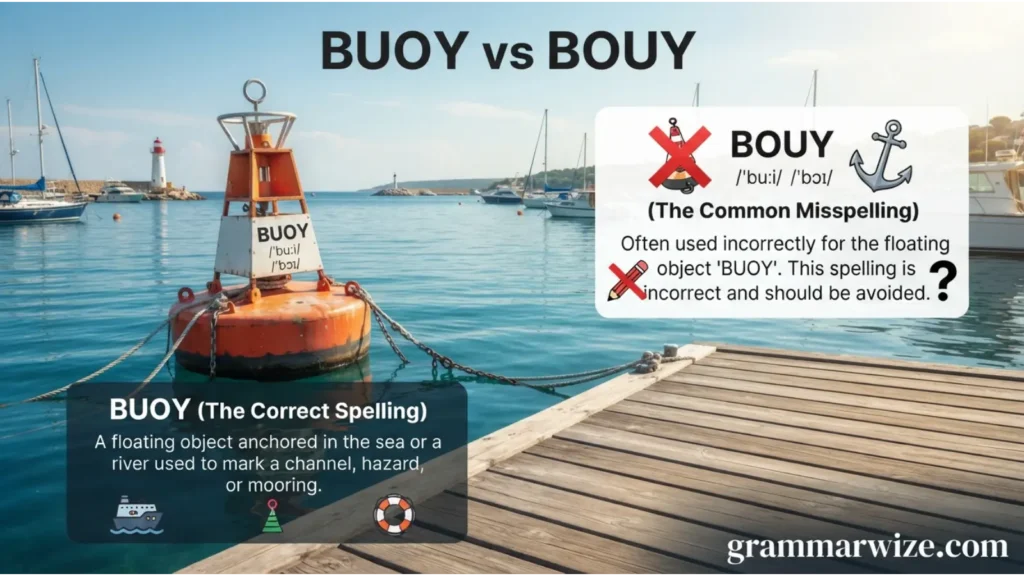
Buoy vs Bouy Comparison
| Word | Correct? | Meaning | Example |
|---|---|---|---|
| Buoy | Yes | A floating marker or something that supports | The boat moved toward the buoy. |
| Bouy | No | Misspelling of buoy | Do not use bouy in formal writing. |
There is no separate English word bouy with a different meaning. If you mean the floating marker or the verb meaning to support, use buoy.
How Do You Pronounce Buoy?
Pronunciation is one reason this word causes confusion.
Cambridge gives the UK pronunciation as /bɔɪ/ and the US pronunciation as /bɔɪ/, while also listing /ˈbuː.i/ as a US pronunciation. (Cambridge Dictionary)
The first pronunciation sounds like boy.
So you may hear:
buoy → boy
or, in some US usage:
buoy → BOO-ee
This difference between spelling and pronunciation can make the written form harder to remember.
Where Did the Word Buoy Come From?
The history of buoy goes back to the late 13th century. Etymonline records an early form as boie and connects the word with Old French buie or Middle Dutch boeye. It also notes that the exact origin is debated. (Etymology Online)
The verb developed later. Etymonline dates the verb buoy to the 1590s in the sense of marking something with a buoy. The meaning related to keeping something afloat appeared later. (Etymology Online)
So, buoy has a long history in English. The spelling is not a modern invention or an abbreviation.

Why Is Buoy Often Misspelled as Bouy?
The mistake usually comes from the order of the vowels.
People may expect the spelling to follow a familiar pattern such as bouy. The pronunciation can make the problem worse because buoy does not sound like its individual letters might suggest.
Another reason is visual familiarity. Bouy looks natural to many readers because English has many words containing ou.
However, buoy is the established spelling.
Dictionary Recommendation
Major dictionary sources recognize buoy, not bouy, as the standard English spelling.
Cambridge defines buoy as a floating object used for directing ships and warning about possible danger. It also lists several verb meanings, including keeping something from sinking and encouraging someone. (Cambridge Dictionary)
For reliable writing, use buoy whenever you mean the floating object or the related verb.
Real Life Examples of Buoy
Here are some natural examples showing how buoy is used.
- The captain steered the boat around the buoy.
- A yellow buoy marked the swimming zone.
- We could see several buoys floating offshore.
- The sailor tied the rope to the buoy.
- The red buoy warned boats about shallow water.
- The lifeguard watched the swimmers near the buoy.
- The strong current pushed the buoy toward the shore.
- The boat followed the line of buoys.
- Her team’s success buoyed her confidence.
- The good news buoyed the workers’ spirits.

Common Mistakes With Buoy
The most common mistake is adding o before the u.
Wrong: Bouy
Correct: Buoy
Another mistake is assuming that the pronunciation tells you exactly how to spell the word. English contains many words whose pronunciation does not clearly reveal their spelling.
For example:
- Boy is not the spelling of the floating marker.
- Bouy is not an alternative spelling.
- Buoy is the standard form.
An Easy Memory Trick
Think of buoy as starting with bu.
BU + OY = BUOY
Do not rearrange the vowels into BOUY.
Another useful trick is to connect the word with buoyancy. Both words begin with buoy:
Buoy → Buoyancy
Cambridge also lists buoyancy as a related word for the quality of being able to float. (Cambridge Dictionary)
Remembering this word family can make the spelling easier.
Professional Writing Recommendation
Always use buoy in professional, academic, technical, and general English writing.
Use it when referring to:
- Floating navigation markers.
- Warning markers in water.
- Objects that help something stay afloat.
- Figurative support or encouragement.
Avoid bouy because it is a spelling error, not a recognized alternative spelling of buoy.
Frequently Asked Questions
Is buoy or bouy correct?
Buoy is correct. Bouy is a misspelling.
Is bouy a word?
No. Bouy is not the standard English spelling. Use buoy instead.
What does buoy mean?
A buoy is a floating object used to guide boats, mark locations, or warn about danger in water. As a verb, buoy can mean to keep something afloat or encourage someone. (Cambridge Dictionary)
How do you pronounce buoy?
In UK English, Cambridge gives /bɔɪ/. US English includes /bɔɪ/ and /ˈbuː.i/. (Cambridge Dictionary)
Why is buoy spelled with U before O?
The spelling comes from the word’s historical development through older European forms. Its modern spelling does not simply follow its pronunciation. (Etymology Online)
What is the plural of buoy?
The plural is buoys.
Example: Several buoys marked the safe channel.
Is buoy the same in British and American English?
Yes. Buoy is the standard spelling in both British and American English. Pronunciation can vary.
Conclusion
The answer to Buoy or Bouy is straightforward: buoy is the correct spelling, while bouy is a misspelling. The word refers to a floating marker in water and can also function as a verb meaning to support, keep afloat, or encourage.
The unusual spelling and pronunciation explain why people often write bouy by mistake. Remember BU + OY = BUOY, and you will have an easy way to get the spelling right.

Olivia Bennett is a grammar expert and language content writer at GrammarWize.com. She specializes in English grammar, word usage, spelling differences, and writing improvement. Through clear explanations and practical examples, Olivia helps students, professionals, and language learners communicate more effectively. Her goal is to make English grammar simple, accessible, and easy to apply in everyday writing.