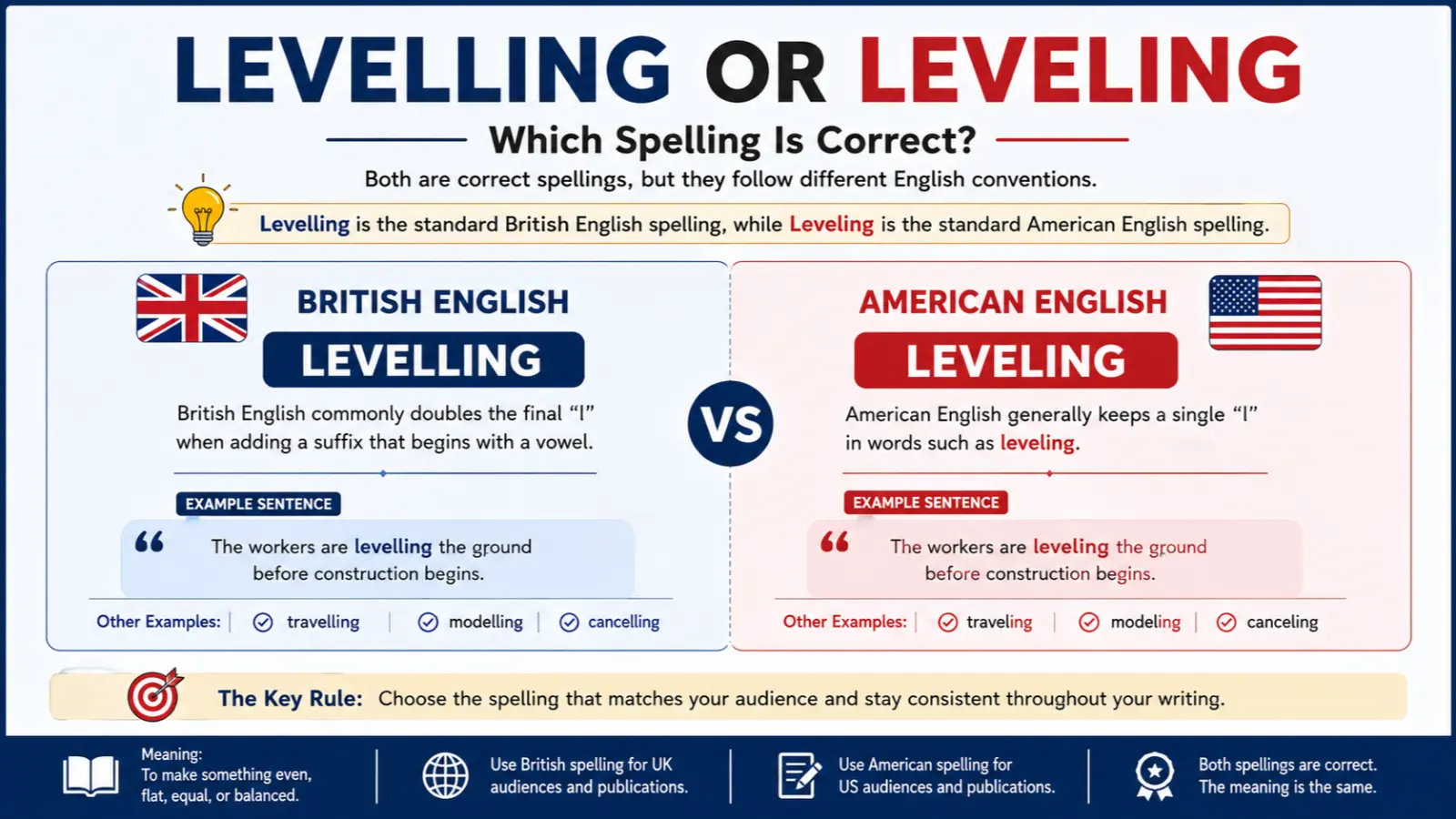
Levelling and leveling are both correct spellings, but they follow different English conventions. Flattening is preferred in British English, while leveling is standard in American English.
Levelling or Leveling is a common spelling confusion in English, especially when choosing between British and American English. Both spellings are correct, but their use depends on the English variety you follow.
If you are unsure which spelling fits your sentence, this guide makes it easy. Learn the difference between Levelling and Leveling, see clear examples, and choose the right spelling with confidence.
The difference is mainly a spelling convention rather than a difference in meaning. The word comes from level, meaning to make something even, flat, equal, or balanced. Choosing the right form depends on the English style you are using.
Levelling vs Leveling at a Glance
| Spelling | English variety | Status |
|---|---|---|
| Levelling | British English | Correct |
| Leveling | American English | Correct |
Quick answer: Use levelling for British English and leveling for American English.
Why British English Uses Levelling
British English commonly doubles the final l when adding a suffix that begins with a vowel.
For example:
- level → levelling.
- travel → travelling.
- cancel → cancelling.
- model → modelling.
This convention explains why levelling is common in British publications, academic writing, and other British English contexts.
Why American English Uses Leveling
American English generally keeps a single l in words such as leveling.
Common American forms include:
- level → leveling.
- travel → traveling.
- cancel → canceling.
- model → modeling.
Therefore, leveling is the preferred spelling in standard American English.

Is Levelling a Correct Spelling
Yes. Levelling is a correct spelling in British English and other varieties that follow British spelling conventions.
It can refer to the process of making something level or even.
Example:
The workers are levelling the ground before construction begins.
British dictionaries and style conventions recognize levelling as the spelling used for this form.

Is Leveling a Correct Spelling
Yes. Leveling is also correct.
It is the standard American English spelling of the same word.
Example:
The workers are leveling the ground before construction begins.
The meaning does not change when the spelling changes.
Levelling or Leveling in British English
For British English, choose levelling.
This spelling fits the British convention of doubling the final l in many words before adding ing.
Use it in:
- British school assignments.
- UK business documents.
- British newspapers.
- UK academic writing.
- British English websites.

Levelling or Leveling in American English
For American English, choose leveling.
It follows the spelling convention commonly used in American dictionaries and publishing.
Use it in:
- US school assignments.
- American business writing.
- US publications.
- American academic work.
- American English websites.
Examples of Levelling in a Sentence
Here are some examples using the British spelling:
- The team is levelling the playing field.
- Workers are levelling the floor.
- The machine helps with accurate levelling.
- They are levelling the soil before planting.
- The project involves levelling the surface.
Examples of Leveling in a Sentence
Here are the same ideas using American English:
- The team is leveling the playing field.
- Workers are leveling the floor.
- The machine helps with accurate leveling.
- They are leveling the soil before planting.
- The project involves leveling the surface.
Dictionary and Style Guide Guidance
Major English dictionaries recognize both spellings as regional forms. British dictionaries generally show levelling, while American dictionaries use leveling.
The important point is consistency. A writer using British English should normally follow British spelling throughout the document. An American English writer should maintain American spelling.
Style guides also encourage writers to follow the spelling system appropriate to their audience, publication, institution, or organization.
Levelling or Leveling in Academic Writing
Both forms can appear in academic writing.
The correct choice depends on the required English variety.
For a UK university or British journal, levelling is usually appropriate. For a US university or American publication, leveling is normally preferred.
The most important rule is to remain consistent throughout the paper.
Levelling or Leveling in Business Writing
Business writers should match the spelling to their target audience.
A company using British English can write:
The new system is improving production by levelling workloads.
An American company can write:
The new system is improving production by leveling workloads.
Neither spelling changes the meaning.
Levelling or Leveling in International Communication
International writers may encounter both forms.
The safest approach is to follow the style used by the organization or audience. If a document already uses British spellings such as organising and colour, levelling will usually fit better.
If it uses American forms such as organizing and color, leveling is the natural choice.
The History Behind the Different Spellings
The difference is connected to broader spelling traditions in British and American English.
American English developed spelling preferences that often simplified certain British forms. Noah Webster played an important role in promoting distinct American spelling conventions in the nineteenth century.
The single l in leveling fits the broader American tendency seen in words such as traveling and modeling.
British English retained the doubled l in these forms.
Current Usage Trends
Both spellings remain widely used today.
Levelling is strongly associated with British English, while leveling is strongly associated with American English. Digital publishing has made both forms easy to encounter worldwide.
Search engines may display either spelling depending on the source, region, and search context. Neither form should automatically be treated as a spelling mistake.
Common Mistake to Avoid
Do not mix spelling systems unnecessarily.
For example, using leveling alongside strongly British forms can make a document look inconsistent.
Likewise, levelling may look unusual in a document that otherwise follows American English conventions.
Pick one style and apply it consistently.
Frequently Asked Questions
Is levelling or leveling correct
Both are correct. Levelling is the British English spelling, while leveling is the American English spelling.
Is levelling British or American
Levelling is primarily British English.
Is leveling British or American
Leveling is the standard American English spelling.
Does levelling have a different meaning from leveling
No. Both forms have the same meaning. The difference is mainly regional spelling.
Which spelling should I use in the US
Use leveling in standard American English.
Which spelling should I use in the UK
Use levelling in standard British English.
Why does British English double the L
British English commonly doubles the final l in forms such as levelling, travelling, and modelling.
Conclusion
Levelling and leveling are both correct. The choice depends on the English variety.
- 🇬🇧 British English: levelling
- 🇺🇸 American English: leveling
If you are writing for a US audience, choose leveling. For a UK audience, choose levelling. Most importantly, keep your spelling consistent throughout the entire document.

Olivia Bennett is a grammar expert and language content writer at GrammarWize.com. She specializes in English grammar, word usage, spelling differences, and writing improvement. Through clear explanations and practical examples, Olivia helps students, professionals, and language learners communicate more effectively. Her goal is to make English grammar simple, accessible, and easy to apply in everyday writing.