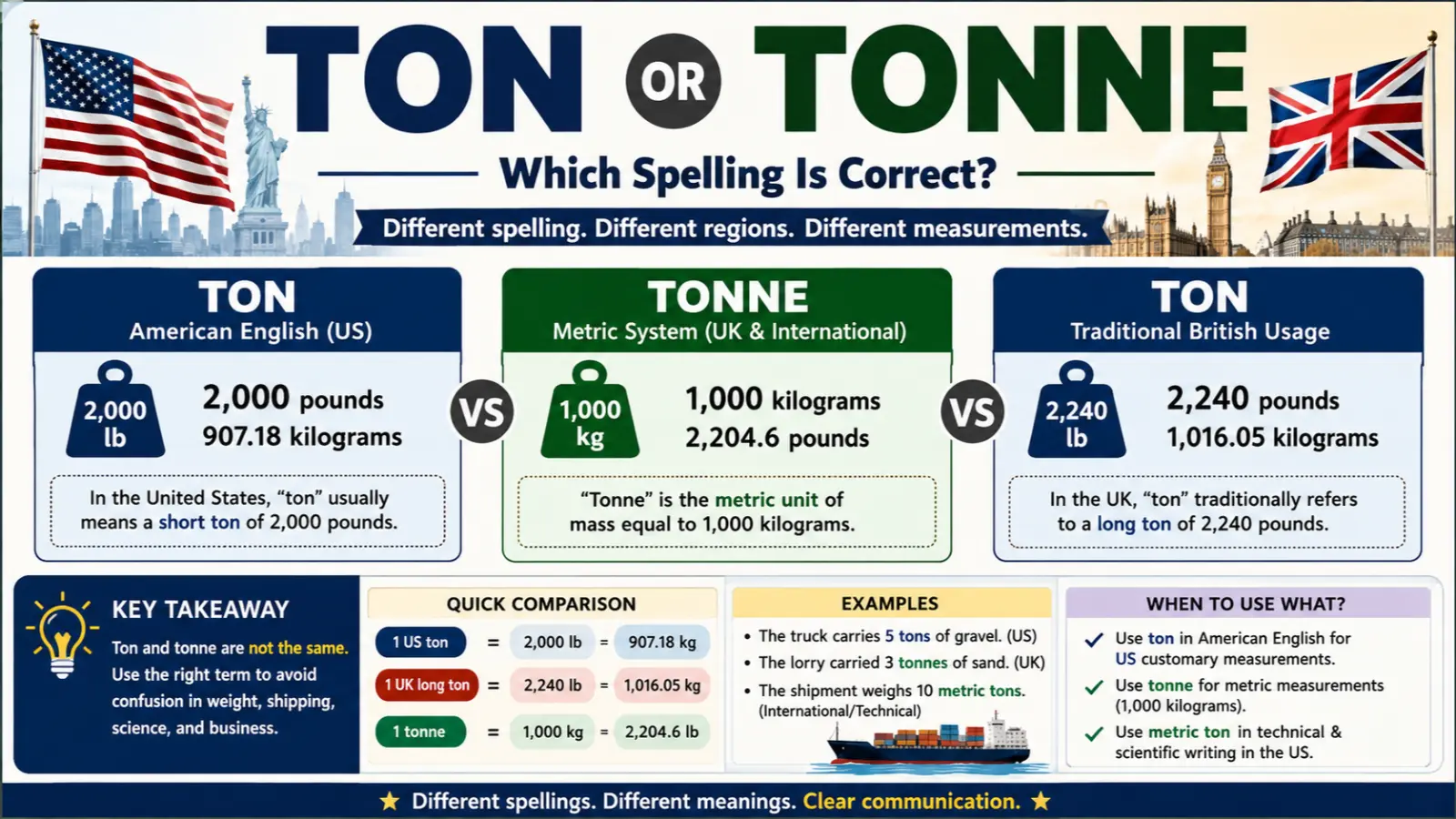
Ton and tonne are both correct words, but they do not always refer to the same measurement. The main difference is regional usage and the type of ton being discussed. In American English, ton commonly refers to 2,000 pounds, while tonne refers specifically to 1,000 kilograms. (Cambridge Dictionary)
Ton or Tonne can be confusing because both spellings are correct, but they are used differently depending on the measurement system and region. Ton is commonly used in American English, while tonne refers to the metric unit equal to 1,000 kilograms. Understanding this simple difference can help you choose the right word in writing.
In this guide, we’ll explain Ton or Tonne with clear examples and simple rules. You’ll learn the difference between ton and Mass unit, their meanings, measurements, and common usage so you can use the correct term confidently.
The distinction becomes especially important in shipping, manufacturing, science, trade, and international communication. Using the wrong term can create a significant difference in weight, so it is best to identify the measurement clearly.
Ton vs Tonne at a Glance
| Word | Common usage | Weight |
|---|---|---|
| Ton | American English | 2,000 lb / 907.18 kg |
| Ton | Traditional British usage | 2,240 lb / 1,016 kg |
| Tonne | Metric system | 1,000 kg / 2,204.6 lb |
| Metric ton | Common US technical term | 1,000 kg / 2,204.6 lb |
Cambridge confirms that a US ton is about 907 kg, a UK ton is about 1,016 kg, and a tonne is 1,000 kg. (Cambridge Dictionary)
Is Ton or Tonne the Correct Spelling?
Both spellings are correct.
Ton is the standard spelling in American English when referring to the customary US unit. It can also refer to the British long ton depending on context.
Tonne is the spelling used for the metric unit of 1,000 kilograms. It is especially common in British English and international writing.
For example:
- The truck can carry 2 tons.
- The factory produces 500 tonnes of steel.
- The shipment weighs 10 metric tons.
Ton in American English
In American English, ton usually means a short ton, which equals 2,000 pounds or approximately 907 kilograms. (Cambridge Dictionary)
This usage appears frequently in American business, transportation, construction, agriculture, and everyday measurement.
Examples:
- The truck carries five tons of gravel.
- The company shipped 20 tons of material.
- The machine weighs nearly one ton.
When precision matters, American technical writing may use short ton or metric ton to prevent confusion.
Tonne in British English
Mass unit refers to a metric measurement equal to 1,000 kilograms. It is commonly used in British English and many other countries that use the metric system. (Cambridge Dictionary)
Examples:
- The lorry carried three tonnes of sand.
- The factory produces 50 tonnes of steel each day.
- The waste weighed several tonnes.
The spelling with -ne helps distinguish the metric unit from other meanings of ton.
Ton and Tonne Are Not Always Equal
This is the most important point.
A tonne is exactly 1,000 kilograms. A US ton is approximately 907 kilograms. A traditional British long ton is approximately 1,016 kilograms. (Cambridge Dictionary)
So these measurements are different:
- 1 US ton = 907.18 kg
- 1 tonne = 1,000 kg
- 1 UK long ton = 1,016.05 kg
Because of these differences, technical documents should identify the measurement system when the context could be unclear.
Why Does Ton Have Different Meanings?
The word ton has a long history of use in English measurement. Different measurement systems developed in Britain and the United States, leading to different definitions.
The US commonly uses the short ton, equal to 2,000 pounds. Traditional British measurement uses the long ton, equal to 2,240 pounds. The metric system introduced the Mass unit, based on 1,000 kilograms.
Today, international industries often use metric measurements to make quantities easier to compare across countries.
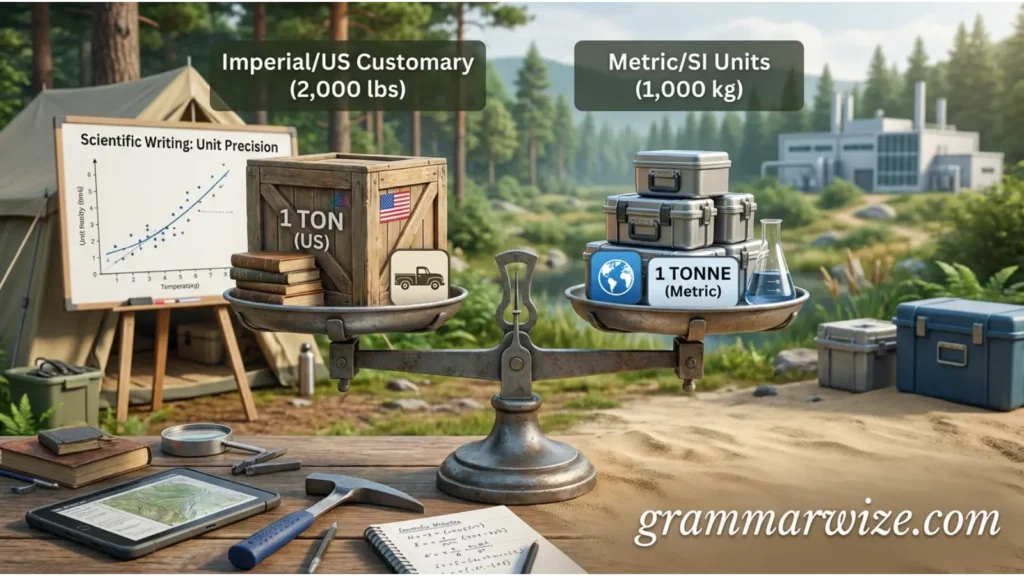
Ton vs Tonne in Scientific Writing
Scientific and technical writing requires extra precision.
The metric unit is 1,000 kilograms, and NIST identifies this unit as a metric ton with the symbol t in its US guidance. (NIST)
For an international scientific audience, writers should avoid assuming that ton has one universal meaning.
Instead, use terms such as:
- metric ton
- tonne
- short ton
- long ton
This makes the measurement immediately clear.
Ton vs Tonne in Business Writing
Business documents often involve international suppliers, customers, and shipping companies. A small wording difference can therefore have a major practical impact.
About American business documents, ton may be appropriate when the quantity uses US customary measurements.
For international or metric-based documents, Mass unit or metric ton is clearer.
For example:
The supplier delivered 100 tonnes of raw material.
This clearly indicates 100,000 kilograms.

Ton vs Tonne in Academic Writing
Academic writing should prioritize accuracy and consistency.
If your research uses metric measurements, Mass unit or metric ton is usually clearer than simply writing ton. Define the unit when it first appears if readers could interpret it differently.
For example:
The study examined 2,000 tonnes of agricultural waste.
If the research specifically uses US customary units, state that clearly:
The facility processed 2,000 short tons of material.
This approach prevents readers from making incorrect conversions.
Ton vs Tonne in International Communication
International communication is where the distinction matters most.
A US reader may understand ton as 2,000 pounds. A British or international reader may interpret the same word differently. Tonne provides a clearer reference to the metric unit.
For international reports, contracts, shipping documents, and technical specifications, identify the measurement system rather than relying on ton alone.
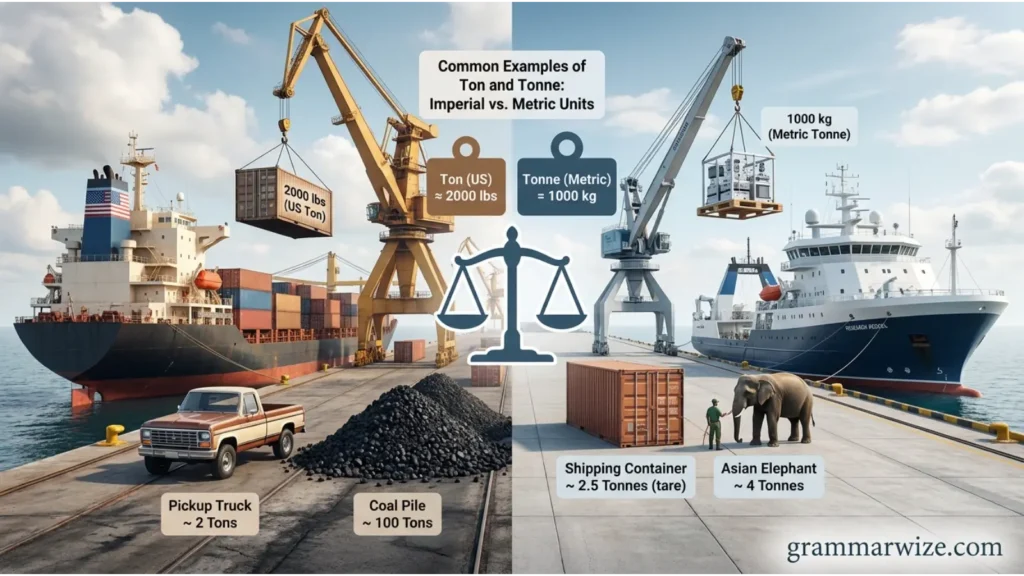
Common Examples of Ton and Tonne
Here are some practical examples:
- US: The shipment weighs 10 tons.
- UK: The shipment weighs 10 tonnes.
- International: The shipment weighs 10 metric tonnes.
- Technical US: The material weighs 10 short tons.
- Traditional British: The cargo weighs 10 long tons.
The correct choice depends on the measurement being used, not simply the writer’s preferred spelling.
Which One Should You Use?
Use ton when:
- Writing in American English.
- Referring to a US short ton.
- The measurement system is already clear.
- The context specifically uses tons.
Apply tonne when:
- Referring to exactly 1,000 kilograms.
- Writing for a British or international audience.
- Using metric measurements.
- You want to distinguish the metric unit from the US ton.
Use metric ton when:
- Writing for an American technical audience.
- Precision is important.
- You want to make the 1,000 kg measurement completely explicit.
Dictionary Recommendations
For reliable definitions and usage information, these dictionaries are useful:
- Cambridge Dictionary distinguishes the US ton, UK long ton, and metric ton and defines Mass unit as 1,000 kilograms. (Cambridge Dictionary)
- NIST provides authoritative US guidance for measurement terminology and identifies the metric ton as 1,000 kilograms. (NIST)
Frequently Asked Questions
Is tonne British or American?
Tonne is widely associated with British English and international metric usage. In the United States, metric ton is commonly used for the same 1,000 kg measurement. (Cambridge Dictionary)
Is a ton the same as a tonne?
No. A US ton is 2,000 pounds, or about 907 kg. A Mass unit is 1,000 kg. (Cambridge Dictionary)
Is tonne spelled with an e?
Yes. Tonne is the spelling used for the metric unit of 1,000 kilograms.
Which is correct in the USA, ton or tonne?
Both words can appear in American English, but ton commonly means the US short ton. For 1,000 kilograms, metric ton is a common American term. (Cambridge Dictionary)
Which is correct in the UK, ton or tonne?
Both can be correct. Tonne means 1,000 kilograms, while ton can traditionally refer to the British long ton of 2,240 pounds. (Cambridge Dictionary)
How many kilograms are in a tonne?
One tonne equals exactly 1,000 kilograms. (Cambridge Dictionary)
How many pounds are in a US ton?
One US ton equals 2,000 pounds. (Cambridge Dictionary)
Conclusion
Ton and tonne are both correct, but they describe different measurement systems. A US ton is 2,000 pounds, while a tonne is 1,000 kilograms. Traditional British usage also includes the long ton, which is 2,240 pounds. (Cambridge Dictionary)
For everyday American writing, ton is usually the natural choice. For metric measurements, international communication, and precise technical writing, tonne or metric ton makes the intended measurement clearer.

Olivia Bennett is a grammar expert and language content writer at GrammarWize.com. She specializes in English grammar, word usage, spelling differences, and writing improvement. Through clear explanations and practical examples, Olivia helps students, professionals, and language learners communicate more effectively. Her goal is to make English grammar simple, accessible, and easy to apply in everyday writing.