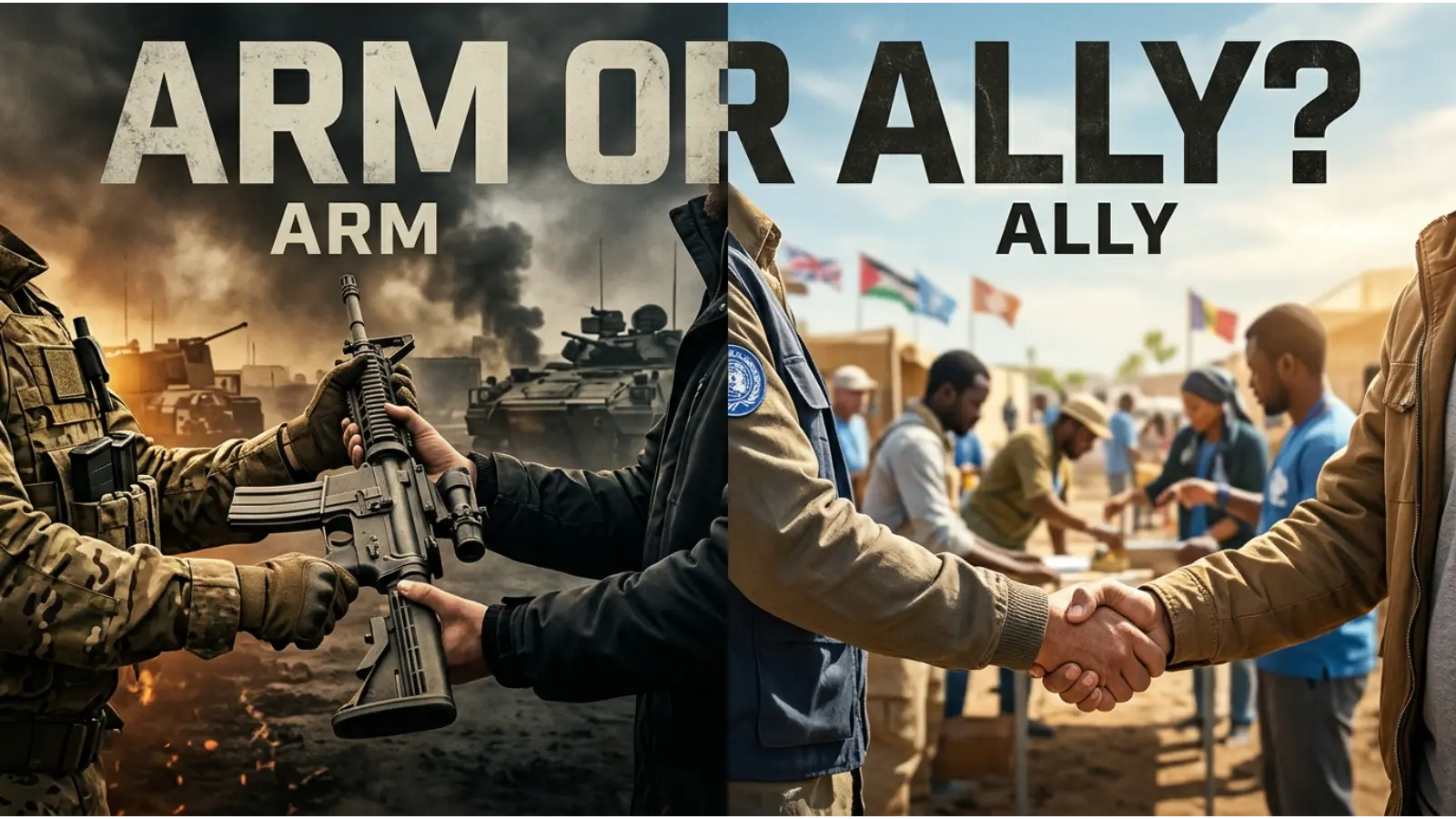
Arm or ally can confuse English learners because both words can appear in conversations about people, groups, and relationships. However, they do not share the same meaning or grammatical function.
The word arm usually refers to a body part, a weapon, or the act of providing weapons. In contrast, ally describes someone who supports another person, group, or country. Both words also work as verbs in different situations.
Understanding their meanings and sentence patterns helps you choose the right word. This guide explains arm and ally with simple definitions, grammar rules, everyday examples, and common mistakes.
Quick Answer: Arm or Ally?
Arm and ally are both correct English words, but they have different meanings.
- Arm: A body part, a weapon, or the act of supplying weapons.
- Ally: A person, organization, or country that supports or cooperates with another.
Examples:
- She injured her right arm while playing tennis.
- Canada is an important ally of the United States.
Remember, use arm when discussing a limb or weapons. Use ally when describing a supportive relationship.
Arm vs Ally: What’s the Main Difference?
The main difference is their meaning and purpose.
An arm can describe a physical part of the human body. It can also refer to weapons or the act of preparing someone with weapons. For example, soldiers may arm themselves before a mission.
An ally describes a person or group that works with another toward a shared goal. Countries can become allies through agreements, while individuals can support each other as allies.
| Feature | Arm | Ally |
|---|---|---|
| Main meaning | Body part or weapon | Supporter or partner |
| Part of speech | Noun and verb | Noun and verb |
| Plural form | Arms | Allies |
| Verb form | Arms, armed, arming | Allies, allied, allying |
| Common use | Body parts, weapons, equipment | Friendship, support, cooperation |
| Example | He raised his arm. | She is my closest ally. |
These words are not interchangeable. Their correct use depends on the meaning you want to express.
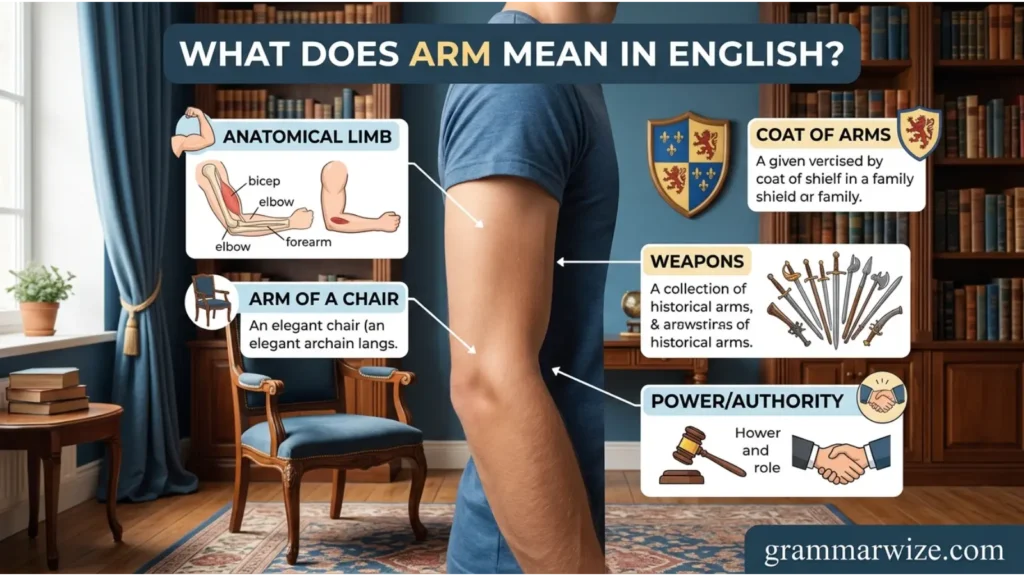
What Does Arm Mean in English?
The word arm has several meanings. Its meaning changes according to the sentence.
As a noun:
An arm is one of the upper limbs of the human body. It connects the shoulder to the hand.
Examples:
- My left arm hurts after exercising.
- He raised his arm to ask a question.
- The child held her father’s arm.
Arm can also refer to a weapon or firearm, especially in formal and military contexts.
Examples:
- The museum displays historic arms.
- The soldiers carried their arms during the parade.
As a verb:
Arm means to provide someone or something with weapons or prepare them for a particular situation.
Examples:
- The government decided to arm its forces.
- The guards armed themselves before entering the building.
In everyday English, arm can also appear in expressions such as arm yourself with knowledge. This means preparing yourself with useful information.
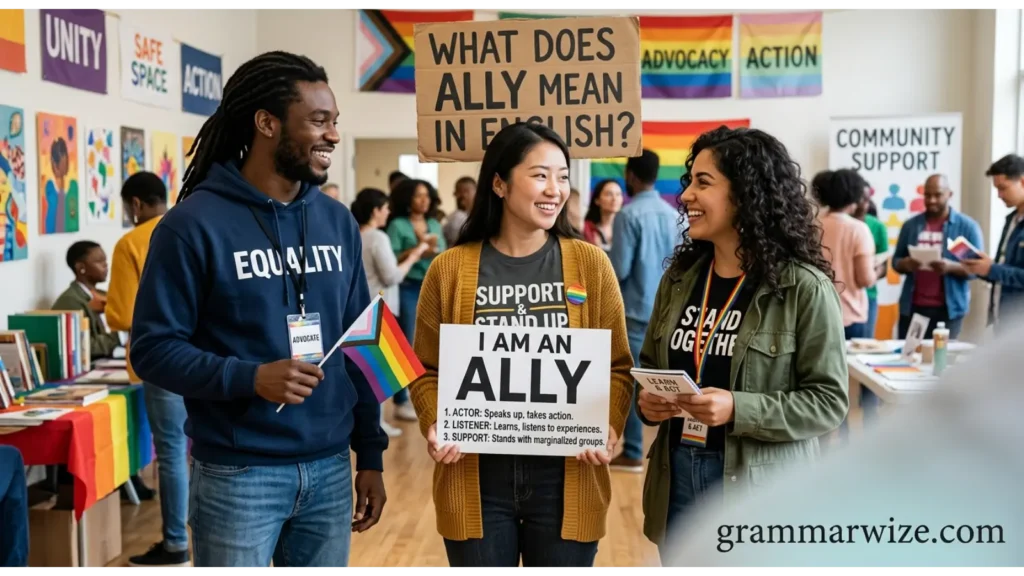
What Does Ally Mean in English?
Ally refers to a person, organization, or country that supports another person or shares a common purpose.
It often appears in discussions about friendship, teamwork, politics, business, and international relationships.
As a noun:
An ally is someone who supports or cooperates with another.
Examples:
- She became a trusted ally during difficult times.
- The two countries remained strong allies.
- Every student needs an ally who encourages them.
As a verb:
Ally means to join, connect, or cooperate with another person or group.
Examples:
- The two organizations decided to ally against the problem.
- Small businesses can ally to reach more customers.
The phrase ally with is particularly useful when describing cooperation.
Example:
The organization chose to ally with local communities.
Arm and Ally Grammar Rules You Should Know
Both words can function as nouns and verbs. However, their grammar patterns are different.
Arm as a noun
Arm is a countable noun. Its plural form is arms.
- One arm
- Two arms
- A broken arm
- Strong arms
Example: Both of his arms were tired after the workout.
Arm as a verb
Arm follows regular verb patterns.
- Present: Arm
- Third-person singular: Arms
- Past: Armed
- Present participle: Arming
Example: The authorities armed the security team.
Ally as a noun
Ally is a countable noun. Its plural form is allies.
- One ally
- Two allies
- A political ally
- Trusted allies
Example: The company found new allies in the industry.
Ally as a verb
Ally also follows regular verb patterns, but its spelling changes when adding certain endings.
- Present: Ally
- Third-person singular: Allies
- Past: Allied
- Present participle: Allying
Example: The two groups allied to achieve their goal.
Notice that ally changes its final Y to I before adding certain endings.
Arm or Ally in Everyday Sentences
The easiest way to understand these words is to see how people use them in everyday situations.
Using Arm:
- My arm feels sore after lifting weights.
- She wrapped a bandage around her arm.
- The soldier carried an arm during the exercise.
- The company plans to arm its security team.
- He raised his arms to celebrate the victory.
Using Ally:
- My brother has always been my strongest ally.
- We need an ally to complete this project.
- The two nations became close allies.
- She decided to ally with an experienced team.
- Good friends can become valuable allies.
Each sentence shows a different meaning or grammatical use.

Common Mistakes When Using Arm and Ally
English learners sometimes confuse these words because they focus on their appearance rather than their meanings.
Here are some mistakes to avoid.
Mistake 1: Using ally for a body part
Incorrect: She hurt her ally while running.
Correct: She hurt her arm while running.
Mistake 2: Using arm for a supporter
Incorrect: He is my strongest arm in difficult situations.
Correct: He is my strongest ally in difficult situations.
Mistake 3: Writing the wrong plural form
Incorrect: The two countries became armys.
Correct: The two countries became allies.
Mistake 4: Using the wrong verb form
Incorrect: The organizations allyed with each other.
Correct: The organizations allied with each other.
Mistake 5: Confusing their meanings in professional writing
Incorrect: Our company needs an arm to support its expansion.
Correct: Our company needs an ally to support its expansion.
Choose the word according to the intended meaning rather than its appearance.
Arm vs Ally: Formal and Informal Usage
Both words appear in formal and informal English. Their meanings remain the same, but their contexts can change.
Arm in formal writing:
Writers use arm in medical, military, historical, and organizational contexts.
Examples:
- The patient reported pain in her left arm.
- The government decided to arm its military forces.
- The research examined injuries affecting the upper arm.
Arm in informal conversations:
People commonly use arm when discussing daily activities and physical experiences.
Examples:
- My arm is hurting.
- He grabbed my arm.
- I cannot lift my arm properly.
Ally in formal writing:
Ally frequently appears in business, political, diplomatic, and social discussions.
Examples:
- The two nations maintained their relationship as strategic allies.
- The organization allied with several community groups.
- Every employee deserves an ally in the workplace.
Ally in informal conversations:
People use ally when discussing friendship, personal support, and shared goals.
Examples:
- She is always my ally.
- I need an ally on this project.
- Thanks for being my ally.
Arm or Ally: Real-Life Conversations
Short conversations can help you understand how these words work naturally.
Conversation 1: Talking About an Injury
Alex: Why are you holding your arm?
Sam: I hurt my right arm during practice.
Alex: Does it hurt badly?
Sam: A little, but I think it will recover.
Conversation 2: Talking About Friendship
Emma: Who helped you during the difficult project?
Olivia: Sarah was my biggest ally.
Emma: That is great. Everyone needs someone supportive.
Conversation 3: Talking About International Relations
David: Why are those two countries cooperating?
James: They have been allies for many years.
David: So they support each other?
James: Exactly.
Easy Memory Tricks to Remember Arm and Ally
A simple memory trick can help you choose the correct word without checking a dictionary.
Remember Arm:
Think of your physical arm. You use it to lift, carry, write, and perform everyday activities.
You can also connect arm with weapons and military equipment.
Remember Ally:
Think of an ally as an assistant or supporter. An ally stands with you and helps you achieve a shared goal.
Quick memory tip:
- Arm = Body part or weapons.
- Ally = Supporter or partner.
This simple distinction makes both words easier to remember.
Frequently Asked Questions About Arm or Ally
Is arm or ally the correct word?
Both words are correct. Arm refers to a body part or weapons, while ally describes a supporter or partner.
What is the plural of ally?
The plural of ally is allies. The Y changes to I before adding ES.
Example: The two organizations became strong allies.
What is the plural of arm?
The plural of arm is arms.
Example: He crossed his arms while waiting.
Can ally be used as a verb?
Yes. Ally can function as a verb meaning to join or cooperate with someone.
Example: The two companies allied to expand their business.
Is ally the same as a friend?
Not exactly. A friend shares a personal relationship, while an ally provides support or works toward a common goal. A person can be both.
What does arm mean as a verb?
As a verb, arm means to provide someone or something with weapons or prepare them for a particular situation.
Example: The guards armed themselves before the operation.
Can I use arm and ally interchangeably?
No. They have different meanings and cannot replace each other in ordinary sentences.
Conclusion
Arm and ally are two different English words with separate meanings and grammatical uses. Arm usually refers to a body part, weapons, or the act of supplying weapons. Ally describes someone who supports or cooperates with another person or group.
Both words work as nouns and verbs, but their sentence structures and forms differ. Remember that arms is the plural of arm, while allies is the plural of ally.
Use arm when discussing body parts or weapons. Choose ally when talking about support, cooperation, or partnerships. Understanding this difference will help you write clearer and more accurate English.

Olivia Bennett is a grammar expert and language content writer at GrammarWize.com. She specializes in English grammar, word usage, spelling differences, and writing improvement. Through clear explanations and practical examples, Olivia helps students, professionals, and language learners communicate more effectively. Her goal is to make English grammar simple, accessible, and easy to apply in everyday writing.