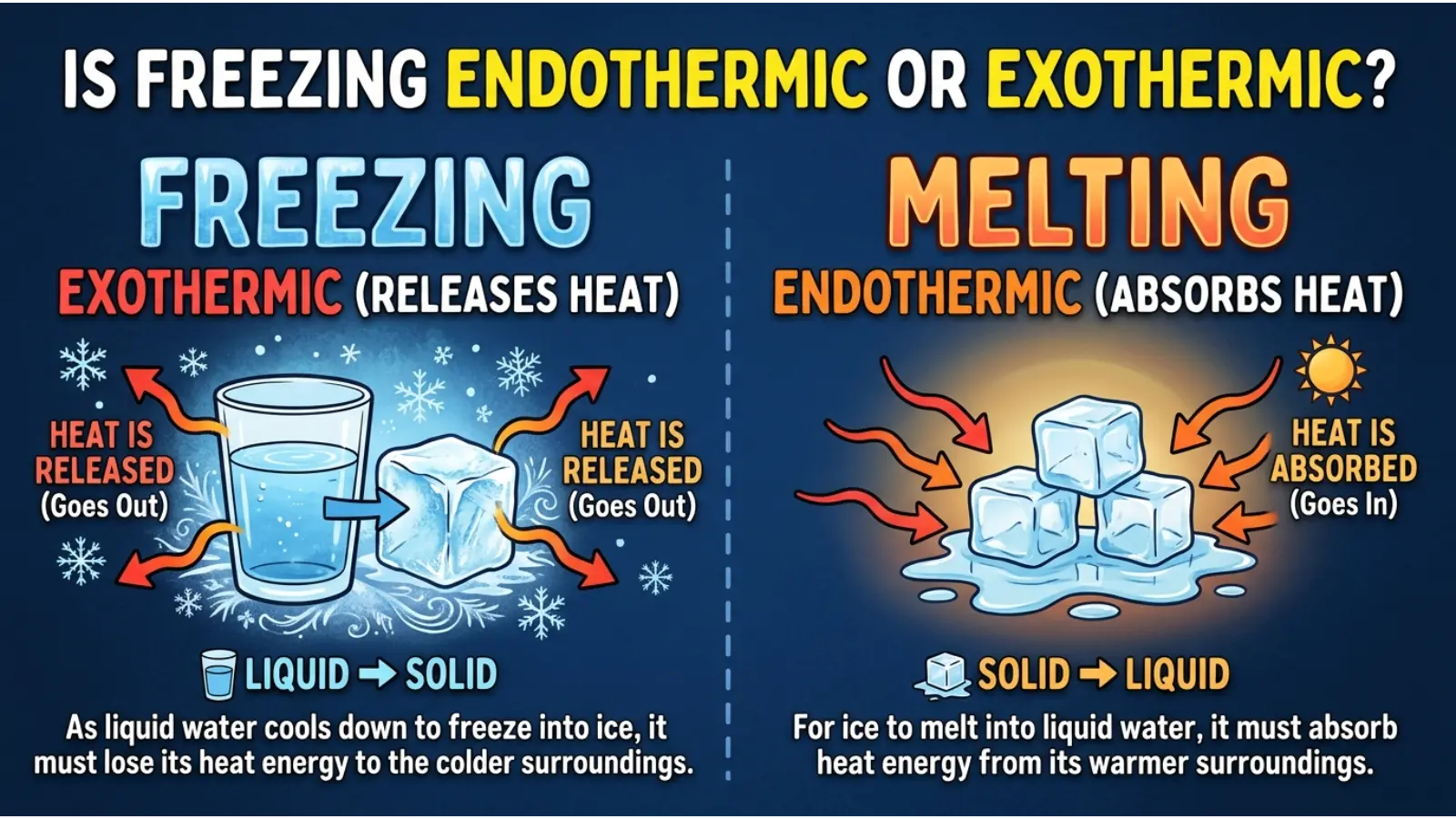
Is freezing endothermic or exothermic? Freezing is an exothermic process because a substance releases heat energy into its surroundings as it changes from a liquid to a solid. This happens when water turns into ice or melted wax becomes solid again.
The key is understanding where the heat goes. During freezing, a substance loses energy to its surroundings. Its particles form a more ordered arrangement, and energy is released during this change. The surroundings receive that energy, even if the freezing substance itself becomes colder.
Understanding this process helps explain everyday events, such as ice formation, frozen food, and frost on cold surfaces. It also makes the difference between endothermic and exothermic processes easier to remember.
Quick Answer:
Freezing is exothermic because it releases heat into the surroundings. During this phase change, a liquid becomes a solid as energy leaves the substance.
For example, when water freezes into ice at its freezing point, it releases latent heat while changing state. The temperature remains constant during the phase change of a pure substance at constant pressure.
What Does Exothermic Mean?
An exothermic process releases energy from a system into its surroundings, usually as heat. This energy transfer can warm the surrounding environment.
Freezing is exothermic because the liquid releases energy as its particles settle into a solid structure. The substance does not need to become hot for this process to release heat.
For example, water can freeze in a cold freezer while transferring heat to the colder environment. The freezer removes that energy to keep the water freezing.
Why Is Freezing an Exothermic Process?
In a liquid, particles move around and remain close to one another. As the liquid freezes, its particles form a more organized solid structure.
Forming and strengthening attractive interactions between particles releases energy. That energy transfers from the substance to its surroundings.
Water provides a useful example. As liquid water forms ice, its molecules arrange themselves into a crystal structure held together by hydrogen bonds. The formation of these interactions releases energy.
The process is the reverse of melting, which requires energy to help overcome the attractions that maintain the solid structure.

What Happens to Heat During Freezing?
Heat flows from the freezing substance into its surroundings. However, the exact temperature changes depend on the conditions around the substance.
Consider water placed in a freezer. The water transfers heat to the colder environment until it reaches its freezing point. As the water turns into ice, it continues to release latent heat.
During the phase change, that energy transfer does not cause the temperature of a pure substance to fall below its freezing point immediately. Instead, the energy change accompanies the conversion from liquid to solid.
Once freezing is complete, the ice can become colder if it continues to lose heat.

Freezing vs Melting: What Is the Difference?
Freezing and melting are opposite physical processes. Freezing releases heat, while melting absorbs heat.
| Feature | Freezing | Melting |
|---|---|---|
| Change of state | Liquid to solid | Solid to liquid |
| Energy transfer | Releases heat | Absorbs heat |
| Process type | Exothermic | Endothermic |
| Water example | Water becomes ice | Ice becomes liquid water |
| Enthalpy change | Negative | Positive |
For water at approximately standard pressure, freezing and melting occur at about 0°C. The energy change has the same magnitude in both directions but the opposite sign.
Everyday Examples of Freezing
Freezing occurs in many familiar situations. These examples show how a liquid releases energy as it becomes solid.
Water freezing into ice: Water releases heat as its molecules form an ordered ice structure.
Ice cream becoming firm: The mixture loses heat in the freezer and gradually solidifies.
Melted candle wax hardening: Liquid wax releases heat as it returns to a solid state.
Frost forming on a surface: Water vapor can change directly into solid ice through deposition, releasing heat to the surroundings.
Water freezing in a pond: As ice forms, the water releases heat into the colder environment. This heat transfer affects how quickly additional water can freeze.
These examples involve different substances or phase changes, but they share the release of energy during the transition to a more stable condensed state.
How Does Freezing Relate to Latent Heat?
Latent heat is the energy transferred during a change of state without a temperature change during that phase transition.
For freezing, this energy is called the latent heat of fusion. A substance releases this energy as it changes from liquid to solid.
For water at 0°C and standard pressure, the latent heat of fusion is approximately 334 joules per gram. This means one gram of water releases about 334 joules when it freezes at those conditions.
The amount of heat released can be calculated using:
Heat released = mass × latent heat of fusion
For example, freezing 10 grams of water releases approximately:
10 g × 334 J/g = 3,340 J
Therefore, the water releases about 3.34 kilojoules of heat during freezing, assuming the stated conditions.

Common Misconceptions About Freezing
Several misunderstandings can make this topic confusing.
Misconception: Freezing is endothermic because the surroundings are cold.
Correction: Freezing is exothermic because the substance releases heat. The surroundings can still be colder than the substance.
Misconception: A substance must become warmer to release heat.
Correction: A substance can release heat while its temperature remains constant during freezing. Temperature and heat transfer describe different things.
Misconception: Freezing and melting release heat in the same way.
Correction: Freezing releases heat, while melting absorbs it. These processes have opposite energy changes.
Misconception: Every change involving ice is freezing.
Correction: Water becoming ice is freezing. Water vapor turning directly into ice is deposition, another exothermic phase change.
How to Remember Endothermic and Exothermic Processes
A simple memory trick makes the distinction easier.
- Exothermic means energy exits. The system releases heat into its surroundings.
- Endothermic means energy enters. The system absorbs heat from its surroundings.
Freezing is exothermic because heat exits the liquid as it becomes solid. Melting is endothermic because the solid absorbs energy as it becomes liquid.
You can also remember the direction of the change:
- Freezing: liquid → solid → releases heat.
- Melting: solid → liquid → absorbs heat.
This method works for many basic questions about phase changes in chemistry and physics.
Frequently Asked Questions About Freezing
Is freezing endothermic or exothermic in chemistry?
Freezing is exothermic because the substance releases heat into its surroundings as it changes from liquid to solid.
Does freezing release or absorb heat?
Freezing releases heat. The substance transfers energy to its surroundings during the phase change.
Why does temperature stay constant during freezing?
For a pure substance freezing at constant pressure, the temperature stays constant during the phase change because energy transfer accompanies the change of state rather than changing the temperature.
Is melting endothermic or exothermic?
Melting is endothermic because a solid absorbs energy as it changes into a liquid. It is the reverse of freezing.
Is condensation exothermic like freezing?
Yes. Condensation is exothermic because a gas releases heat as it becomes a liquid. Both processes transfer energy to their surroundings.
Does water release heat when it freezes?
Yes. Water releases approximately 334 joules per gram as it freezes at 0°C under standard pressure. The exact conditions matter when applying this value.
Conclusion
Freezing is an exothermic process because a liquid releases heat as it changes into a solid. During this transition, particles form a more ordered arrangement, and energy transfers into the surroundings.
Melting is the opposite process because it absorbs energy. Remembering that freezing releases heat and melting absorbs heat makes it easier to understand phase changes, latent heat, and energy transfer in everyday life.

Olivia Bennett is a grammar expert and language content writer at GrammarWize.com. She specializes in English grammar, word usage, spelling differences, and writing improvement. Through clear explanations and practical examples, Olivia helps students, professionals, and language learners communicate more effectively. Her goal is to make English grammar simple, accessible, and easy to apply in everyday writing.