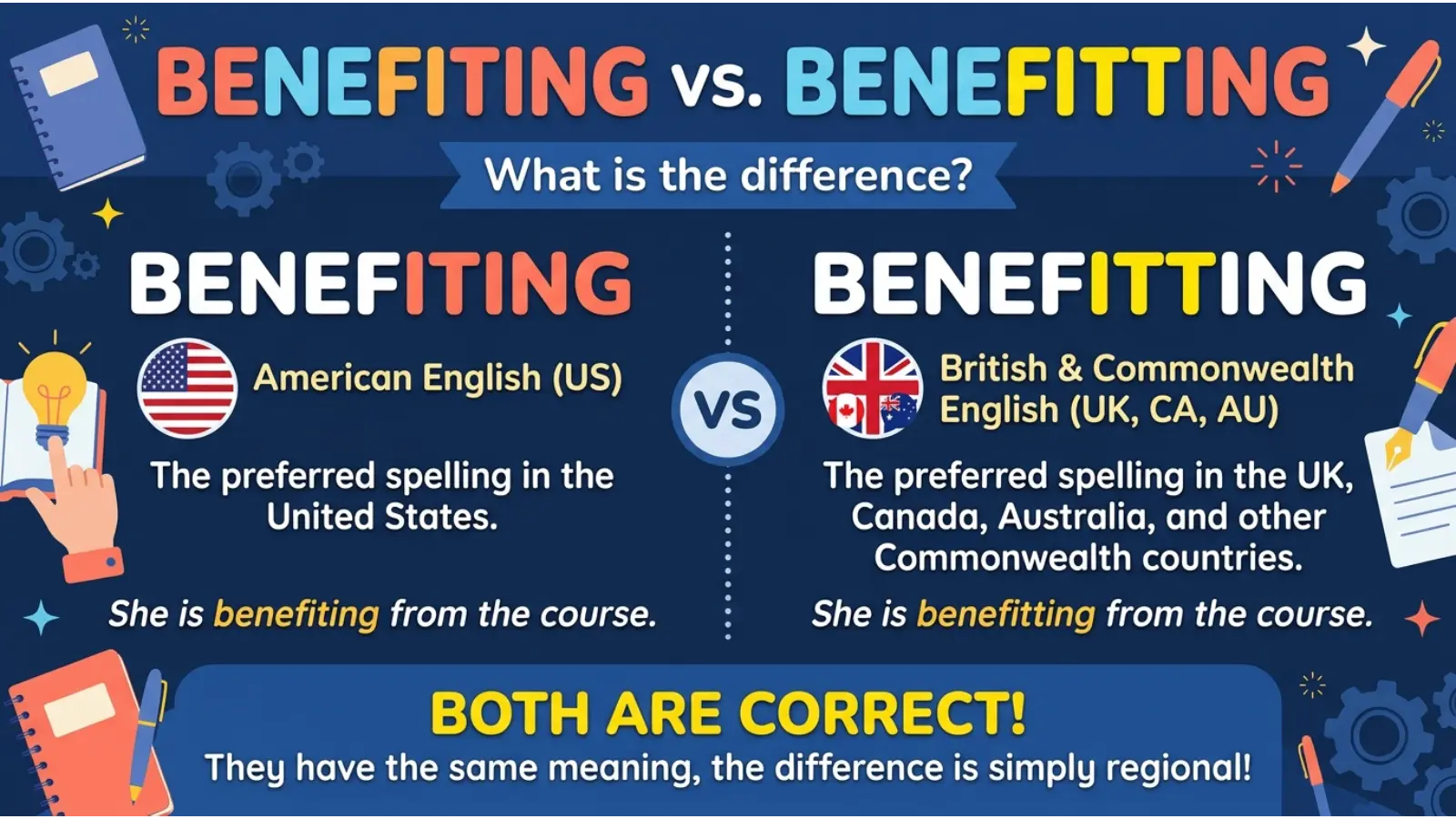
Benefiting or benefitting can be confusing because both spellings appear in English writing. The two forms come from the verb benefit, which means to receive an advantage or help someone improve. However, the spelling with one t is generally the more common choice in both American and British English.
The difference comes from how English handles the final consonant when adding the suffix -ing. Many verbs double their final consonant, but benefit usually keeps one t. This pattern explains why writers commonly use benefiting instead of benefitting. Major dictionaries recognize both forms, so the double-t spelling is not automatically wrong.
In this guide, you will learn the meaning of both spellings, their regional usage, the relevant spelling rule, and examples for everyday and professional writing. You will also discover which form to choose for academic papers, business documents, and online content.
Quick Answer
Benefiting is the preferred spelling for most writing in both American and British English. Benefitting is also an accepted variant, but it is less common.
Example: Regular exercise is benefiting her health.
Use benefiting when you want a straightforward spelling that follows common dictionary recommendations.
What Does Benefiting Mean?
Benefiting is the present participle of the verb benefit. It describes receiving an advantage or providing help to someone or something.
For example:
- Students are benefiting from the new teaching method.
- The company is benefiting from increased sales.
In both sentences, benefiting describes an ongoing process that produces a positive result.
What Does Benefitting Mean?
Benefitting has the same meaning as benefiting. It is an alternative spelling of the present participle of benefit.
For example:
- Local businesses are benefitting from increased tourism.
- The new program is benefitting families across the region.
These sentences are understandable and use a recognized spelling variant. However, benefiting is the safer choice for consistent professional writing.

Benefiting vs Benefitting Comparison Table
| Feature | Benefiting | Benefitting |
|---|---|---|
| Meaning | Receiving or providing an advantage | Receiving or providing an advantage |
| Spelling | One t | Two t’s |
| American English | Standard and widely preferred | Accepted variant, less common |
| British English | Standard and widely preferred | Accepted variant, less common |
| Dictionary recognition | Listed by major dictionaries | Recognized by major dictionaries |
| Professional writing | Recommended default | Use when a chosen style permits it |
| Overall preference | More common | Less common |
The key difference is spelling frequency, not meaning. Both forms describe the same action.

Is Benefiting British or American English?
Benefiting is widely used in both British and American English. It is not an American-only spelling.
The double-t form, benefitting, also appears in British and American sources. However, it is less common than the single-t version. Oxford lists both forms for the -ing form of benefit, while Cambridge identifies benefiting as its standard form. <Cite refs={[“turn448195search3″,”turn448195search0″,”turn448195search6”]}/>
Therefore, it is misleading to say that benefiting belongs exclusively to American English and benefitting belongs exclusively to British English.
Why Do Writers Confuse These Spellings?
The confusion comes from a common English spelling rule. Some verbs double their final consonant when they take an ending such as -ing.
For example:
- Run becomes running.
- Sit becomes sitting.
- Plan becomes planning.
Writers may apply the same pattern to benefit and produce benefitting. However, English spelling depends partly on the stress pattern of a word and established usage.
The stress in benefit falls on the first syllable: BEN-e-fit. Because the final syllable is unstressed, the usual spelling keeps one t when adding -ing.
This explains the common form benefiting.
What Do Major Dictionaries Recommend?
Dictionary guidance helps writers distinguish a preferred spelling from an accepted alternative.
- Cambridge Dictionary: Lists benefiting as the present participle and past tense benefited. <Cite refs={[“turn448195search0″,”turn448195search8”]}/>
- Oxford Learner’s Dictionaries: Recognizes both benefiting and benefitting. <Cite refs={[“turn448195search3″,”turn448195search6”]}/>
- Collins Dictionary: Records benefitting as a form of the verb benefit in British English. <Cite refs={[“turn448195search11″,”turn448195search12”]}/>
These entries show that both forms exist, but dictionary recognition does not mean they occur equally often. For general writing, benefiting remains the most practical choice.

Real Life Examples of Benefiting and Benefitting
Everyday Conversation
- I am benefiting from my daily exercise routine.
- She is benefiting from the extra practice.
- We are benefiting from better communication.
- He is benefiting from a healthier diet.
- The children are benefiting from outdoor activities.
Education
- Students are benefiting from online learning resources.
- The school is benefiting from community support.
- She is benefiting from regular reading practice.
- Teachers are benefiting from updated training.
- The new library is benefiting the entire campus.
Business and Work
- The company is benefiting from its new marketing strategy.
- Employees are benefiting from flexible working hours.
- The business is benefiting from customer feedback.
- Our team is benefiting from improved communication.
- Small companies are benefiting from digital tools.
Health and Fitness
- He is benefiting from regular physical activity.
- Patients are benefiting from better medical care.
- She is benefiting from a balanced diet.
- The community is benefiting from health education.
- Many people are benefiting from improved public facilities.
Technology and Online Services
- Users are benefiting from faster internet connections.
- The website is benefiting from better content.
- Customers are benefiting from improved security.
- Students are benefiting from educational applications.
- Businesses are benefiting from automated processes.
All these examples use the single-t spelling because it is the recommended default. The meaning would remain unchanged if the double-t variant were substituted.
Common Spelling Mistakes to Avoid
Using benefitting because it looks more logical
English does not double every final consonant before -ing. Use benefiting as your standard form.
Assuming benefitting is always incorrect
Major dictionaries recognize the double-t variant. It is less common, but it is not universally considered a spelling error.
Claiming each spelling belongs to a different country
The distinction is not a simple British-versus-American rule. Both forms occur in both varieties of English.
Mixing spelling forms in one document
Switching between benefiting and benefitting can make an article look inconsistent. Choose one form and use it throughout.
Confusing benefiting with beneficial
Benefiting is a verb form, while beneficial is an adjective.
Example: The students are benefiting from a beneficial learning program.
A Simple Memory Trick
Remember this phrase: One benefit, one t in benefiting.
The word benefit already ends with one t. In its usual -ing form, that t stays single.
Compare these examples:
- Benefit → Benefiting
- Visit → Visiting
- Limit → Limiting
This trick helps you remember the standard spelling without memorizing a long list of rules.
Which Spelling Should You Use in Professional Writing?
For academic assignments, business reports, website articles, emails, and other formal documents, choose benefiting unless your organization’s style guide specifies otherwise.
The single-t spelling is widely recognized and aligns with the preferred form shown in major learner’s dictionaries. It also helps maintain consistency across documents written for international audiences.
If you are editing a document that already uses benefitting, check the relevant style guide before changing every instance. The double-t form is an accepted variant, so the decision may involve consistency rather than correcting a clear error.
For SEO content, use benefiting naturally in headings, examples, and body text when it matches your target keyword. You do not need to repeat both spellings excessively to rank for the topic.
Frequently Asked Questions
Is benefiting or benefitting correct?
Both spellings are accepted. Benefiting is more common and is the preferred default for most writing.
Is benefitting wrong in British English?
No. British English sources recognize benefitting, but benefiting is also standard and widely used in the United Kingdom.
Do Americans spell it benefiting or benefitting?
Americans generally prefer benefiting. The double-t version is recognized as a variant but is less common.
Why does benefit become benefiting?
The word’s final syllable is unstressed, so the usual spelling retains one t when adding -ing. This follows the established spelling of the verb.
What is the past tense of benefit?
Benefited is the standard and widely preferred spelling. Benefitted is also recognized as a variant in major dictionaries.
Which spelling is best for SEO articles?
Use benefiting as your main spelling because it is the more common form. Include benefitting only when discussing the spelling difference naturally.
Conclusion
Benefiting and benefitting have the same meaning, and both forms are recognized in English. The main difference is how frequently writers use each spelling.
Benefiting is the better default for American English, British English, academic writing, business documents, and website content. Benefitting remains an accepted alternative, but it is less common.
When you want clear, consistent writing, choose benefiting and follow that spelling throughout your document. This simple choice will help your content match common dictionary usage and meet most professional writing expectations.

Olivia Bennett is a grammar expert and language content writer at GrammarWize.com. She specializes in English grammar, word usage, spelling differences, and writing improvement. Through clear explanations and practical examples, Olivia helps students, professionals, and language learners communicate more effectively. Her goal is to make English grammar simple, accessible, and easy to apply in everyday writing.