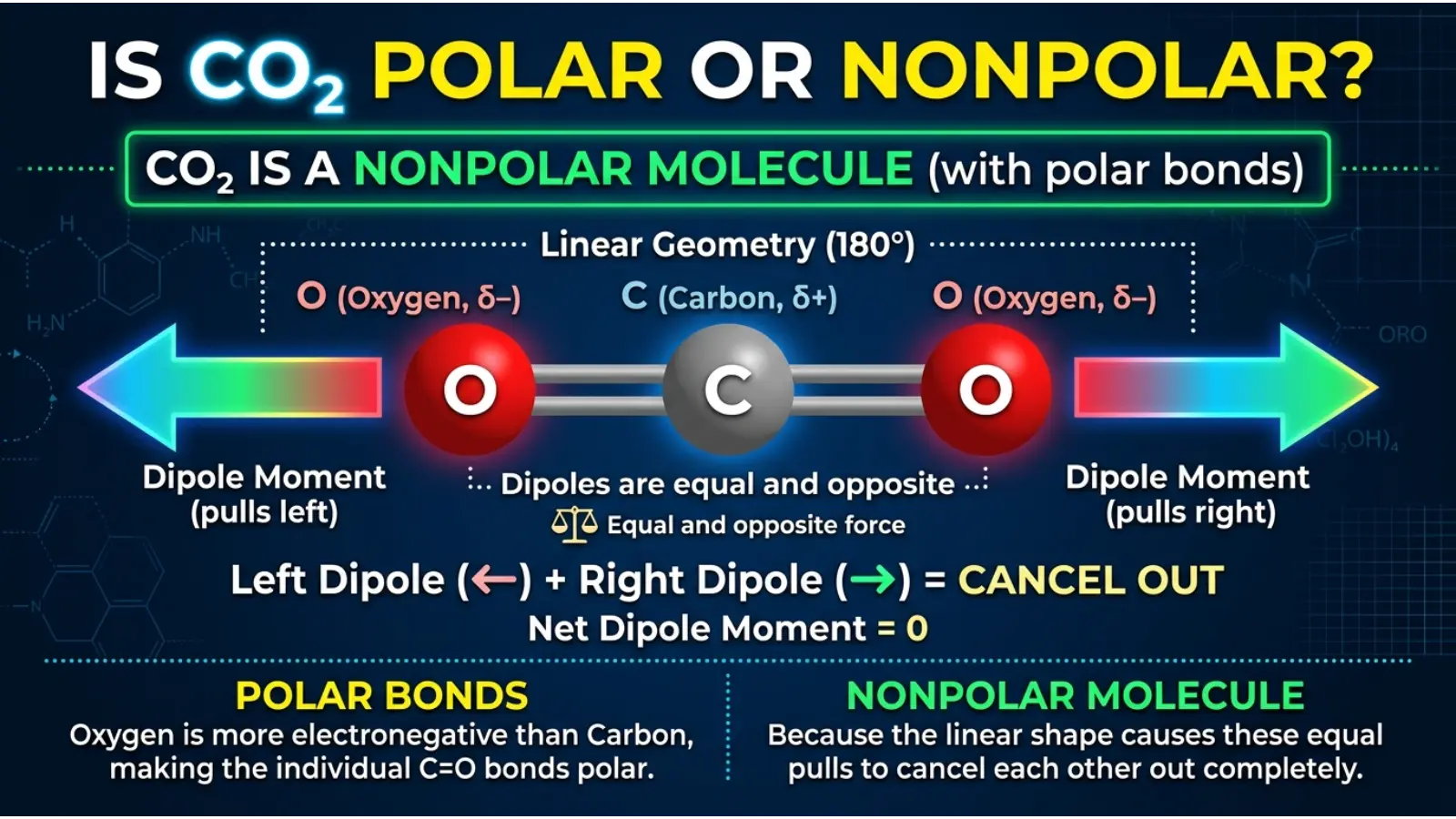
Is CO2 polar or nonpolar? Carbon dioxide (CO2) is a nonpolar molecule because its linear shape allows the two polar carbon–oxygen bonds to cancel each other out. Although oxygen attracts electrons more strongly than carbon, the molecule has no overall dipole moment.
Is CO2 Polar or Nonpolar? This is a common question in chemistry, especially for students learning about molecular polarity, chemical bonds, and molecular geometry. Carbon dioxide (CO2) contains two polar carbon-oxygen bonds, but its overall polarity depends on the molecule’s shape. So, is CO2 a polar or nonpolar molecule? The answer becomes clear when you understand how its atoms are arranged.
Understanding CO2 polarity becomes easier when you look at its molecular structure. The carbon atom sits between two oxygen atoms, creating a straight arrangement with a bond angle of 180 degrees. Each C=O bond has a dipole, but the two dipoles point in opposite directions. This symmetry makes CO2 a useful example of why polar bonds do not always create a polar molecule.
Quick Answer: Is CO2 Polar or Nonpolar?
CO2 is nonpolar. Its two polar carbon–oxygen bonds have equal dipole moments that point in opposite directions. Because the molecule is linear and symmetrical, these dipoles cancel, leaving a net dipole moment of zero.
What Is CO2?
CO2 is the chemical formula for carbon dioxide. Each molecule contains one carbon atom and two oxygen atoms.
Carbon dioxide occurs naturally in the atmosphere and is produced during processes such as respiration and combustion. Plants also use it during photosynthesis.
The molecule has a simple structure, written as O=C=O. Carbon forms a double bond with each oxygen atom. These bonds create a stable, linear arrangement.
Why Is CO2 Nonpolar?
Three important factors explain why CO2 is nonpolar.
1. The Carbon–Oxygen Bonds Are Polar
Oxygen is more electronegative than carbon, meaning it attracts shared electrons more strongly. As a result, each carbon–oxygen bond has an uneven distribution of electron density.
Oxygen carries a partial negative charge, while the carbon side carries a partial positive charge. This creates a bond dipole directed toward each oxygen atom.
However, bond polarity alone cannot determine the polarity of the entire molecule.
2. CO2 Has a Linear Molecular Shape
CO2 has a linear molecular geometry. The carbon atom sits between the two oxygen atoms, and the O=C=O bond angle is 180 degrees.
This arrangement places the two identical C=O bonds on opposite sides of the carbon atom. Their dipoles point in opposite directions with equal strength.
3. The Bond Dipoles Cancel Each Other
The two bond dipoles cancel because they have equal magnitudes and opposite directions.
As a result, the molecule has no permanent net dipole moment. This makes CO2 nonpolar even though its individual bonds are polar.

CO2 Molecular Structure and Geometry
The molecular structure of CO2 explains its polarity better than the formula alone.
Its Lewis structure is O=C=O. Carbon forms two double bonds and has no lone pairs on the central atom. Each oxygen atom has two lone pairs.
According to VSEPR theory, the two regions of electron density around the central carbon arrange themselves as far apart as possible. This creates a linear shape.
The 180-degree bond angle keeps the two bond dipoles directly opposite each other. Their effects cancel completely.
Is the C=O Bond Polar or Nonpolar?
The C=O bond in carbon dioxide is polar. Oxygen attracts shared electrons more strongly than carbon, creating an uneven charge distribution.
However, a polar bond does not always make a polar molecule. Molecular polarity depends on both the polarity of individual bonds and their three-dimensional arrangement.
In CO2, the two identical polar bonds point in opposite directions. Their dipole moments cancel, so the whole molecule remains nonpolar.
CO2 Polarity at a Glance
| Property | CO2 |
|---|---|
| Chemical name | Carbon dioxide |
| Molecular formula | CO2 |
| Lewis structure | O=C=O |
| Molecular geometry | Linear |
| Bond angle | 180° |
| C=O bond polarity | Polar |
| Molecular symmetry | Symmetrical |
| Net dipole moment | Zero |
| Overall molecular polarity | Nonpolar |
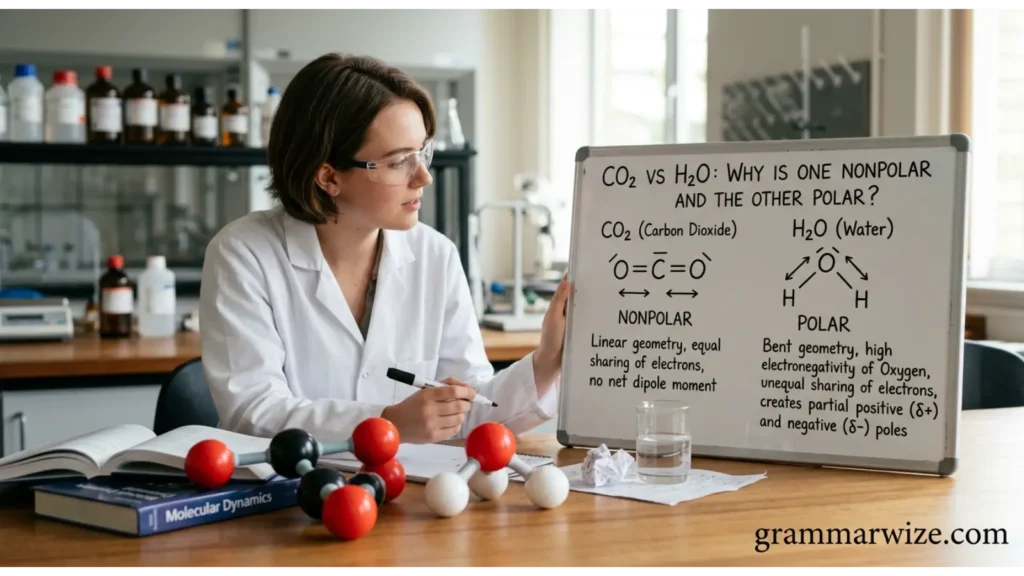
CO2 vs H2O: Why Is One Nonpolar and the Other Polar?
CO2 and water both contain polar bonds, but they have different molecular shapes. This difference determines their overall polarity.
| Feature | CO2 | H2O |
|---|---|---|
| Central atom | Carbon | Oxygen |
| Molecular shape | Linear | Bent |
| Bond angle | 180° | Approximately 104.5° |
| Bond polarity | Polar C=O bonds | Polar O–H bonds |
| Dipole cancellation | Complete | Incomplete |
| Overall polarity | Nonpolar | Polar |
Water has a bent shape because the central oxygen atom has two lone pairs. Its O–H bond dipoles do not point in opposite directions, so they cannot cancel completely.
CO2 has a straight, symmetrical shape. Its two bond dipoles cancel, making it nonpolar.
Common Mistakes When Determining CO2 Polarity
Mistake 1: Assuming Polar Bonds Make Every Molecule Polar
A molecule can contain polar bonds without having an overall dipole. Always examine the molecular shape before deciding.
Mistake 2: Ignoring Molecular Geometry
The formula CO2 does not tell the complete story by itself. Its linear geometry explains why the bond dipoles cancel.
Mistake 3: Confusing Bond Polarity With Molecular Polarity
Bond polarity describes electron distribution between two atoms. Molecular polarity describes the overall charge distribution across the entire molecule.
Mistake 4: Thinking Oxygen’s Electronegativity Makes CO2 Polar
Oxygen is more electronegative than carbon, but both oxygen atoms pull electron density in opposite directions. Their equal and opposing dipoles cancel.

How to Remember CO2 Polarity
Use this simple memory trick: Linear and symmetrical means the dipoles cancel when the bonds are identical.
Picture two people pulling a rope with equal force in opposite directions. The forces balance each other. The two C=O bond dipoles behave similarly in CO2.
Remember that molecular shape matters. This rule works for symmetrical CO2, but it does not apply to every molecule with polar bonds.
Real-Life Importance of CO2 Polarity
CO2 polarity is useful for understanding several chemical properties.
- Intermolecular forces: Nonpolar CO2 molecules do not have a permanent molecular dipole, although they still experience London dispersion forces.
- Solubility: Carbon dioxide dissolves in water despite being nonpolar. Its behavior also involves chemical reactions that form carbonic acid and related species.
- Atmospheric chemistry: CO2 interacts with infrared radiation, helping Earth retain heat. Its greenhouse effect does not require the molecule to have a permanent dipole.
- Chemical structure: CO2 demonstrates why scientists consider molecular geometry when predicting physical and chemical behavior.
Frequently Asked Questions
Is CO2 polar or nonpolar?
CO2 is nonpolar because its two equal C=O bond dipoles cancel in its linear molecular structure.
Why is CO2 nonpolar even though its bonds are polar?
The two polar bonds point in opposite directions. Their equal dipole moments cancel, producing no net molecular dipole.
What is the molecular shape of CO2?
CO2 has a linear molecular shape with a bond angle of 180 degrees.
Does CO2 have a dipole moment?
An ideal isolated CO2 molecule has a net permanent dipole moment of zero. Each C=O bond is polar, but the bond dipoles cancel.
Is CO2 more polar than H2O?
No. CO2 is nonpolar overall, while H2O is polar because its bent shape prevents its bond dipoles from canceling.
Are both C=O bonds in CO2 polar?
Yes. Both carbon–oxygen bonds are polar because oxygen attracts shared electrons more strongly than carbon.
Conclusion
CO2 is a nonpolar molecule because its linear, symmetrical structure causes the two polar carbon–oxygen bond dipoles to cancel. Each bond is polar, but the entire molecule has no net dipole moment.
The key lesson is that molecular polarity depends on both bond polarity and molecular geometry. When you examine the bonds and their arrangement together, it becomes clear why CO2 is nonpolar while a bent molecule such as H2O is polar.

Olivia Bennett is a grammar expert and language content writer at GrammarWize.com. She specializes in English grammar, word usage, spelling differences, and writing improvement. Through clear explanations and practical examples, Olivia helps students, professionals, and language learners communicate more effectively. Her goal is to make English grammar simple, accessible, and easy to apply in everyday writing.