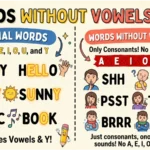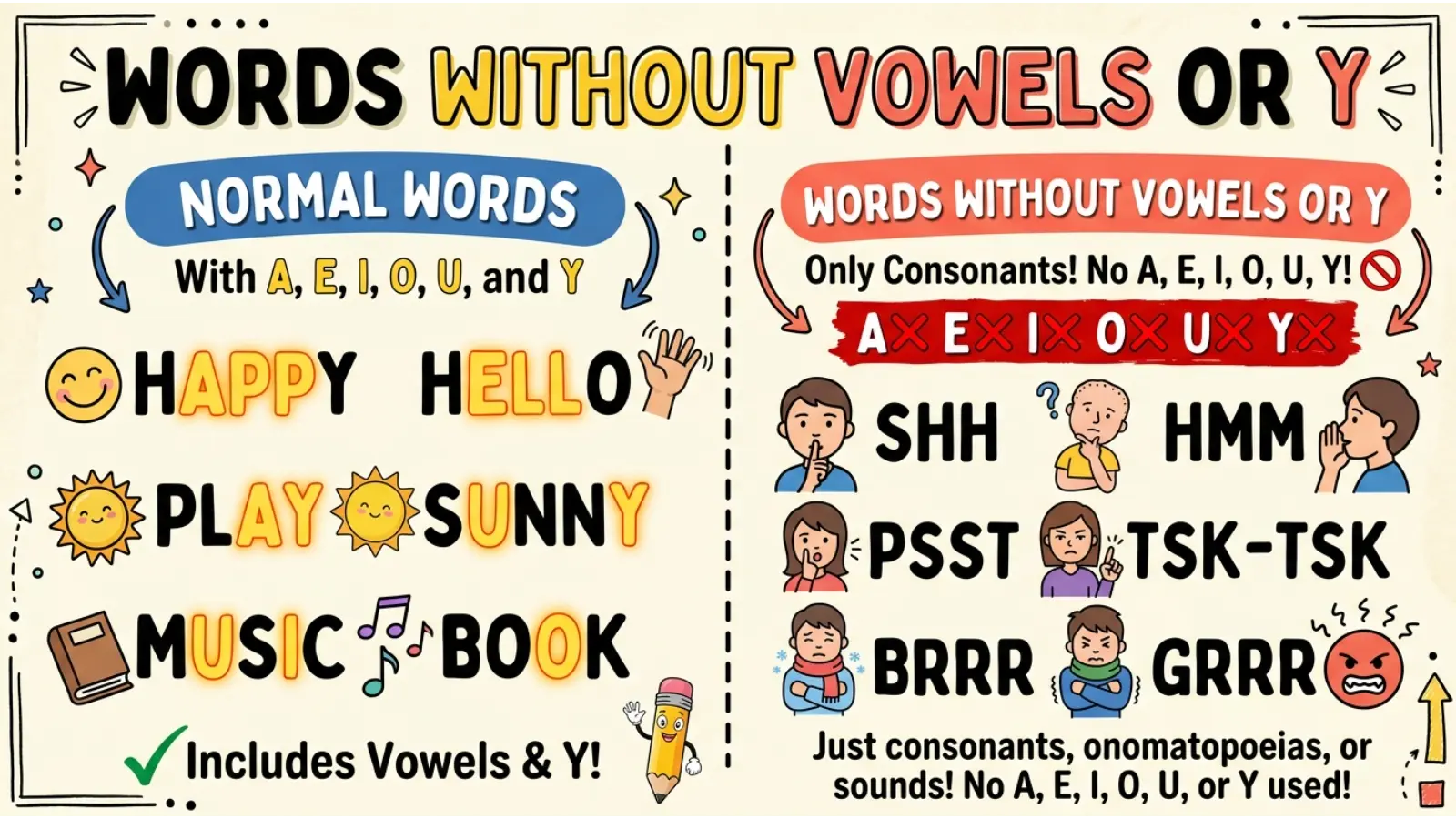
Words without vowels or Y can seem unusual because most English words contain at least one traditional vowel: A, E, I, O, or U. However, English also has words that use consonants without these letters. Some are common words, while others come from abbreviations, borrowed languages, or specialized terminology.
Words Without Vowels or Y are becoming a popular topic for word game fans, puzzle lovers, and people who enjoy exploring the English language. These unusual words can make spelling challenges more exciting and help you expand your vocabulary. But is it really possible to write English words without the letters A, E, I, O, U, or Y? Yes, several words fit this rule, including short words and unusual terms used in everyday language or specialized fields.
Understanding words without vowels or Y helps you recognize unusual spelling patterns and improve your vocabulary. It also explains why certain words can be difficult to pronounce or spell. Although Y often acts as a vowel in English, this topic focuses on words that contain neither Y nor the traditional vowel letters.
Quick Answer: What Are Words Without Vowels or Y?
Words without vowels or Y contain none of these six letters: A, E, I, O, U, or Y.
Examples include cwm, a word for a deep mountain hollow, and crwth, a traditional Welsh stringed instrument. Both are borrowed from Welsh.
These words are uncommon in everyday English. Many English words that appear to lack vowels actually contain Y or use other letters to represent vowel sounds.
What Does It Mean to Have No Vowels?
In English, the letters A, E, I, O, and U are traditionally called vowels. The remaining letters are generally classified as consonants, although Y can function as either a consonant or a vowel.
A word without vowels or Y contains none of these letters in its spelling. This does not necessarily mean the word has no vowel sound in pronunciation. Some borrowed words use spelling and pronunciation patterns that differ from ordinary English words.
For example, cwm is pronounced approximately like “koom.” Its spelling contains no traditional vowel letters or Y, even though its pronunciation includes a vowel sound.

Examples of Words Without Vowels or Y
Here are some examples, including their meanings and origins.
| Word | Meaning | Origin or usage |
|---|---|---|
| Cwm | A deep, rounded mountain hollow | Welsh geographical term |
| Crwth | An ancient Welsh stringed instrument | Welsh musical term |
| Cwtch | A cuddle, hug, or cozy hiding place | Welsh word used in English, especially in Wales |
| Psst | A sound used to attract someone’s attention quietly | English interjection |
| Shh | A sound used to ask someone to be quiet | English interjection |
| Hm | A sound expressing thought or hesitation | English interjection |
Important distinction: Cwm, crwth, and cwtch contain no A, E, I, O, U, or Y. However, psst, shh, and hm are interjections or sound representations, not ordinary words with conventional vowel-based pronunciation.
Why Are Words Without Vowels So Unusual?
Most English words use vowels to form syllables. Vowels help make words easier to pronounce and distinguish from one another.
Words without traditional vowel letters often fall into a few categories.
Borrowed Words
English adopts words from other languages. Their original spelling may follow different rules.
For example, cwm and crwth come from Welsh, where W can represent a vowel sound.
Interjections and Sound Words
Some written expressions represent sounds rather than conventional words.
Examples include psst and shh. They communicate attention or silence without following typical spelling patterns.
Abbreviations and Technical Terms
Initialisms and specialized terms can omit traditional vowels. However, these should not always be treated as ordinary dictionary words.
When researching a word, check its dictionary entry and context before deciding whether it fits this category.

Can English Words Have No Vowel Sounds?
Yes, some English expressions can be spoken without a clear vowel sound. Interjections such as shh and psst are common examples.
However, a word with no traditional vowel letters may still have a vowel sound. This distinction matters because letters and sounds are not the same thing.
For example, cwm has no traditional vowel letters, but its pronunciation includes a vowel sound represented by W in the original Welsh spelling.
Therefore, a word can lack A, E, I, O, U, and Y in its written form without being completely vowel-free in speech.

Words Without A, E, I, O, U, but With Y
Words containing Y belong to a different category. Y can function as a vowel in many English words.
Examples include:
- Myth: A traditional story or widely held belief.
- Crypt: An underground room or chamber.
- Lynx: A wild cat with tufted ears.
- Rhythm: A regular pattern of sounds or movement.
- Glyph: A written or carved symbol.
These words have no A, E, I, O, or U, but they all contain Y. They therefore do not qualify as words without vowels or Y.
Common Mistakes When Identifying These Words
Counting Y as a Traditional Vowel
Y often represents a vowel sound, but it is not one of the five traditional vowel letters. If a task excludes Y explicitly, words containing it do not qualify.
Confusing Letters With Sounds
A word can lack traditional vowel letters and still have a vowel sound. Always distinguish spelling from pronunciation.
Treating Every Consonant Cluster as a Word
A sequence such as brr may represent a sound, but it is not necessarily an ordinary dictionary word. Consider the type of expression and how it is used.
Assuming All Examples Are Native English Words
Some examples entered English from other languages. Their spelling may follow the original language’s conventions rather than typical English patterns.
A Simple Memory Trick
Remember the six-letter test: A, E, I, O, U, and Y.
To check a word, scan its spelling for each of these letters. If none appears, the word may qualify. Then check a reliable dictionary to confirm that it is an established word or recognized expression.
This method is more reliable than judging a word by how it sounds.
How to Use These Words in Real Life
Words without traditional vowel letters appear in specific contexts.
- Geography: A writer may use cwm when describing a Welsh mountain landscape.
- Music history: A discussion of Welsh instruments may mention the crwth.
- Informal communication: Someone might type psst to attract a friend’s attention.
- Conversation: A person may write hm to show hesitation or thought.
- Language study: A spelling exercise may ask learners to identify words that contain no A, E, I, O, U, or Y.
These examples show why context matters. A technical term, a borrowed word, and a written sound may all fit a broad spelling pattern but serve different purposes.
Frequently Asked Questions
Is there an English word without A, E, I, O, U, or Y?
Yes. Cwm and crwth are recognized English dictionary words borrowed from Welsh. Both omit all five traditional vowel letters and Y.
Is W a vowel in English?
W is generally classified as a consonant in English. However, it represents a vowel sound in some borrowed Welsh words, including cwm and crwth.
Does rhythm count as a word without vowels?
No, not when Y is excluded. Rhythm contains Y, which functions as a vowel in the word.
Is cwm a real word?
Yes. Cwm is a recognized geographical term for a steep-sided hollow or valley, especially one formed by glacial action.
Are words without vowels common in everyday English?
No. Most ordinary English words contain traditional vowel letters. Words without them are more likely to be borrowed terms, specialized vocabulary, abbreviations, or interjections.
Conclusion
Words without vowels or Y demonstrate that English spelling does not always follow familiar patterns. Words such as cwm and crwth show how borrowed vocabulary can preserve unusual letter combinations, while expressions such as psst and shh illustrate how writing represents sounds.
The most important rule is to distinguish vowel letters from vowel sounds. Check the spelling, identify the word’s meaning, and confirm its usage in a reliable dictionary. This approach helps you understand unusual words without confusing spelling patterns with pronunciation rules.

Olivia Bennett is a grammar expert and language content writer at GrammarWize.com. She specializes in English grammar, word usage, spelling differences, and writing improvement. Through clear explanations and practical examples, Olivia helps students, professionals, and language learners communicate more effectively. Her goal is to make English grammar simple, accessible, and easy to apply in everyday writing.