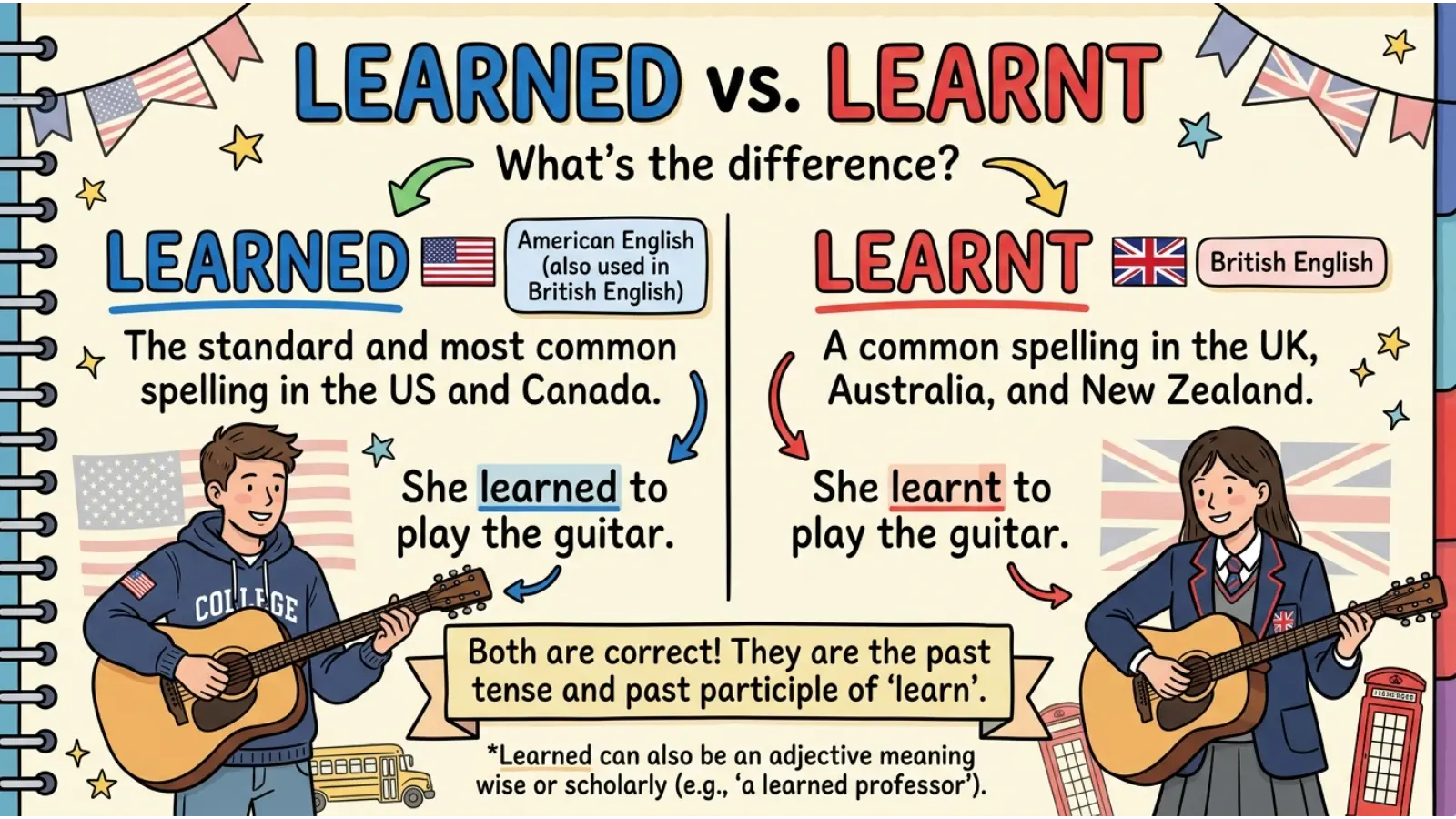
Learned or learnt is a common English grammar question because both words describe something that happened in the past. The difference mainly comes from regional spelling preferences. American English usually favors learned, while British English commonly uses learnt. However, British writers also use learned, so neither spelling is limited to one country.
Words Learned or Learnt is a common English spelling question that confuses writers, students, and English learners. Both words refer to gaining knowledge or developing a new skill, but their usage often depends on regional preferences. So, should you write learned or learnt in your sentences? The answer is simple once you understand the difference between American and British English.
Learned is the preferred form in American English, while learnt is widely used in British English. However, both forms are correct in many English-speaking regions. You can use either spelling to describe something you studied, discovered, or practiced. In this guide, you will learn when to use each word, explore real-life examples, and discover which spelling works best for academic writing, professional communication, and everyday conversations.
Both words are forms of the verb learn. You can use either one to describe gaining knowledge, developing a skill, or discovering information. For example, you can say, “I learned to drive last year” or “I learnt to drive last year.” Both sentences are grammatically correct.
The important thing is to understand your audience and maintain consistent spelling. This guide explains the meanings, grammar rules, sentence structures, and everyday uses of learned and learnt.
Quick Answer: Learned or Learnt?
Learned is the preferred spelling in American English. Learnt is especially common in British English, although learned is also correct in British writing.
Examples:
- American English: I learned a new skill yesterday.
- British English: I learnt a new skill yesterday.
Both sentences have the same meaning. Neither form is grammatically wrong.
What Does Learned Mean?
Learned is the past tense and past participle of the verb learn. It describes gaining knowledge, understanding information, or developing a skill.
Examples:
- She learned how to swim when she was young.
- We have learned several useful lessons from this experience.
Learned is the usual choice in American English. It is also widely accepted in British English.
Learned can also work as an adjective meaning knowledgeable or educated. In this use, it is often pronounced with two syllables, as in “a learned professor.”
Example: The university invited a learned historian to speak.
What Does Learnt Mean?
Learnt is another accepted past tense and past participle of learn. It carries the same basic meaning as learned.
Examples:
- He learnt French during his stay in London.
- They have learnt how to solve the problem.
Learnt is especially common in British English and appears in other varieties of English, including Australian English. American writers generally prefer learned.
The choice does not change the meaning of the sentence. It mainly reflects regional preference and writing style.

Learned vs Learnt Comparison Table
| Feature | Learned | Learnt |
|---|---|---|
| Meaning | Gained knowledge or a skill | Gained knowledge or a skill |
| Base verb | Learn | Learn |
| Past tense | Correct | Correct |
| Past participle | Correct | Correct |
| American English | Preferred | Less common |
| British English | Correct and common | Common |
| Formal writing | Fully acceptable | Fully acceptable |
| Example | I learned the rules. | I learnt the rules. |
What Is the Grammar Rule for Learned and Learnt?
English verbs can have different forms depending on the tense. Learn is a regular verb in American English, where its past forms usually take the ending -ed.
British English commonly accepts both the regular form learned and the alternative form learnt.
| Verb form | Example |
|---|---|
| Base form | I learn something new every day. |
| Present third person | She learns quickly. |
| Past tense | She learned quickly. |
| Alternative past tense | She learnt quickly. |
| Past participle | I have learned a lot. |
| Alternative past participle | I have learnt a lot. |
| Present participle | She is learning English. |
Notice that the present participle is learning in both varieties. You should not write learnning or learnting.

When Should You Use Learned?
Use learned when you follow American English conventions or when your publication prefers the regular verb form.
American English Writing
American dictionaries and most American style guides favor learned.
Example: The students learned about climate change in science class.
Academic and Professional Writing
Learned is a safe choice for international audiences, especially when American English is your chosen style.
Example: Our team learned valuable lessons during the project.
Describing Knowledge or Skills
Use learned to explain how someone gained experience or understanding.
Example: I learned to manage my time more effectively.
As an Adjective
Learned can describe someone with extensive knowledge.
Example: The learned researcher published an important study.
In this adjective use, learned is generally pronounced with two syllables.

When Should You Use Learnt?
Choose learnt when you are following British English conventions or a publication that prefers British spelling.
British English Conversations and Writing
Learnt is natural in British English and works well in everyday communication.
Example: I learnt to ride a bicycle when I was six.
Australian English
Learnt is also widely used in Australian English, although learned remains acceptable.
Example: She learnt several new techniques during training.
Informal Messages
You can use learnt in texts, emails, and casual conversations when it matches your usual English variety.
Example: I learnt something interesting today.
Past Experiences
Learnt works when describing knowledge gained through experience.
Example: We learnt the importance of teamwork during the competition.
Why Do Learned and Learnt Both Exist?
The difference comes from two accepted ways of forming the past tense of learn.
English has many verbs with regular and irregular forms. For example, burned and burnt are both accepted forms of burn. Similarly, learned and learnt developed as alternative past forms of learn.
American English generally favors the regular ending in learned. British English retains more frequent use of learnt, although the regular form is also established.
This is a difference in language preference, not a difference in meaning. Neither spelling is a mistake when used as the past tense or past participle of learn.
Common Mistakes to Avoid
Treating Learnt as Incorrect
Incorrect assumption: Learnt is always wrong.
Correction: Learnt is a standard English form, especially in British English.
Assuming Learned Is Only American
Incorrect assumption: British writers must use learnt.
Correction: Learned is also correct and widely used in British English.
Mixing Styles Without a Reason
Example: The report says the team learned new methods, then says they learnt new procedures.
Correction: Choose one form for consistency unless you are quoting another source.
Using Learnting Instead of Learning
Incorrect: She is learnting English.
Correct: She is learning English.
The present participle of learn is learning in both American and British English.
Using Learned Incorrectly as a Verb
Incorrect: I have learn the lesson.
Correct: I have learned the lesson.
Also correct: I have learnt the lesson.
After have, has, or had, use the past participle.
Learned or Learnt in Real-Life Sentences
At School
American: I learned multiplication in primary school.
British: I learnt multiplication in primary school.
Both sentences are correct.
At Work
American: Our manager learned a new software tool.
British: Our manager learnt a new software tool.
Both describe the same event.
While Traveling
American: We learned about local customs during our trip.
British: We learnt about local customs during our trip.
The spelling changes, but the meaning stays the same.
During Personal Growth
American: She learned from her mistakes.
British: She learnt from her mistakes.
Both sentences describe gaining knowledge through experience.
In Academic Research
American: The researchers learned more about the disease.
British: The researchers learnt more about the disease.
Both forms are grammatically valid. Follow the spelling conventions of your journal or institution.
How to Remember the Difference
Use this simple memory trick:
Learned = American preference. Learnt = common British alternative.
Think of the ending:
- -ed is the regular past tense ending used in learned.
- -t appears in learnt, an alternative past form.
This trick helps you remember the regional preference. It does not mean that learned is incorrect in British English or that learnt is grammatically invalid elsewhere.
Which Form Is Better for Professional Writing?
The best choice depends on your target audience and style guide.
| Audience | Recommended choice |
|---|---|
| United States | Learned |
| United Kingdom | Learned or learnt |
| Australia | Learned or learnt |
| International business | Learned is a practical default |
| British publication | Follow the publication’s house style |
| Academic journal | Follow the journal’s style guide |
For websites targeting American readers, use learned throughout your article. For British readers, either form is acceptable, but consistency matters.
Professional writing should prioritize clarity and consistency over unnecessary spelling corrections. Do not change learnt to learned merely because you assume the original form is wrong.
Frequently Asked Questions
Is learned or learnt correct?
Both are correct. Learned is preferred in American English, while learnt is especially common in British English.
Is learnt British or American English?
Learnt is more strongly associated with British English. It is also used in Australian English and other varieties.
Do learned and learnt mean the same thing?
Yes. As past tense and past participle forms of learn, they have the same meaning.
Should I write learned or learnt in an essay?
Follow the spelling conventions required by your school, university, or publication. Learned is a practical choice for American English, while both forms are accepted in British English.
Can I say “I have learnt”?
Yes. “I have learnt” is grammatically correct because learnt can function as the past participle of learn.
Is learned always pronounced with one syllable?
No. As a verb, learned is usually pronounced as one syllable. As an adjective meaning knowledgeable, it is often pronounced with two syllables.
Conclusion
Learned and learnt are both correct forms of the verb learn. They differ mainly in regional preference rather than meaning or grammar.
Use learned for American English and as a practical default for international content. Use learnt when it suits your British English style or publication guidelines.
Most importantly, do not treat either spelling as universally wrong. Choose the form that suits your audience, maintain consistency, and focus on making your writing clear.

Olivia Bennett is a grammar expert and language content writer at GrammarWize.com. She specializes in English grammar, word usage, spelling differences, and writing improvement. Through clear explanations and practical examples, Olivia helps students, professionals, and language learners communicate more effectively. Her goal is to make English grammar simple, accessible, and easy to apply in everyday writing.