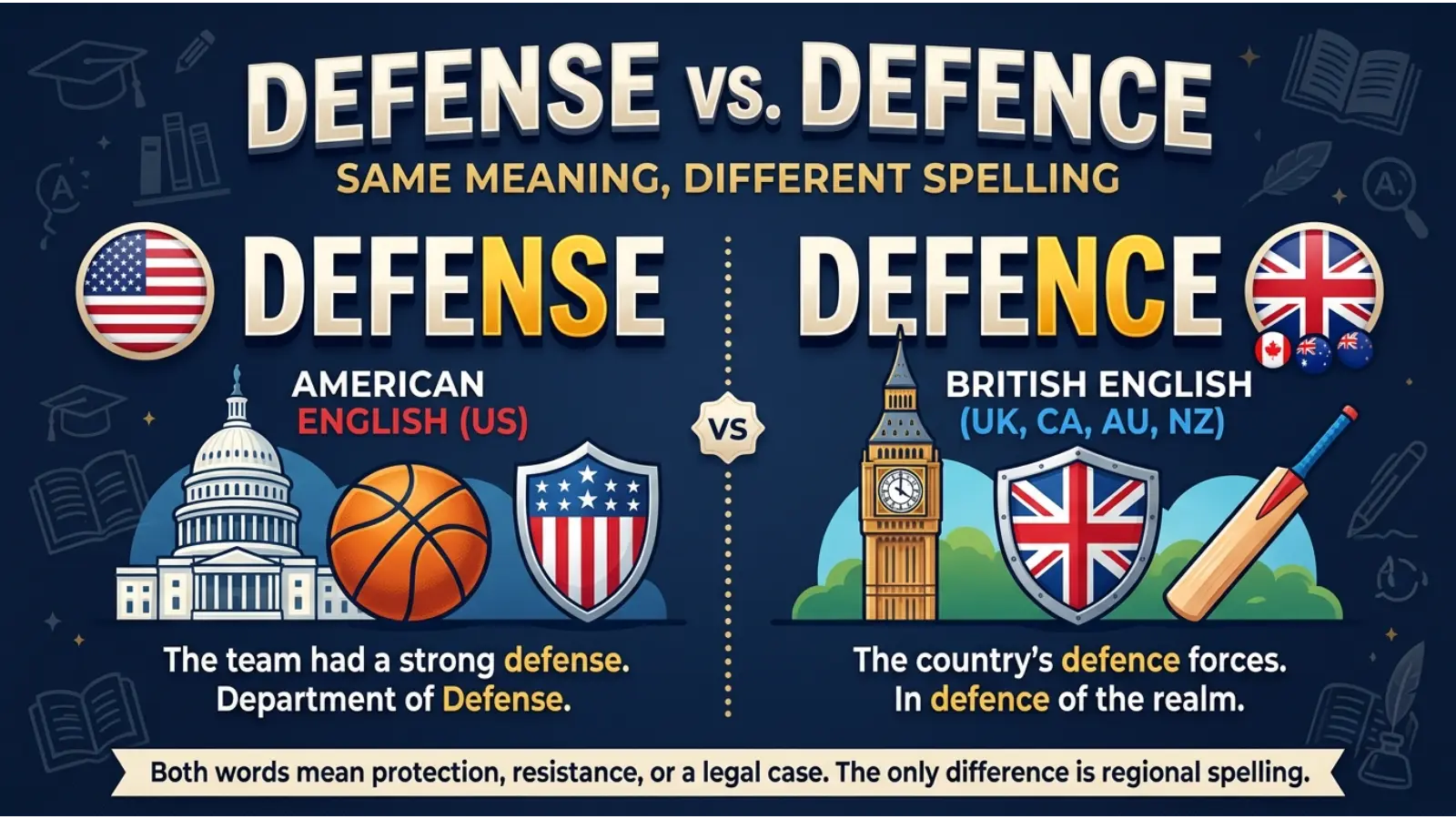
Defense or defence is a common spelling question for English learners, students, and professional writers. Both words are correct, and both have the same meaning. The difference comes from regional spelling preferences. American English uses defense, while British English uses defence.
Defense or Defence is a trending spelling comparison that often confuses English writers, students, and professionals. Both words have the same meaning, but the correct spelling depends on the type of English you use. So, should you write “defense” or “defence” in your articles, emails, or academic assignments? The answer mainly depends on your audience and location.
Defense is the standard spelling in American English, while defence is preferred in British English and countries that follow British spelling conventions, including the UK. Both spellings are correct, so neither is a mistake in its appropriate variety of English. In this guide, you will learn the key differences between defense and defence, explore real-life examples, and discover which spelling works best for professional writing, education, and everyday communication.
These spellings refer to protection against danger, an attack, or an accusation. For example, an American newspaper might report a strong national defense, while a British newspaper might discuss national defence. The same distinction appears in sports, law, military writing, and everyday communication.
Choosing the right spelling helps you match your audience and maintain consistency throughout your writing. This guide explains the meanings, grammar rules, regional differences, common mistakes, and practical examples of defense and defence. You will also learn which spelling to use in academic papers, business documents, and online content.
Quick Answer:
Use defense in American English and defence in British English. Both spellings are correct, so your choice depends on your audience or the style guide you follow.
- American English: The country strengthened its national defense.
- British English: The country strengthened its national defence.
What Does Defense Mean?
Defense is a noun that means protection against an attack, danger, injury, or accusation. American English uses this spelling in legal, military, sports, and everyday contexts.
Examples:
- The country increased its defense budget.
- The lawyer prepared a strong defense for her client.
- Our team played excellent defense during the match.
In each example, defense describes an action, system, or argument that protects someone or something.
What Does Defence Mean?
Defence has the same meaning as defense. British English uses this spelling in formal writing, news reports, legal documents, and everyday communication.
Examples:
- The government reviewed its defence policy.
- The lawyer presented a strong defence in court.
- The team improved its defence before the final match.
The meaning does not change when you replace defense with defence. Only the spelling changes.

Defense vs Defence: Key Differences
| Feature | Defense | Defence |
|---|---|---|
| English variety | American English | British English |
| Meaning | Protection or resistance | Protection or resistance |
| Pronunciation | /dɪˈfens/ | /dɪˈfens/ |
| Part of speech | Noun | Noun |
| Common regions | United States | United Kingdom, Australia, Pakistan |
| Legal usage | Defense attorney | Defence solicitor or defence lawyer |
| Military usage | Defense forces | Defence forces |
| Related adjective | Defensive | Defensive |
| Related verb | Defend | Defend |
The two spellings are interchangeable in meaning, but regional conventions determine which one readers expect.
Why Are There Two Spellings?
The difference reflects the development of American and British spelling conventions. Noah Webster, an American lexicographer, helped promote spelling forms that differed from traditional British usage.
Many American words use -se where British English uses -ce in certain nouns. Examples include defense and defence, offense and offence, and license and licence.
These differences developed through historical spelling preferences and later dictionary and publishing conventions. Neither form is a modern misspelling.

When Should You Use Defense?
Choose defense when writing for an American audience or following an American English style guide.
Common situations include:
- School assignments: Use American spelling in papers written under US English conventions.
- Legal writing: Use defense when discussing the defense in a US court case.
- Sports reporting: Write about a team’s defense in American sports coverage.
- Military news: Use defense in articles about US defense policy.
- Business content: Follow American spelling in company documents intended for US readers.
Example: The company invested in advanced cybersecurity defense systems.
When Should You Use Defence?
Choose defence when writing in British English or following a style guide that prefers British spelling.
Common situations include:
- Academic writing: Use defence when your institution requires British English.
- News articles: Follow British spelling conventions in UK publications.
- Legal documents: Use defence when the document follows British English conventions.
- Military reports: Write about national defence in British English.
- International content: Use the spelling preferred by your target audience or publication.
Example: The government announced a new national defence strategy.
Defense or Defence in Different Countries
English spelling conventions vary across regions. The following table offers a practical guide.
| Country or region | Preferred spelling |
|---|---|
| United States | Defense |
| United Kingdom | Defence |
| Australia | Defence |
| New Zealand | Defence |
| Pakistan | Defence is common in British English usage |
| Canada | Defence is widely used, though context and style conventions matter |
Canada often follows British spelling for words such as defence, but Canadian English has its own conventions. Check the relevant publication or organization’s style guide when precision matters.

Defense vs Defence in Professional Writing
Consistency is more important than choosing one spelling for every audience. Before writing, identify the English variety your readers expect.
For a US audience, use defense, offense, and other American spellings consistently. For a UK audience, use defence and offence in line with British conventions.
In academic writing, follow your institution’s instructions. In business writing, follow your organization’s style guide. For websites, select the spelling that matches your target market and use it consistently across related pages.
Avoid switching between defense and defence in the same article unless you are quoting a source or explaining regional differences.
Common Mistakes to Avoid
Treating One Spelling as Incorrect
Both defense and defence are accepted spellings. The correct choice depends on regional conventions.
Mixing American and British English
Using defense in one paragraph and defence in another can make an article look inconsistent. Choose a style before writing.
Changing Related Words Incorrectly
The spelling difference does not apply to every related word in the same way. Both varieties use defend and defensive.
Assuming Pronunciation Changes
The two spellings generally have the same pronunciation. The difference is written, not spoken.
Ignoring the Audience
A US publication generally expects defense, while a UK publication generally expects defence. Follow the readers’ regional conventions.
Easy Memory Trick
Remember this simple rule:
- Defense ends in S for the States. Use it for American English.
- Defence with C follows British conventions. Use it for British English and many other varieties that follow its spelling traditions.
This trick can also help you remember the difference between offense and offence.
Defense or Defence in Real-Life Sentences
In a Conversation
American English
“How was the team’s defense last night?”
“It was strong enough to stop most of the attacks.”
British English
“How was the team’s defence last night?”
“It was strong enough to stop most of the attacks.”
In News Writing
American English: The government announced additional funding for national defense.
British English: The government announced additional funding for national defence.
In Legal Writing
American English: The defense argued that the evidence was insufficient.
British English: The defence argued that the evidence was insufficient.
In Academic Writing
American English: The research examines the country’s defense strategy.
British English: The research examines the country’s defence strategy.
In Sports
American English: The team’s defense prevented several scoring opportunities.
British English: The team’s defence prevented several scoring opportunities.
Frequently Asked Questions
Is defense or defence correct?
Both are correct. Defense is the standard American spelling, while defence is the standard British spelling.
Is defence British or American?
Defence is the standard British spelling. It is also common in other varieties of English, including Australian and Pakistani usage.
Does defense mean the same as defence?
Yes. Both words mean protection against danger, attack, or accusation. Their meaning does not change with the spelling.
Which spelling should I use in an essay?
Follow the spelling convention required by your teacher, institution, or style guide. Use defense for American English and defence for British English.
Is defensive spelled with C or S?
The standard spelling is defensive in both American and British English. The noun spelling difference does not carry over to this adjective.
Are defense and defence pronounced differently?
No significant pronunciation difference is generally made between these spellings. Both are commonly pronounced as dih-FENS.
Conclusion
Defense and defence are both correct spellings of the same noun. The main difference is regional preference, not meaning or grammar.
Use defense for American English and defence for British English. In professional, academic, and online writing, follow the relevant style guide and remain consistent. Once you know your audience, choosing the correct form becomes simple.

Olivia Bennett is a grammar expert and language content writer at GrammarWize.com. She specializes in English grammar, word usage, spelling differences, and writing improvement. Through clear explanations and practical examples, Olivia helps students, professionals, and language learners communicate more effectively. Her goal is to make English grammar simple, accessible, and easy to apply in everyday writing.