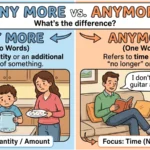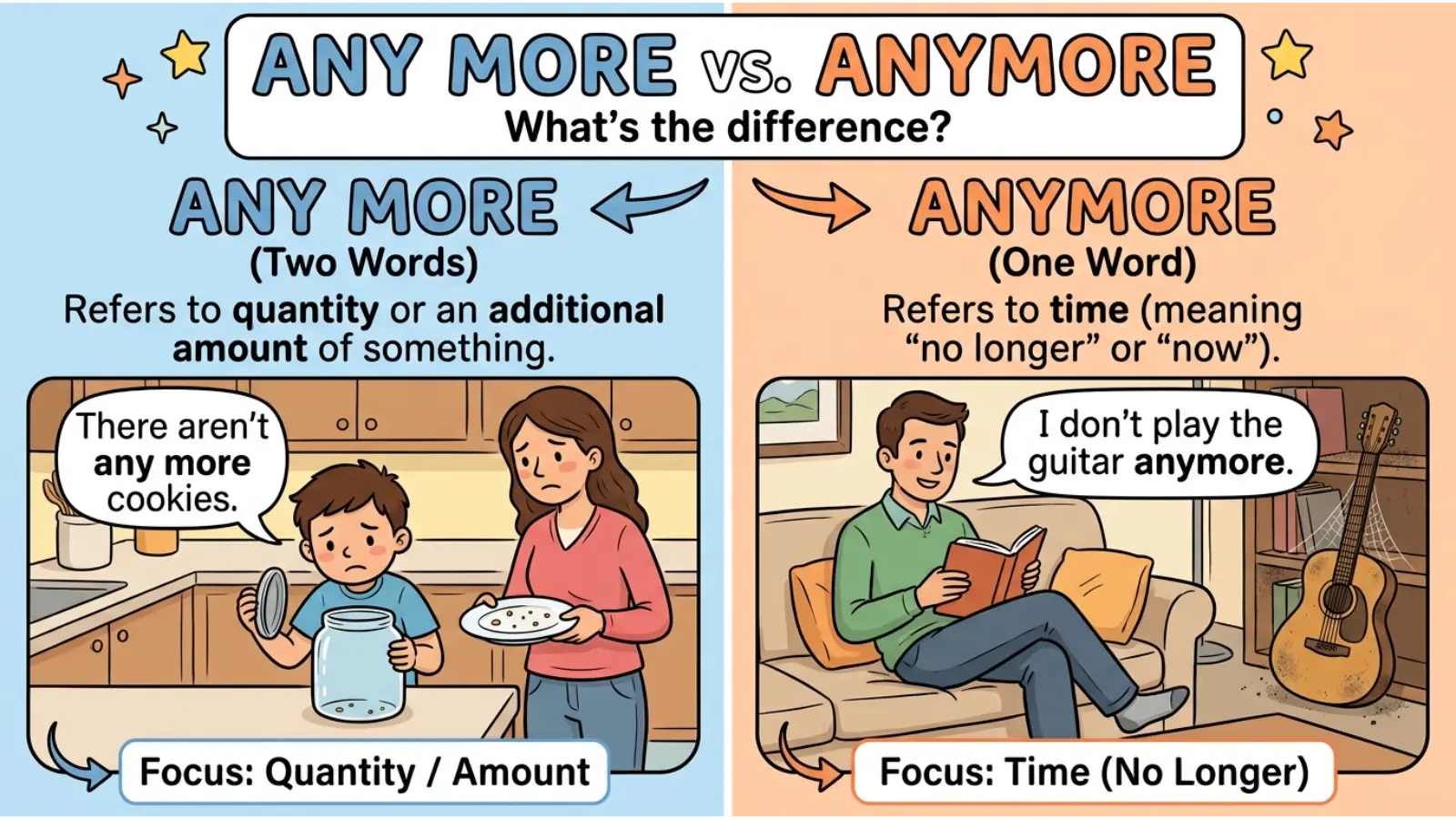
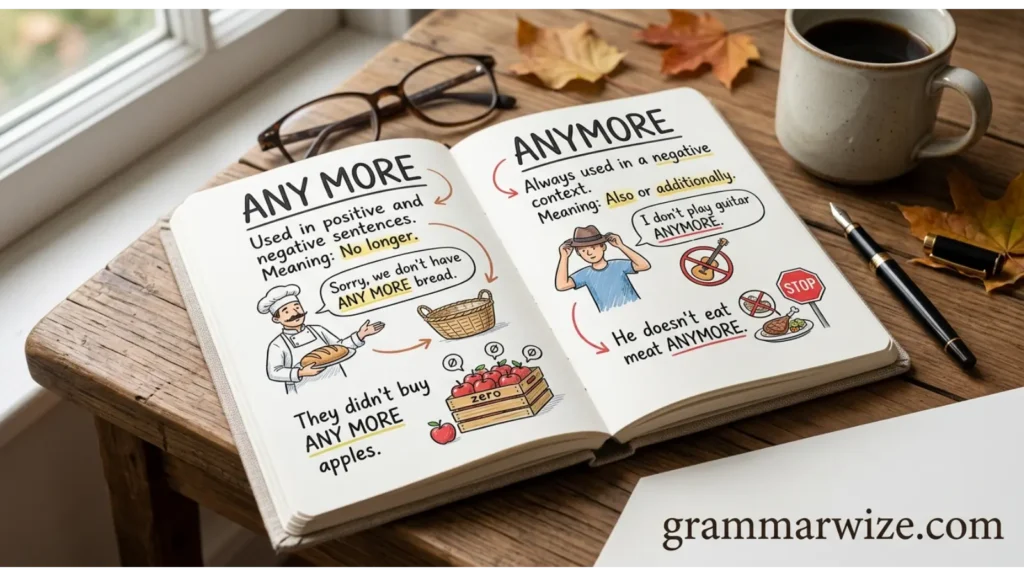
Any more or anymore can confuse English learners because both forms are correct, but they do not always mean the same thing. The difference depends on how you use them in a sentence. Any more usually refers to an additional amount or number. Anymore usually means no longer or now not.
For example, you might ask, “Do you want any more coffee?” Here, you are asking about an additional amount. However, you might say, “I do not work there anymore.” In this sentence, anymore means you no longer work there.
Understanding this small difference can improve your grammar, everyday conversations, and professional writing. This guide explains the rules in plain English, with sentence examples and practical tips to help you choose the correct form.
Quick Answer: Any More vs Anymore
- Any more: Use it when you mean an additional amount or number. Example: Do you need any more time?
- Anymore: Use it when you mean no longer or now not. Example: I do not live there anymore.
Remember that regional preferences can differ. American English commonly uses anymore as one word for the meaning “no longer.” British English has traditionally favored any more in this sense, although one-word anymore is also used.
What Does Any More Mean?
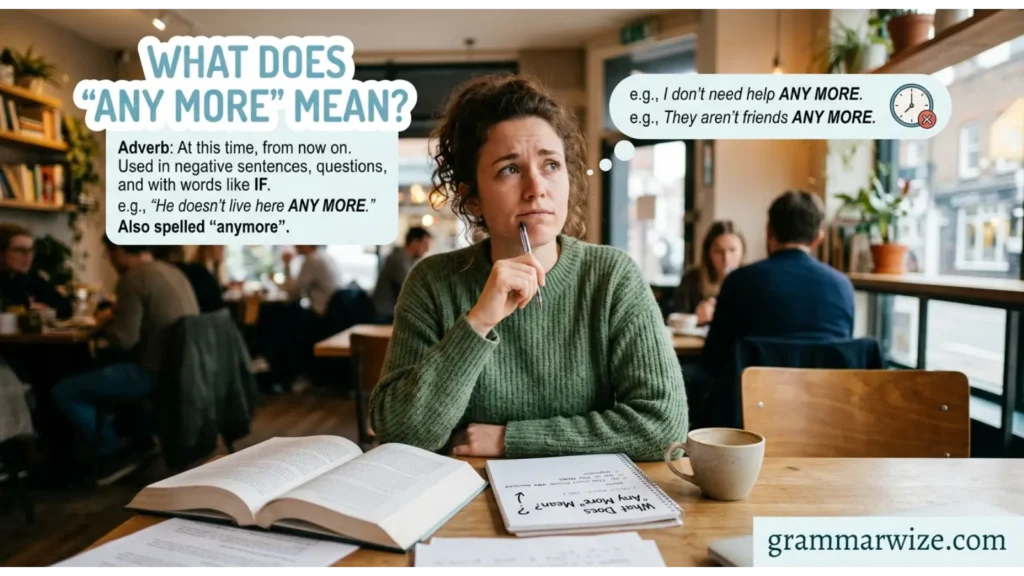
Any more is a two-word expression that usually refers to an additional amount, number, or quantity. It often appears in questions and negative sentences.
Use any more when you want to know if someone needs something extra or when you say that no additional amount is available.
Examples of any more
- Would you like any more tea?
- We do not have any more tickets.
- She needs any more information that becomes available. (This wording is awkward; see the corrected explanation below.)
- Do you have any more questions?
- I cannot eat any more food.
A more natural version of the third example is: “She needs any additional information that becomes available.” The phrase any more generally works best when the sentence clearly refers to an extra amount or number.
How to Use Any More in a Sentence
Any more often appears before a noun, such as time, money, food, questions, or information.
- We need any more time to finish the project. (Usually better as “We need more time to finish the project.”)
- Do you have any more money?
- They are not accepting any more applications.
- Is there any more milk in the fridge?
In everyday English, any more is especially common in questions and negative statements. In positive statements, more often sounds more natural unless the sentence has a specific grammatical reason for using any more.
What Does Anymore Mean?
Anymore is an adverb that usually means “no longer” or “from this time onward, not.” It describes a change in a situation, habit, or activity.
It often appears in negative sentences, especially in American English.
Examples of anymore
- I do not play tennis anymore.
- She does not work here anymore.
- We cannot afford that house anymore.
- He does not call me anymore.
- They rarely visit us anymore.
In each example, anymore shows that something that happened before does not happen now.
How to Use Anymore in a Sentence
Anymore commonly appears at the end of a negative sentence. This position makes the meaning easy to understand.
- I do not watch that show anymore.
- My brother does not live with us anymore.
- She is not interested in that job anymore.
- We do not use that software anymore.
In informal American English, you may also hear anymore in positive statements, as in “Anymore, people shop online.” This usage means “nowadays” or “these days.” It is regional and informal, so avoid it in formal writing unless your style guide permits it.
Any More vs Anymore: Key Differences
| Feature | Any more | Anymore |
|---|---|---|
| Word form | Two words | One word |
| Main meaning | An additional amount or number | No longer |
| Grammar role | Usually a determiner or quantity expression | Adverb |
| Common sentence | Do you need any more help? | I do not need help anymore. |
| American English | Common | Common for “no longer” |
| British English | Traditionally used for both meanings | Increasingly used for “no longer” |
| Main purpose | Refers to extra quantity | Shows that a situation has changed |
Why Are Any More and Anymore Confused?
The confusion exists because the expressions sound the same when spoken. Their meanings can also overlap in some sentence patterns.
For example, “I do not need any more” means that you do not need an additional amount. “I do not need it anymore” means that you no longer need it.
The first sentence focuses on quantity. The second focuses on a change over time.
Regional spelling habits add another layer of confusion. American dictionaries commonly recognize anymore as the standard one-word form for “no longer.” British usage has traditionally preferred any more for that meaning, although modern usage is not completely uniform.
Grammar Rules for Any More and Anymore
Use these simple rules to choose the right expression.
Rule 1: Use Any More for Extra Quantity
When you mean an additional amount or number, write any more as two words.
Correct: Do you need any more paper?
Incorrect for the intended meaning: Do you need anymore paper?
Rule 2: Use Anymore for No Longer in American English
When you describe something that has stopped happening, use anymore as one word in standard American English.
Correct: I do not drive that car anymore.
Traditionally British: I do not drive that car any more.
Both forms can be understood, but follow your chosen regional style consistently.
Rule 3: Check What the Sentence Means
Ask yourself whether the sentence refers to extra quantity or a change in a situation.
- Extra quantity: We do not have any more bread.
- No longer: We do not buy bread there anymore.
This quick check helps you select the correct form without memorizing complicated grammar terms.
Any More or Anymore in British and American English
The distinction is partly regional.
In American English, writers usually separate the expressions by meaning. They use any more for additional quantity and anymore for “no longer.”
In traditional British English, any more has often been used for both meanings. For example, a British writer might say, “I do not work there any more.”
However, one-word anymore also appears in British English, and usage varies by writer and publication. If you are writing for a specific audience, follow the dictionary and style guide used by that publication.
Common Mistakes to Avoid
Mistake 1: Writing Anymore for Additional Quantity
Incorrect: Would you like anymore coffee?
Correct: Would you like any more coffee?
The question asks if someone wants an additional amount of coffee.
Mistake 2: Mixing the Forms in American English
Less standard in American English: I do not live here any more.
Standard American form: I do not live here anymore.
The two-word version is still familiar and traditional in British English.
Mistake 3: Thinking Anymore Always Means Extra
Incorrect interpretation: “I do not go there anymore” means I do not want an additional visit.
Correct interpretation: It means I no longer go there.
Focus on the meaning of the whole sentence rather than the sound of the words.
Mistake 4: Assuming One Form Is Always Wrong
Both forms are correct. Their suitability depends on meaning, regional usage, and the writing style you follow.
Mistake 5: Using Any More When More Is Sufficient
Awkward: We need any more staff to complete the work.
Better: We need more staff to complete the work.
Any more is natural in many questions and negative statements, but positive statements often work better with more.
Easy Memory Trick
Use this simple reminder:
Any more = extra.
Example: Do you need any more money?
Anymore = no longer.
Example: I do not need that service anymore.
Think about what you want to express. If you mean something additional, choose any more. If you mean something has stopped or is no longer true, choose anymore in American English.
Any More vs Anymore in Real-Life Conversations
These examples show how both forms work naturally in everyday situations.
At a restaurant
Customer: Could I have any more water?
Waiter: Of course. I will bring you another glass.
Talking about a habit
Alex: Do you still play video games every night?
Sam: No, I do not play them that often anymore.
At work
Manager: Do you have any more questions about the project?
Employee: No, I understand everything now.
Talking about a former job
Mia: Does your brother still work at that store?
Noah: No, he does not work there anymore.
Shopping for groceries
Parent: Do we need any more eggs?
Child: No, we have enough for breakfast.
Professional Writing Recommendations
For professional writing, choose the form that matches your meaning and audience.
Use any more when discussing additional quantities, resources, questions, or supplies. Use anymore to express “no longer” in American English. If your audience follows British English conventions, check the publication’s preferred usage.
Consistency matters more than forcing one regional convention on every reader. In academic papers, business reports, and website content, choose a recognized style and apply it throughout the document.
When editing, also check the surrounding sentence. Sometimes more or any longer communicates the idea more clearly than either form.
Frequently Asked Questions
Is any more one word or two words?
Any more is two words when it refers to an additional amount or number. Anymore is one word when it means “no longer” in standard American English.
Is anymore grammatically correct?
Yes. Anymore is a recognized adverb, especially in American English. It commonly appears in negative sentences to show that a situation has changed.
Is any more correct in British English?
Yes. British English has traditionally used any more for both additional quantity and the meaning “no longer.” However, one-word anymore also appears in British usage.
Can I use any more and anymore in the same sentence?
Yes, if each form has a different function. For example, “I do not buy any more snacks because I do not eat them anymore.” The first refers to additional snacks, while the second means “no longer.”
What is another word for anymore?
No longer is a useful alternative in many sentences. For example, “I do not work there anymore” can become “I no longer work there.”
Conclusion
Any more and anymore are both correct, but their meanings usually differ. Use any more for an additional amount or number. Use anymore to mean “no longer” in standard American English, while remembering that British English traditionally favors any more for that meaning.
When you are unsure, check the sentence’s meaning and consider your audience. With this simple distinction, you can use both forms confidently in conversations, schoolwork, and professional writing.

Olivia Bennett is a grammar expert and language content writer at GrammarWize.com. She specializes in English grammar, word usage, spelling differences, and writing improvement. Through clear explanations and practical examples, Olivia helps students, professionals, and language learners communicate more effectively. Her goal is to make English grammar simple, accessible, and easy to apply in everyday writing.