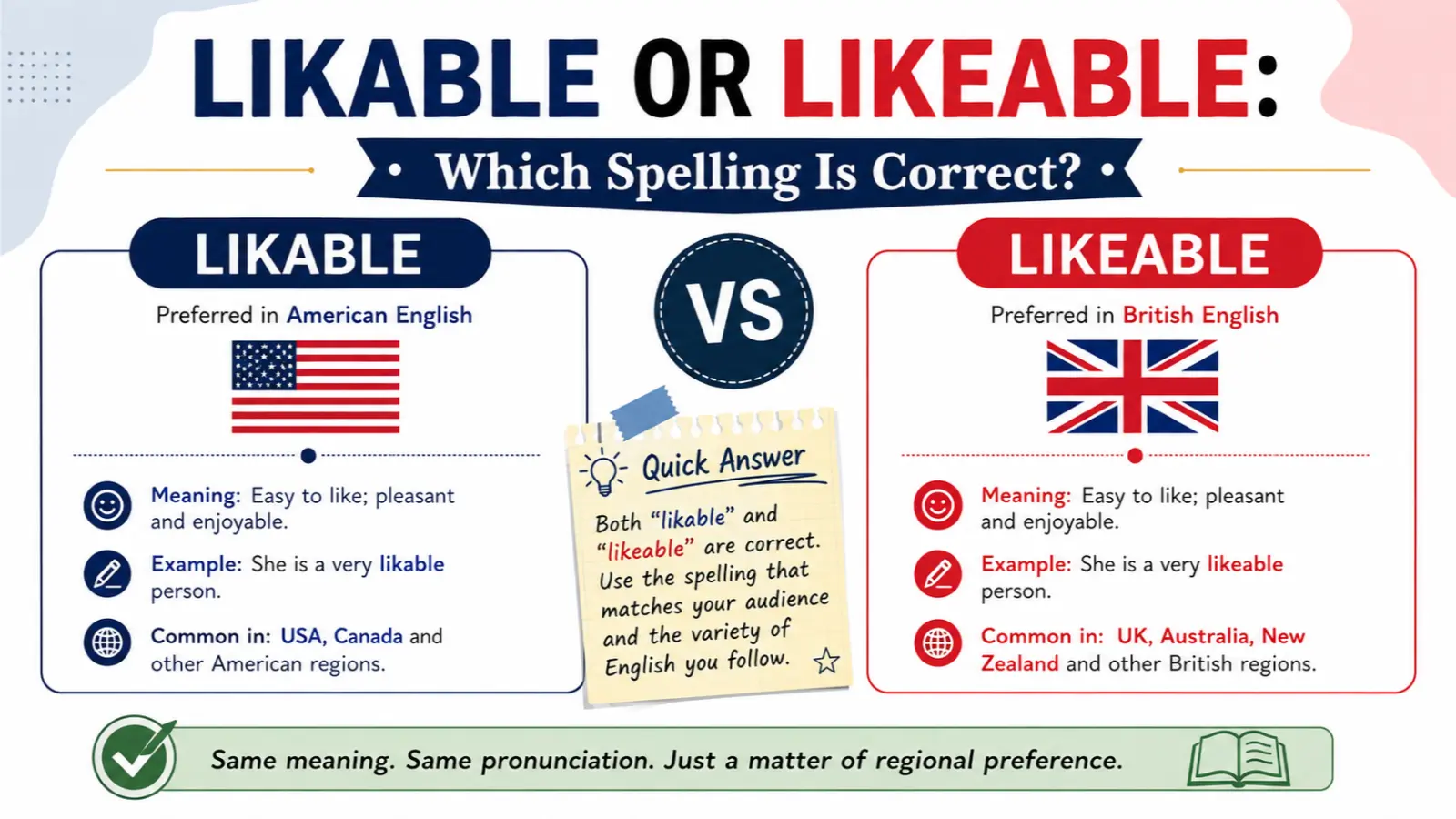
Likable or likeable often causes confusion because both spellings are correct. The difference mainly comes from regional English preferences, not meaning.
Likable or Likeable is a common spelling question in English. Both forms are correct, but likable is more common in American English, while likeable is widely used in British English. The difference comes from spelling preferences rather than meaning.
If you are unsure which spelling to use, this guide makes the choice simple. Learn the correct spelling, understand the regional difference, and see clear examples so you can use Likable or Likeable confidently in your writing.
If you are writing for a US audience, likable is usually the better choice. In British English, likeable is more common. Both words describe someone or something that is pleasant and easy to like.
Quick Answer
Both “likable” and “likeable” are correct.
- Likable is especially common in American English.
- Likeable is especially common in British English.
- Both have the same meaning.
- Neither spelling is a mistake.
- Use the spelling that matches your preferred variety of English.
Oxford lists likable as especially North American and likeable as especially British. (Oxford Learner’s Dictionaries)
What Does Likable Mean?
Likable is an adjective that describes a person or thing that is pleasant and easy to like.
For example:
She is a very likable teacher.
This means people enjoy her personality and find her pleasant.
The word can describe people, characters, personalities, animals, and even certain things or ideas.
Examples:
- He has a warm and likable personality.
- The main character is surprisingly likable.
- Our new neighbor seems very likable.
- The puppy has a friendly and likable nature.
Cambridge defines likable as something or someone that is easy to like.
What Does Likeable Mean?
Likeable has exactly the same basic meaning as likable.
It describes someone or something that people find pleasant, appealing, or easy to like.
Examples:
- She is a warm and likeable person.
- He has a very likeable personality.
- The character becomes more likeable as the story develops.
- Everyone found the new manager likeable.
Cambridge identifies likeable as the mainly British spelling of likable.
Likable vs Likeable Comparison
| Feature | Likable | Likeable |
|---|---|---|
| Word type | Adjective | Adjective |
| Meaning | Easy to like | Easy to like |
| American English | Preferred | Also understood |
| British English | Less common | Preferred |
| Correct spelling | Yes | Yes |
| Pronunciation | Same | Same |
| Meaning difference | None | None |
Why Are There Two Spellings?
The difference comes from spelling conventions used in different varieties of English.
Likeable keeps the e from the base word like before adding the suffix able.
American English often uses a shorter form and drops that e, producing likable.
This pattern is not unique to this word. English has many spelling differences between American and British usage.
Oxford lists likable as especially North American and likeable as especially British. (Oxford Learner’s Dictionaries)
Which Spelling Does the Dictionary Prefer?
Major dictionaries recognize both forms.
Cambridge Dictionary lists likable as the mainly US spelling and likeable as the mainly UK spelling. (Cambridge Dictionary)
Oxford Learner’s Dictionaries also recognizes both spellings. Oxford describes likable as especially North American and likeable as especially British.
So, there is no need to label either form incorrect.

Likable in American English
Likable is the natural choice for most American English writing.
For example:
- She is a very likable person.
- The actor plays a likable character.
- He has a friendly and likable personality.
- The product has a simple and likable design.
If your website, business, school, or publication follows American English, likable is a good consistent choice.
Likeable in British English
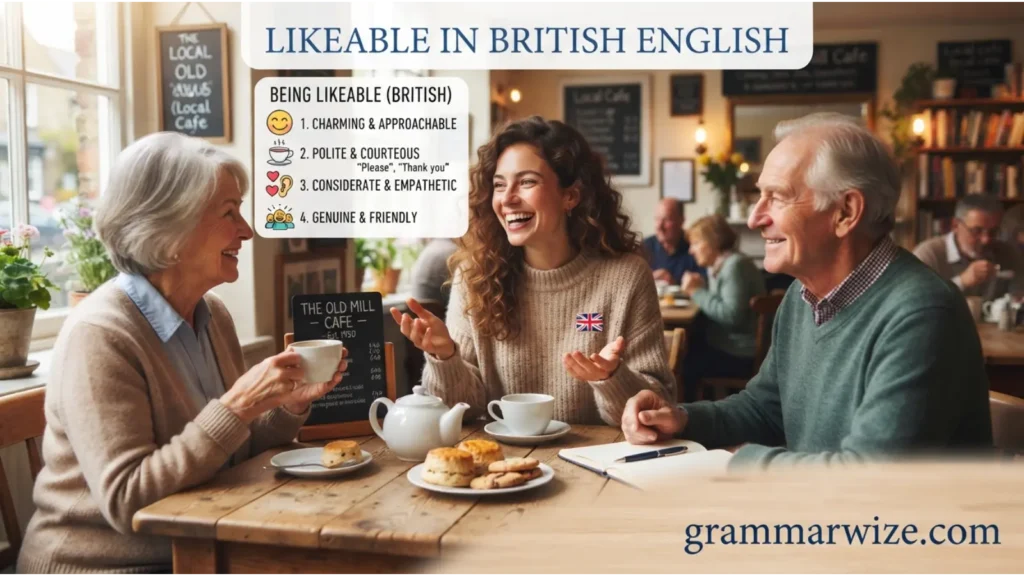
Likeable is commonly preferred in British English.
For example:
- She is a very likeable person.
- He is warm, friendly, and likeable.
- The character is charming and likeable.
- She has a naturally likeable personality.
Oxford specifically marks likeable as especially British English. (Oxford Learner’s Dictionaries)
Real Life Examples
Here are examples showing how both spellings work naturally.
Using Likable
- Mark is a very likable guy.
- The teacher has a calm and likable personality.
- The movie has a likable main character.
- Her friendly attitude makes her likable.
- The puppy is small, playful, and likable.
Using Likeable
- Mark is a very likeable person.
- The teacher has a calm and likeable personality.
- The movie has a likeable main character.
- Her friendly attitude makes her likeable.
- The puppy is small, playful, and likeable.
The meaning stays the same in each pair.
Common Mistake
A common mistake is assuming that one spelling must be wrong because it looks different.
That is not the case here.
Likable and likeable are both established dictionary spellings. The important point is regional consistency.
For example, an American publication may consistently use likable, while a British publication may consistently use likeable.
Easy Memory Trick
Use the location to remember the spelling.
US English → Likable
Think of American English as preferring the shorter form.
UK English → Likeable
Think of British English as keeping the e in likeable.
A simple reminder is:
American = likable
British = likeable
Professional Writing Recommendation
For professional writing, choose the form that matches your audience and style guide.
If you are writing for an American audience, use likable.
If you are writing for a British audience, use likeable.
For international content, either spelling is acceptable. However, keeping one spelling consistent throughout the same document makes your writing look more polished.
The key point is simple: do not treat “likeable” as a misspelling of “likable,” or vice versa.

Likable or Likeable in the USA
For a US audience, likable is generally the preferred spelling.
Cambridge labels likable as the mainly US spelling, while Oxford marks it as especially North American. (Cambridge Dictionary)
Best choice: Likable.
Example:
She is one of the most likable people on the team.
Likable or Likeable in the UK
For a British audience, likeable is generally the preferred spelling.
Cambridge describes likeable as the mainly UK spelling, and Oxford marks it as especially British English. (Cambridge Dictionary)
Best choice: Likeable.
Example:
She is one of the most likeable people on the team.
FAQs:
Is likable or likeable correct?
Both likable and likeable are correct. They have the same meaning and differ mainly by regional spelling preference.
Is likable American or British?
Likable is especially associated with American and North American English. (Cambridge Dictionary)
Is likeable British English?
Yes. Likeable is especially common in British English. (Cambridge Dictionary)
Does likable mean the same as likeable?
Yes. Both adjectives mean pleasant or easy to like.
Should I use likable for a US website?
Yes. Likable is generally the better choice for US English content.
Should I use likeable for a UK website?
Yes. Likeable is generally the preferred British spelling.
Is likeable wrong in American English?
No. American readers understand likeable, and dictionaries recognize it. Likable is simply the more typical US spelling.
Is likable wrong in British English?
No. Likable is understood in British English, but likeable is generally the more typical British form.
Conclusion
Likable and likeable are both correct spellings. They have the same meaning, pronunciation, and grammatical role. The main difference is regional usage.
Choose likable for American English and likeable for British English. If you remember that simple distinction, you can confidently use the right form for your audience. (Cambridge Dictionary)
Sources: Cambridge Dictionary and Oxford Learner’s Dictionaries recognize both forms and document their regional preferences. (Cambridge Dictionary)

Olivia Bennett is a grammar expert and language content writer at GrammarWize.com. She specializes in English grammar, word usage, spelling differences, and writing improvement. Through clear explanations and practical examples, Olivia helps students, professionals, and language learners communicate more effectively. Her goal is to make English grammar simple, accessible, and easy to apply in everyday writing.