Vail and veil are different words with different meanings. They sound alike in some varieties of English, but their uses are not interchangeable. Veil is the common word you will see in everyday English, while vail is rare and mostly appears in older or literary writing.
Vail or Veil can be confusing because both words sound similar, but they have different meanings and uses. Vail is mainly used as a proper name, such as the famous Colorado ski town, while veil refers to a covering that hides or partly covers something.
Knowing the difference between Vail or Veil can help you choose the correct word in writing. In this guide, you will learn their meanings, examples, and simple ways to remember which spelling fits your sentence.
Vail or Veil Meaning
Veil
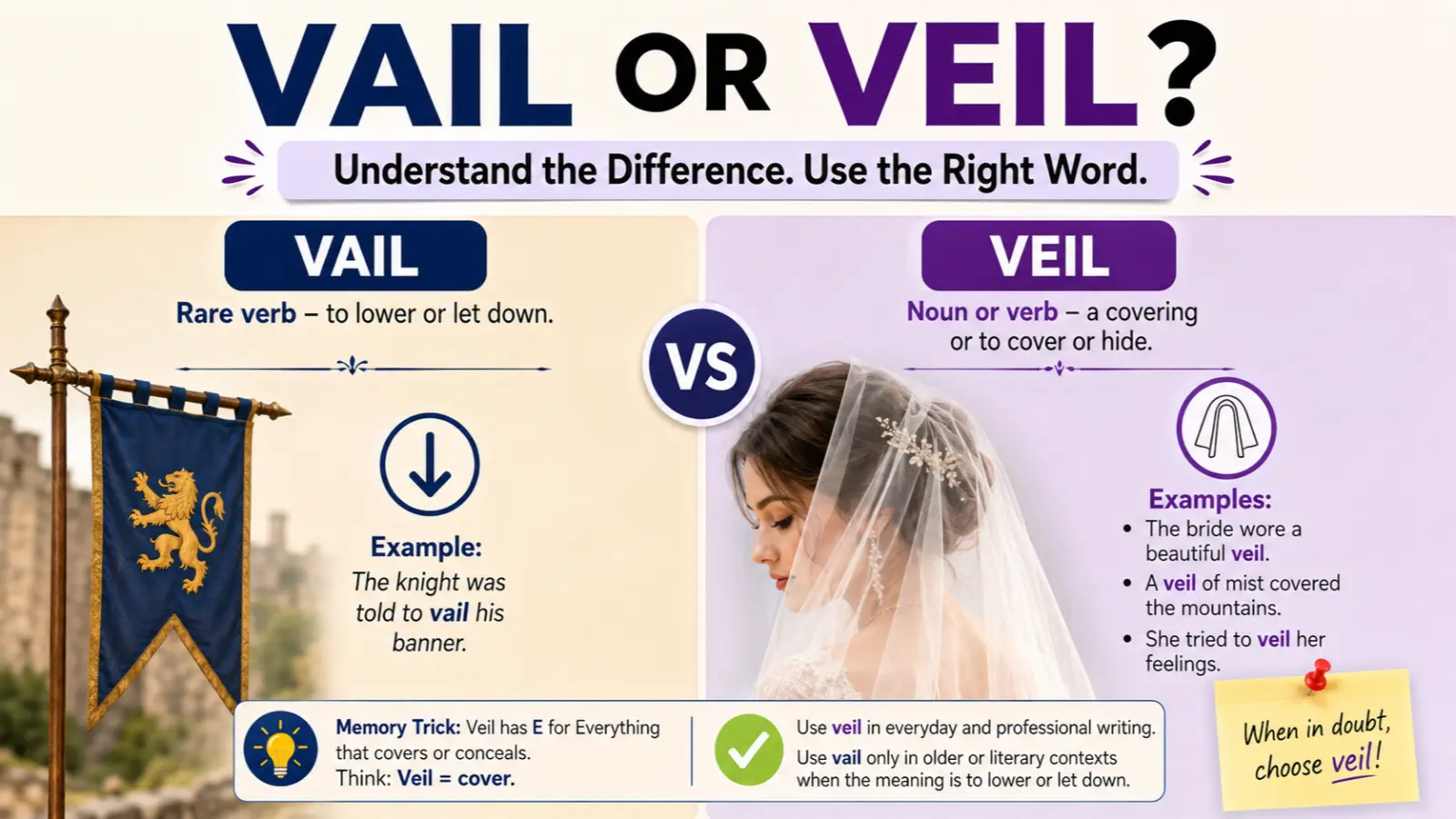
Veil is a noun or verb related to covering, hiding, or concealing something.
As a noun, a veil is a piece of cloth that covers part of a person’s face or head.
Examples:
- The bride wore a beautiful veil.
- A thin veil covered her face.
- The mountain was hidden behind a veil of mist.
As a verb, veil means to hide or partly cover something.
Example:
- Clouds veiled the mountain peaks.
Vail
Vail is a rare verb meaning to lower, drop, or let down. It is mainly found in older English or literary contexts.
Example:
- The knight was told to vail his banner.
In modern everyday English, vail is uncommon. Most readers are far more likely to encounter veil.
Vail vs Veil Grammar Rules
The two words have different grammatical roles and meanings.
| Word | Main use | Meaning |
|---|---|---|
| Veil | Noun and verb | A covering or to cover or hide |
| Vail | Rare verb | To lower, drop, or let down |
The word veil is useful in modern conversations, articles, stories, and professional writing.
The word vail is much less common and may appear in historical or literary contexts.

How to Use Veil in a Sentence
Use veil when talking about a physical covering or something that hides another thing.
Examples:
- She lifted her wedding veil.
- The fog formed a veil over the lake.
- The curtains veiled the room from view.
- A veil covered the statue.
- His smile seemed to veil his true feelings.
Simple rule: Think veil = cover or hide.
How to Use Vail in a Sentence
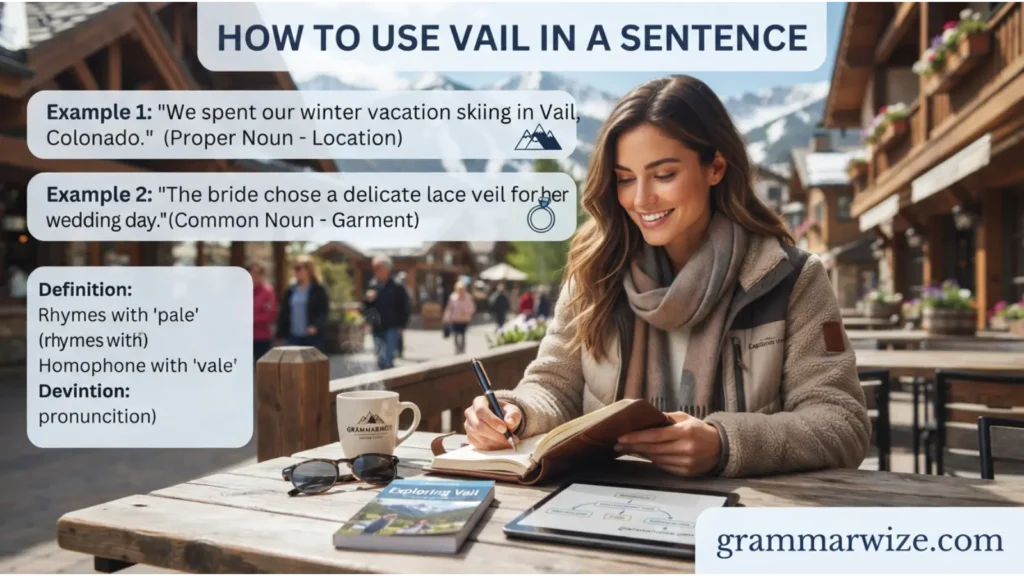
Use vail only when the intended meaning is to lower, drop, or let down something. Its use is rare in modern English.
Example:
- The soldiers were ordered to vail their banners.
Because vail is uncommon, replacing it with a more familiar word such as lower or drop can make modern writing clearer.
Vail or Veil in Professional Writing
Veil is the better choice for almost all modern professional writing when you mean a covering or concealment.
For example:
- The report revealed information that had been veiled from the public.
- The organization used a veil of secrecy around the project.
Vail should be used carefully because many modern readers may not recognize it.
In business emails, reports, educational content, and general articles, a clearer modern verb is usually preferable.
Common Mistakes With Vail and Veil
A common mistake is treating vail and veil as alternate spellings of the same word. They are not.
Incorrect idea:
- She wore a vail at the wedding.
Correct:
- She wore a veil at the wedding.
Another mistake is using vail simply because it looks like a possible spelling of veil.
Remember that veil is the standard modern word for a covering.
Easy Memory Trick
Use this simple trick:
Veil has E for Everything that covers or conceals.
Think:
Veil = cover.
You can also connect veil with common words such as:
- wedding veil
- face veil
- veil of mist
- veil of secrecy
The word vail is rare, so you are unlikely to need it in ordinary writing.

Vail or Veil in Real Life
Here are some natural examples using veil:
Conversation:
“Did you see the bride’s veil?”
“Yes. It looked beautiful.”
Writing:
“A veil of fog covered the valley.”
Professional context:
“The investigation removed the veil of secrecy surrounding the decision.”
By contrast, vail is mainly useful when reading older texts or writing in a deliberately historical or literary style.
Quick Comparison
Veil
- Common modern English word.
- Can be a noun.
- Can be a verb.
- Means a covering or concealment.
- Used in everyday and professional writing.
Vail
- Rare modern English word.
- Mainly used as a verb.
- Can mean to lower or let down.
- Often associated with older or literary language.
- Not normally used as a spelling variant of veil.
Frequently Asked Questions
Is vail or veil correct?
Both are real English words, but they have different meanings. Veil is the common modern word for a covering or something that conceals. Vail is a rare verb meaning to lower or let down.
Is vail another spelling of veil?
No. Vail and veil are separate words. They should not be treated as interchangeable spellings.
What does veil mean?
Veil means a covering that hides or partly covers something. It can also work as a verb meaning to hide or conceal.
What does vail mean?
Vail is a rare verb meaning to lower, drop, or let down. It is mainly encountered in older or literary language.
Which word is used for a wedding?
Use veil.
Example:
“The bride wore a white veil.”
Which spelling is more common?
Veil is far more common in modern English.
Final Answer
Veil is the correct choice for a covering, something that hides, or the act of concealing something. Vail is also a legitimate word, but it is rare and has a different meaning related to lowering or letting down.
For everyday, academic, business, and professional writing, veil will almost always be the word you need when describing a covering or concealment.

Olivia Bennett is a grammar expert and language content writer at GrammarWize.com. She specializes in English grammar, word usage, spelling differences, and writing improvement. Through clear explanations and practical examples, Olivia helps students, professionals, and language learners communicate more effectively. Her goal is to make English grammar simple, accessible, and easy to apply in everyday writing.