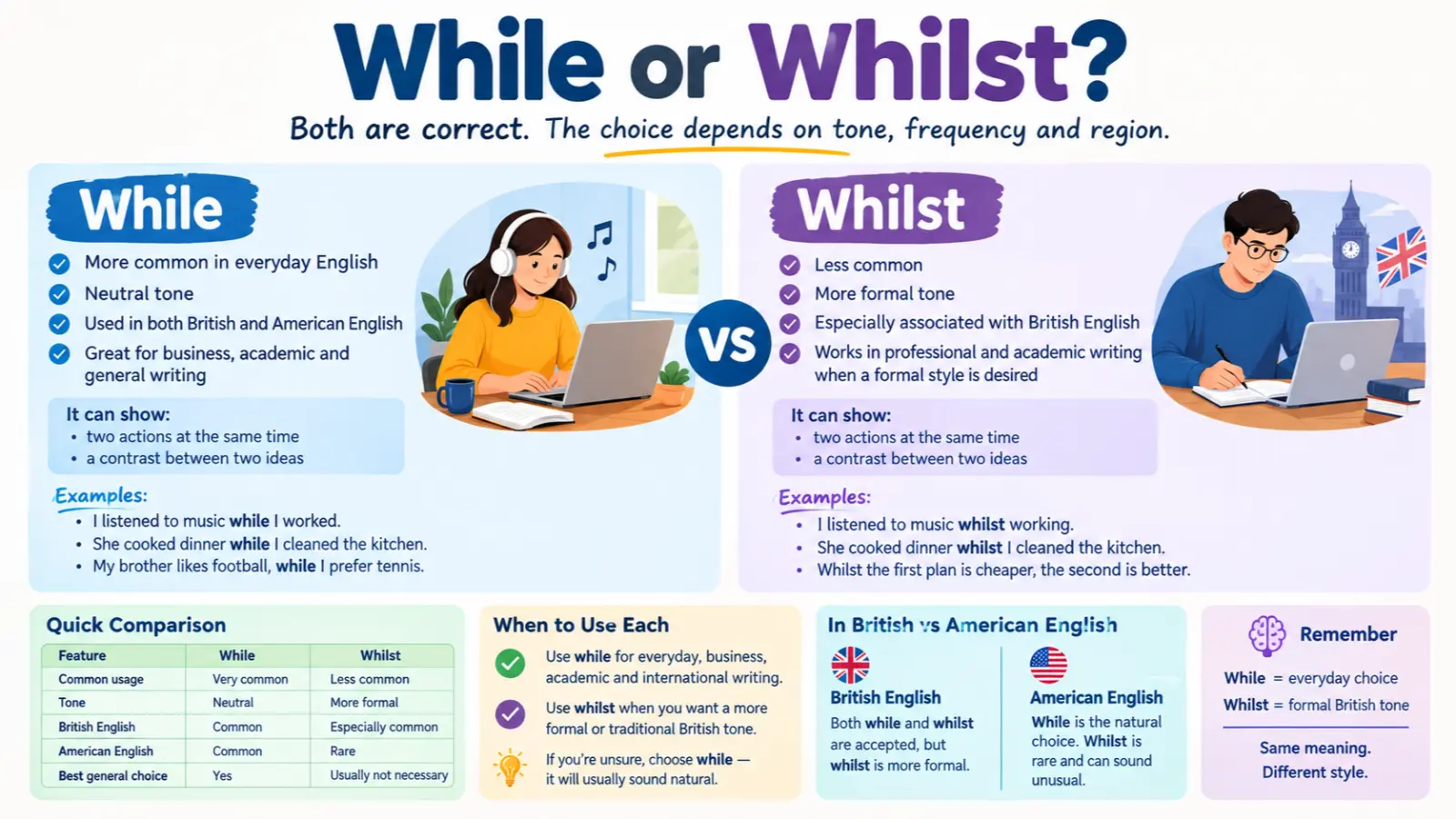
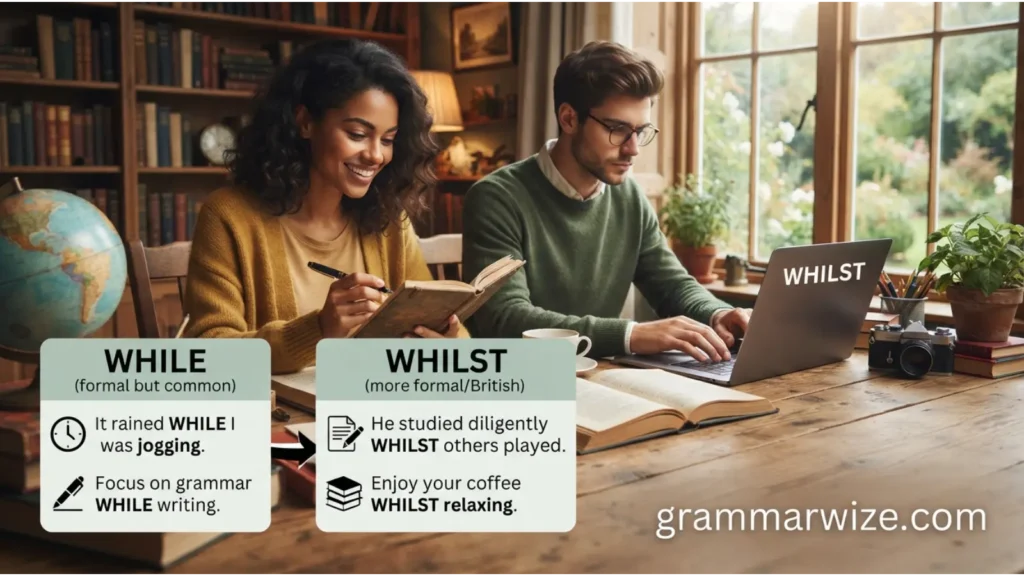
The words while or whilst often confuse English learners because they can appear in the same sentence and usually have the same meaning. The main difference is not correctness but frequency, tone, and regional preference. While is the natural choice in most everyday English, whereas whilst can give writing a more formal or traditional British tone.
While or Whilst is a common English usage question, especially when comparing modern American and British English. Both words can mean the same thing, but their style and regional use can differ.
While is far more common in everyday English, especially in American writing, while whilst is more traditional and formal in British English. Understanding while or whilst helps you choose the right word for emails, essays, websites, and professional writing.
In this guide, you will learn the key difference between while and whilst, with simple examples and practical tips for using each correctly.
Both words can introduce a clause that describes something happening at the same time. They can also introduce a contrast between two ideas. For example, you can say, “I listened to music while I worked” or “I listened to music whilst I worked.” The first sounds more natural for most readers, while the second sounds more formal.
Quick Answer
While is the better choice for most everyday, academic, business, and international writing.
Whilst is also correct, but it is more formal and is especially common in British English.
Example:
I read a book while I waited for the bus.
You can also write:
I read a book whilst I waited for the bus.
The meaning stays essentially the same.
What Does While Mean?
While is a conjunction used to connect two clauses. It commonly means during the time that or at the same time as.
For example:
She cooked dinner while I cleaned the kitchen.
Here, both actions happened at the same time.
While can also show contrast:
My brother likes football, while I prefer tennis.
In this sentence, while connects two different preferences. Cambridge lists both the time and contrast uses of while.
Examples of While
I listened to music while studying.
Please call me while you are at the store.
While she was working, her children were playing.
He likes coffee, while I prefer tea.
What Does Whilst Mean?
Whilst is a conjunction with essentially the same meanings as while when it introduces a clause.
It can describe two things happening at the same time:
She read the report whilst waiting for the meeting.
It can also show contrast:
Whilst he enjoys city life, his sister prefers the countryside.
Cambridge labels whilst as formal, while Oxford describes it as especially British and formal.
Examples of Whilst
I listened to music whilst working.
She called me whilst I was driving.
Whilst he was tired, he continued working.
Whilst the first plan is cheaper, the second is more practical.
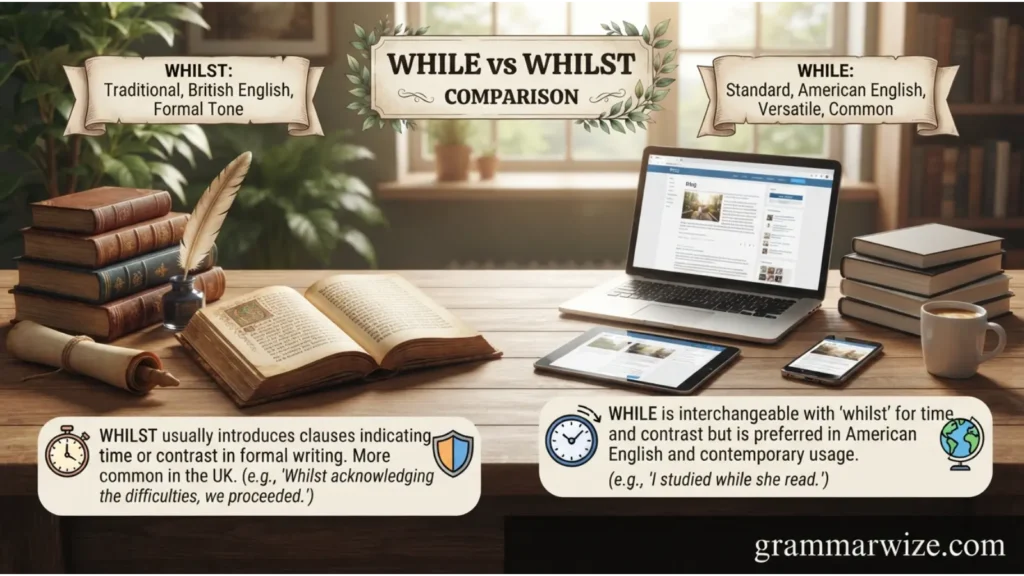
While vs Whilst Comparison
| Feature | While | Whilst |
|---|---|---|
| Correct English | Yes | Yes |
| Main meaning | During the time or contrast | During the time or contrast |
| Common in everyday English | Very common | Less common |
| Formal tone | Neutral | More formal |
| British English | Common | Especially associated with formal British English |
| American English | Common | Much less common |
| Business writing | Usually preferred | Can sound formal |
| Academic writing | Common | Possible but less common |
| Casual conversation | Natural | Can sound formal |
| Best general choice | Yes | Usually not necessary |
The key difference is usage rather than grammar. Cambridge specifically notes that while is much more common and whilst sounds more formal.
When Should You Use While?
Use while when you want your writing to sound natural, clear, and widely understood.
It works especially well in:
- Everyday conversations
- Emails
- Websites
- Business communication
- Academic writing
- General articles
- American English
- International English
Time Relationship
Use while when two activities happen during the same period.
I checked my email while eating breakfast.
She listened to a podcast while walking.
Cambridge grammar guidance confirms that while can connect actions or events happening at the same time.
Contrast
While can also introduce a difference between two situations.
Sarah likes summer, while David prefers winter.
The first option is cheap, while the second is faster.
This makes while useful for comparison writing.
When Should You Use Whilst?
Use whilst when you intentionally want a more formal or traditional tone.
It can work well in some British English contexts, particularly when the writer wants a formal style.
For example:
The company continued its operations whilst the investigation was underway.
However, this does not mean that whilst is required for formal writing. In many cases, while is clearer and more natural.
Oxford lists whilst as especially British and formal and gives both time and contrast uses.
Is Whilst British or American?
Whilst is strongly associated with British English, especially formal British English.
While is widely used in both British and American English.
Cambridge identifies whilst as a formal alternative to while, while Oxford describes it as especially British and formal.
This means you should not think of whilst as a completely different British word with a different meaning. It is largely a formal alternative to while.
British English
I listened to the radio whilst preparing dinner.
American English
I listened to the radio while preparing dinner.
The second version is generally more natural for an American audience.

Grammar Rules for While and Whilst
Both words can introduce a subordinate clause.
A common structure is:
While or whilst + subject + verb
While I was studying, my brother watched television.
Whilst I was studying, my brother watched television.
You can also put the while or whilst clause after the main clause.
My brother watched television while I was studying.
My brother watched television whilst I was studying.
When the introductory clause comes first, a comma is normally used before the main clause. Cambridge gives the same sentence-position guidance for while clauses.
While and Whilst for Contrast
Both words can introduce a contrast.
While John is quiet, his brother is very talkative.
Whilst John is quiet, his brother is very talkative.
The meaning is similar, but whilst gives the sentence a more formal feel.
For most modern writing, while is usually the simpler choice.
Common Mistakes
Treating Whilst as Incorrect
Incorrect idea: Whilst is wrong English.
Better understanding: Whilst is a correct English conjunction. It is simply less common and more formal than while.
Assuming While Is Only Informal
While is not limited to casual speech. It is standard English and works perfectly well in formal and professional writing.
While the results are encouraging, further research is needed.
There is no grammatical problem with this sentence.
Using During Before a Clause
A common mistake is replacing while with during before a full clause.
Incorrect:
During I was studying, my phone rang.
Correct:
While I was studying, my phone rang.
During normally works before a noun or noun phrase, while while can introduce a clause.
Choosing Whilst Just to Sound Intelligent
Using whilst does not automatically make writing better.
Compare:
Please contact us while the offer remains available.
Please contact us whilst the offer remains available.
Both can work, but the first is more direct and natural for most readers.
Which Is Better for Professional Writing?
For most professional writing, while is the safer choice.
It is concise, familiar, and accepted across major varieties of English. It also avoids making ordinary sentences sound unnecessarily formal.
Use whilst when it fits the established style of your publication, organization, or audience.
For example, a British legal or institutional document may use whilst naturally. However, an international website may benefit from the simpler while.
The goal should be clarity and consistency, not formality for its own sake.
While or Whilst in Academic Writing
Both forms can appear in academic writing, but while is usually the more straightforward choice.
For example:
While the study produced useful results, several limitations remained.
This sentence is clear and professional.
Using whilst is not automatically more academic:
Whilst the study produced useful results, several limitations remained.
The second version may sound more formal, but it does not communicate a more advanced idea.
While or Whilst in American English
For an American audience, while is generally the natural choice.
For example:
While the team prepared the report, the manager reviewed the data.
Whilst may be understood, but it can sound unusually formal or distinctly British.
If you are writing for a US website, business audience, or general readership, while is normally the better option.
While or Whilst in British English
Both forms are accepted in British English.
While is common and neutral.
Whilst has a more formal tone and is particularly associated with British English. Oxford specifically labels it especially British and formal.
Therefore, British writers can choose either based on tone and house style.
Real Life Examples
At Work
I will review the document while you prepare the presentation.
A formal British version could be:
I will review the document whilst you prepare the presentation.
At Home
I listened to music while I cleaned my room.
Using whilst here would sound more formal than necessary.
In an Article
While the product is affordable, its features are limited.
This is natural and clear.
In Formal British Writing
Whilst the proposal has advantages, several concerns remain.
This can work when a deliberately formal tone is appropriate.
In Conversation
Wait here while I get my keys.
While sounds natural and conversational.
Memory Trick
Think of while as the everyday choice.
Think of whilst as while with a more formal British tone.
A simple rule is:
Everyday and general writing → while
Formal British style → whilst can work
If you are unsure, choose while.
Which One Should You Use?
| Situation | Best choice |
|---|---|
| Everyday English | While |
| Casual conversation | While |
| American English | While |
| International English | While |
| Business writing | While |
| Academic writing | While |
| General websites | While |
| Formal British writing | While or whilst |
| Deliberately traditional British style | Whilst |
There is no need to avoid whilst completely. The important point is understanding its tone and audience.
Related Keywords
- while or whilst
- whilst or while
- while vs whilst
- is whilst correct
- is whilst a word
- whilst meaning
- while meaning
- while vs whilst British English
- whilst British or American
- difference between while and whilst
FAQs:
Is while or whilst correct?
Both are correct. While is much more common, while whilst is more formal and especially associated with British English.
Is whilst more formal than while?
Yes. Cambridge specifically describes whilst as formal and says that while is much more common.
Is whilst British English?
Whilst is especially associated with British English and is commonly described as formal British usage.
Can I use whilst in American English?
Yes, American readers can understand whilst, but it is much less common in American English. While is normally the more natural choice.
Should I use while in professional writing?
Yes. While is fully suitable for professional writing and is usually the clearer choice. Use whilst only when its formal tone fits your intended style.
Conclusion
While and whilst are both correct. They can express the same relationships between ideas, including time and contrast. The main difference is frequency and tone.
While is the best general choice because it is common, natural, and widely accepted in British, American, and international English. Whilst is a formal alternative that is especially associated with British English.
If you are unsure which word to use, choose while. It will usually sound natural without changing the meaning of your sentence.

Olivia Bennett is a grammar expert and language content writer at GrammarWize.com. She specializes in English grammar, word usage, spelling differences, and writing improvement. Through clear explanations and practical examples, Olivia helps students, professionals, and language learners communicate more effectively. Her goal is to make English grammar simple, accessible, and easy to apply in everyday writing.