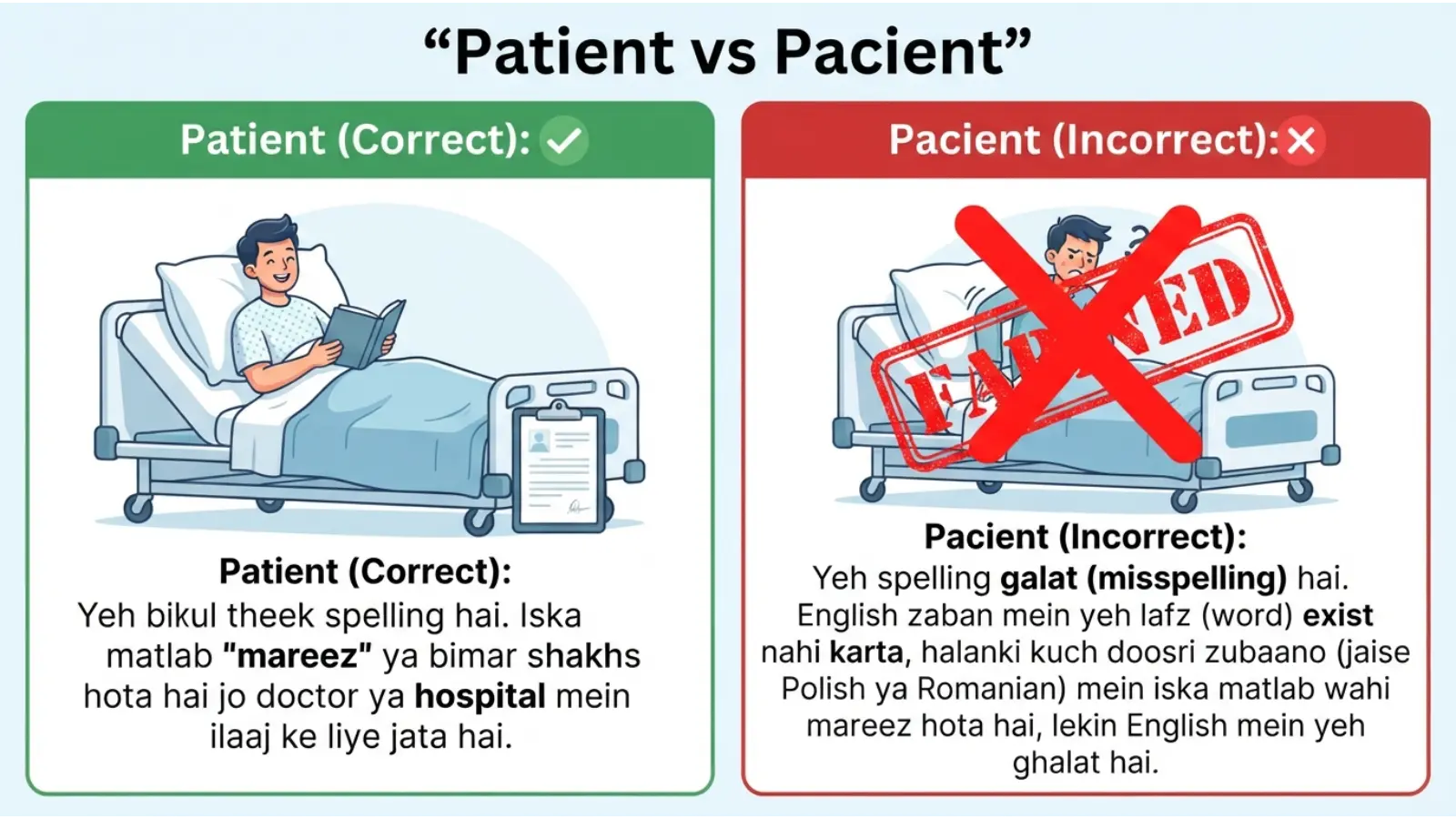
Patient or pacient is a common spelling question, especially when writing about medical care. The correct English spelling is patient. The spelling pacient is not the standard English form.
Patient or Pacient is a common spelling confusion, especially when writing about healthcare, waiting calmly, or someone receiving medical care. Patient is the correct and widely accepted spelling, while Pacient is a misspelling in standard English. This confusion often happens because the word can have different meanings depending on the context.
If you are searching for the correct spelling, Patient is the word you should use. It can describe someone receiving medical treatment or someone who remains calm while waiting. In this guide, we will explain the difference between Patient and Pacient, show clear examples, and help you remember the correct spelling.
The word patient has two common uses. It can describe someone receiving medical treatment, or someone who can wait calmly without becoming upset. Major English dictionaries, including Cambridge, list patient with both meanings.
Quick Answer
Patient is the correct English spelling.
Pacient is not the standard spelling in modern English.
Example:
The patient is waiting to see the doctor.

What Does Patient Mean?
Patient is both a noun and an adjective.
As a noun, patient means a person who receives medical care from a doctor, dentist, nurse, or other healthcare professional. Cambridge Dictionary gives this meaning for someone receiving medical care.
Examples:
- The patient arrived at the hospital early.
- The doctor spoke with the patient after the examination.
As an adjective, patient describes someone who can wait or deal with difficulties calmly.
Examples:
- Please be patient while we check your records.
- She is patient with young children.

What Does Pacient Mean?
Pacient is not the standard English spelling of the word.
If you are writing in English and mean a person receiving medical treatment, use patient.
The unusual spelling may appear because similar forms exist in other languages. For example, the related word appears as pacient in some languages, which can contribute to spelling confusion.
Patient vs Pacient
| Word | Correct in standard English? | Meaning | Example |
|---|---|---|---|
| Patient | Yes | Person receiving medical care | The patient needs further tests. |
| Patient | Yes | Able to wait calmly | Please be patient. |
| Pacient | No | Not the standard English spelling | Use patient instead. |
Where Does Patient Come From?
The word patient has a long history. The American Heritage Dictionary traces it through Middle English pacient, Old French, and Latin patiēns, from patī, meaning “to endure.”
This history helps explain why the spelling can seem unusual today. English adopted the word through earlier forms, while other languages developed related spellings of their own.
The modern English form is patient.

Why Do People Confuse Patient and Pacient?
The confusion often comes from pronunciation and language influence.
The first part of patient sounds like “pay.” This can make the spelling less obvious when someone hears the word rather than reads it.
There is also a second source of confusion. Related words in other languages can use spellings closer to pacient. This can influence multilingual writers and learners.
Another reason is that patient has two very different meanings. Someone can be a patient at a hospital, while another person can be described as patient because they remain calm.
Dictionary Recommendations
Leading English dictionaries recognize patient as the standard English spelling.
Cambridge Dictionary defines patient as a person receiving medical care and also as someone able to wait or tolerate difficulties without becoming annoyed.
The American Heritage Dictionary also lists patient as both a noun and adjective and traces its historical development from Latin through French and Middle English.
For standard English writing, patient is the form you should use.
When Should You Use Patient?
Use patient when referring to someone receiving medical treatment.
- The patient was admitted to the hospital.
- Every patient received a treatment plan.
- The nurse checked the patient’s temperature.
Use patient as an adjective when describing calm behavior.
- You need to be patient with the children.
- He remained patient during the long meeting.
- She was patient while waiting for an answer.
Real Life Examples
In a Hospital
The patient is recovering after surgery.
Here, patient means a person receiving medical care.
At a Doctor’s Office
The doctor asked the patient several questions.
The word refers to the person being examined or treated.
During a Long Wait
Please be patient while your application is reviewed.
Here, patient means calm and willing to wait.
In Education
A patient teacher can help struggling students learn.
In this sentence, patient describes someone who remains calm and understanding.
In Everyday Conversation
You will need to be patient because the repair may take several hours.
Here, patient means able to wait without becoming annoyed.
Common Mistakes
Using Pacient in English
Incorrect:
The pacient visited the doctor.
Correct:
The patient visited the doctor.
Adding Extra Letters
Some writers may accidentally create forms such as paitient or patitent.
The correct spelling is simply patient.
Confusing Patient With Patience
Patient describes a person or a medical-care recipient.
Patience is the ability to remain calm while waiting or dealing with difficulty. Cambridge defines patience as the ability to accept delay, suffering, or annoyance without complaining or becoming angry.
Examples:
She is patient.
She has great patience.
Using Pacient in Professional Writing
Medical documents, emails, reports, and academic writing should use patient.
Using pacient can make otherwise professional writing look like it contains a spelling error.
An Easy Memory Trick
Remember this:
A patient has “ti” in the middle.
Think of:
pa + ti + ent = patient
You can also connect patient with patience. Both words begin with pati.
If you are writing in English, remember:
Patient is the patient spelling.
Professional Writing Recommendation
Always use patient in professional English writing.
This applies to:
- Medical records
- Healthcare websites
- School assignments
- Business communication
- Academic papers
- Reports
- Emails
- Blog articles
If you see pacient in an English sentence, check whether it should be patient.
Frequently Asked Questions
Is patient or pacient correct?
Patient is the correct standard English spelling. Pacient is not the standard English form.
Is pacient a word in English?
Pacient is not the standard English spelling for a person receiving medical care. Use patient instead.
What is the plural of patient?
The plural is patients.
Example:
The hospital treated many patients.
What does patient mean?
As a noun, patient means someone receiving medical care. As an adjective, it describes someone who can wait or tolerate difficulties calmly. (Cambridge Dictionary)
What is the difference between patient and patience?
Patient can describe a person or refer to someone receiving medical care. Patience is the ability to remain calm while waiting or facing difficulty.
Final Verdict
Patient is the correct spelling in standard English.
Pacient should not be used when writing English. If you mean someone receiving medical treatment, write patient. If you mean someone who can wait calmly, patient is also the correct word.
The easiest way to remember it is pa + ti + ent = patient.
Conclusion
When comparing patient or pacient, the correct English spelling is patient. It can refer to someone receiving medical care or describe a person who stays calm while waiting or facing difficulty.
Pacient is not the standard English spelling. Although similar forms may appear in other languages, they should not be used in standard English writing.
For medical, academic, professional, and everyday English, always choose patient. Remember the spelling with the simple pattern pa + ti + ent = patient.

Olivia Bennett is a grammar expert and language content writer at GrammarWize.com. She specializes in English grammar, word usage, spelling differences, and writing improvement. Through clear explanations and practical examples, Olivia helps students, professionals, and language learners communicate more effectively. Her goal is to make English grammar simple, accessible, and easy to apply in everyday writing.