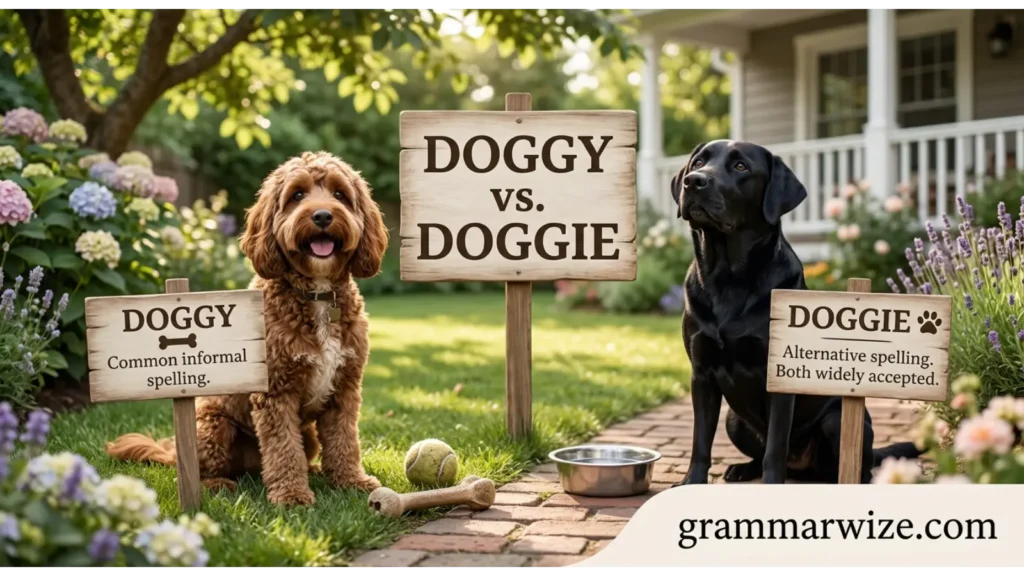
Doggy or doggie are both correct spellings for an informal word meaning a dog, especially in language used with children. The two forms are pronounced similarly and usually have the same meaning. Cambridge lists doggy as a child’s word for a dog and specifically notes doggie as another form.
Doggy or Doggie is a common spelling confusion when people talk about a cute or beloved dog. Both forms appear in English, but doggy is generally the more common spelling in modern writing. Doggie is also correct and often gives the word a more playful or affectionate tone.
This spelling question is trending because people use these terms in social media posts, pet blogs, messages, and everyday conversations. If you are unsure which spelling to choose, this guide explains the difference between doggy and doggie, how each form is used, and which spelling is more suitable for different types of writing.
The main difference is spelling preference rather than meaning. Doggy is the form commonly presented as the main dictionary entry, while doggie is also an established variant. Oxford likewise lists doggy and notes doggie as an alternative spelling.
Quick Answer
Doggy and doggie are both correct. They can both mean a dog in informal or child directed speech.
For general writing, doggy is a straightforward choice because major dictionaries use it as the main entry. Doggie is also acceptable when it fits the tone or style of your writing.
Example:
The little girl called every dog a doggy.
What Does Doggy Mean?
Doggy is an informal noun meaning a dog. It is especially associated with the way children talk about dogs. Cambridge defines it as a child’s word for a dog.
Doggy can also work as an adjective meaning related to or characteristic of a dog. Oxford gives doggy smell as an example of this adjective use.
- The child wanted to pet the friendly doggy.
- That doggy smell is coming from the wet blanket.
What Does Doggie Mean?
Doggie is another spelling of the informal word doggy. Cambridge defines doggie as a child’s word for a dog.
It often appears in friendly, playful, or child focused contexts.
Examples:
- The baby pointed at the doggie.
- She bought some doggie treats for her puppy.
Doggy vs Doggie Comparison
| Feature | Doggy | Doggie |
|---|---|---|
| Correct spelling | Yes | Yes |
| Meaning | A dog, especially in child speech | A dog, especially in child speech |
| Usage | Informal | Informal |
| Pronunciation | Similar | Similar |
| Dictionary status | Main dictionary entry | Established variant |
| Formal writing | Usually avoided | Usually avoided |
| Common context | Children and casual speech | Children and casual speech |
Oxford lists doggy as an informal noun and gives doggie as an alternative.
Why Are Doggy and Doggie Both Used?
The two spellings represent the same basic sound and meaning. The difference comes from how English speakers represent that sound in writing.
Words used with children often develop spelling variants because writers try to reflect friendly or playful pronunciation. That helps explain why both doggy and doggie have remained in use.
The spelling with ie can look especially child friendly. The spelling with y is shorter and is used as the main entry by major learner dictionaries.

Doggy or Doggie for Different Situations
Talking to Children
Both forms work naturally.
Look at that cute doggy!
You could also write:
Look at that cute doggie!
The choice is mainly stylistic.
Casual Writing
Both can appear in friendly messages, social posts, and informal writing.
Doggy may look slightly more straightforward:
My doggy loves going to the park.
Doggie can give the sentence a more playful tone:
The doggie wants another treat.
Professional Writing
Neither spelling is normally suitable when a neutral term such as dog will do.
Instead of:
The doggy was examined by the veterinarian.
Professional writing would usually say:
The dog was examined by the veterinarian.
This keeps the tone precise and neutral.
Doggy and Doggie in Common Expressions
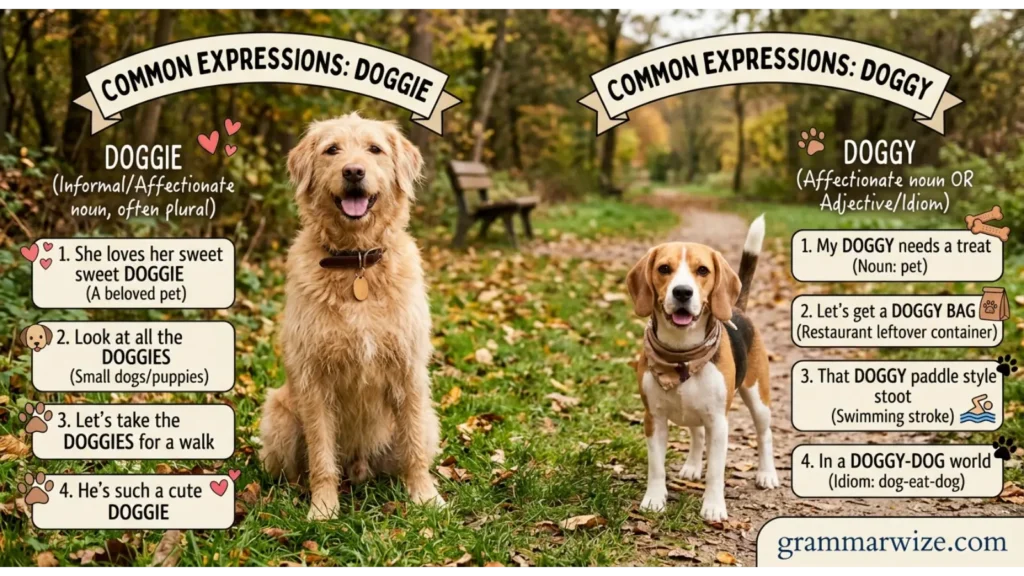
The spelling doggy appears in several familiar expressions.
For example, doggy bag refers to a container used for taking leftover restaurant food home. Cambridge includes examples of this expression and also notes doggie bag as a variant.
Oxford also specifically lists bag among the nouns commonly used after doggy.
Other examples include:
- doggy bag
- doggy paddle
- doggy day care
- doggie treats
- doggie toys
This shows that both spellings remain useful in modern informal English.
Common Mistakes
Treating Doggie as Incorrect
Some writers assume doggie is a misspelling of doggy. It is not. Major dictionaries recognize doggie as an established form.
Using Doggy in Formal Documents
Doggy is informal. In reports, academic writing, and professional documents, dog is usually more appropriate.
Assuming They Have Different Meanings
In their common noun use, doggy and doggie refer to the same thing. The spelling does not normally change the meaning.
Assuming One Is Only British
The distinction is not simply a British versus American spelling difference. Both forms are recognized in English dictionaries, although individual expressions may show different preferences.
Memory Trick
Remember it this way:
Doggy has a Y. Doggie has IE. Both can mean a dog.
If you need a simple general spelling, choose doggy. If you want a playful or child friendly style, doggie also works.
Dictionary Recommendations
Major dictionaries support both forms.
Cambridge Dictionary lists doggy as a child’s word for a dog and identifies doggie as another form. Its separate entry also defines doggie as a child’s word for a dog.
Oxford Learner’s Dictionaries lists doggy as an informal noun and gives doggie as an alternative. It also lists doggy as an adjective meaning of or like a dog.
These dictionary entries confirm that neither spelling should automatically be treated as wrong.
Real Life Examples
Talking About a Pet
My daughter calls our puppy her little doggy.
Speaking With a Child
The child smiled when the doggie came over.
Describing a Smell
The wet blanket has a doggy smell.
Ordering Food
We asked the restaurant for a doggy bag.
Talking About Pet Supplies
The store sells doggie toys and treats.
Professional Writing Recommendation
Use dog in formal and professional writing unless doggy or doggie is part of a specific name, expression, quotation, or intentionally informal wording.
For casual writing, both doggy and doggie are acceptable. If you want the simplest dictionary based choice, doggy is a strong default because major dictionaries use it as the primary entry.
Frequently Asked Questions
Is doggy a correct spelling?
Yes. Doggy is a correct English word. Cambridge and Oxford both list it as an informal word associated with a dog.
Is doggie a correct spelling?
Yes. Doggie is also correct. Cambridge defines it as a child’s word for a dog.
Is doggy or doggie more common?
Both are established forms. Doggy is presented as the main dictionary entry by Cambridge and Oxford, while doggie is listed as an alternative or separate variant.
Are doggy and doggie pronounced the same?
They are generally pronounced very similarly, and their common noun meanings are the same.
Should I use doggy or doggie in formal writing?
For formal writing, dog is usually the better choice. Doggy and doggie are informal expressions.
Conclusion
Doggy and doggie are both correct. They are informal forms used mainly for a dog, especially in child directed or playful language. Major dictionaries recognize both spellings.
Use doggy as a simple general choice. Use doggie when the playful spelling suits your tone. For formal writing, simply use dog.