
If you are confused about stationary or stationery, you are not alone. These words sound almost identical, but they have different meanings and grammatical roles. One describes something that does not move, while the other refers to writing materials such as paper, pens, and envelopes.
Stationary or Stationery is a common English spelling confusion that can change the meaning of your sentence. These words sound almost the same, but they have completely different meanings. Stationary describes something that is not moving, while stationery refers to writing materials such as paper, envelopes, and pens.
This confusion often appears in emails, school assignments, office documents, and online writing. Knowing the difference between stationary and stationery can help you avoid simple spelling mistakes and make your writing clearer. In this guide, you will learn their meanings, correct usage, examples, and an easy memory trick to remember the difference.
The difference becomes easy once you connect each spelling with its meaning. Stationary describes something that stays still or does not change. Stationery is a noun for writing and office materials. Learning this simple distinction can help you avoid mistakes in emails, schoolwork, business writing, and everyday communication.
Quick Answer
Stationary is correct when you mean not moving or not changing.
Stationery is correct when you mean writing materials, such as paper, envelopes, pens, and pencils.
Examples:
- The car remained stationary at the traffic light.
- I bought new stationery for my office.
Both spellings are correct. The correct choice depends entirely on what you mean.
Stationary Meaning
Stationary is an adjective. It means not moving, not intended to move, or not changing.
Cambridge defines stationary as something that is not moving or not changing. Oxford also gives the meanings of not moving and remaining unchanged.
Examples of stationary
- The train remained stationary for several minutes.
- The cyclist stood stationary near the road.
- The machine must remain stationary during the test.
- The population has remained stationary for several years.
You can also use stationary for things that stay in one position.
Example:
The company installed a stationary exercise bike in the gym.
Stationery Meaning
Stationery is a noun. It refers to materials used for writing or office work.
These materials can include paper, envelopes, pens, pencils, and other writing supplies. Oxford and Cambridge both define stationery in this sense.
Examples of stationery
- I need to buy some new stationery.
- The office ordered stationery for its employees.
- She keeps her stationery in a desk drawer.
- The school provided basic stationery to the students.
Stationery can also mean special paper used for letters, often with matching envelopes.
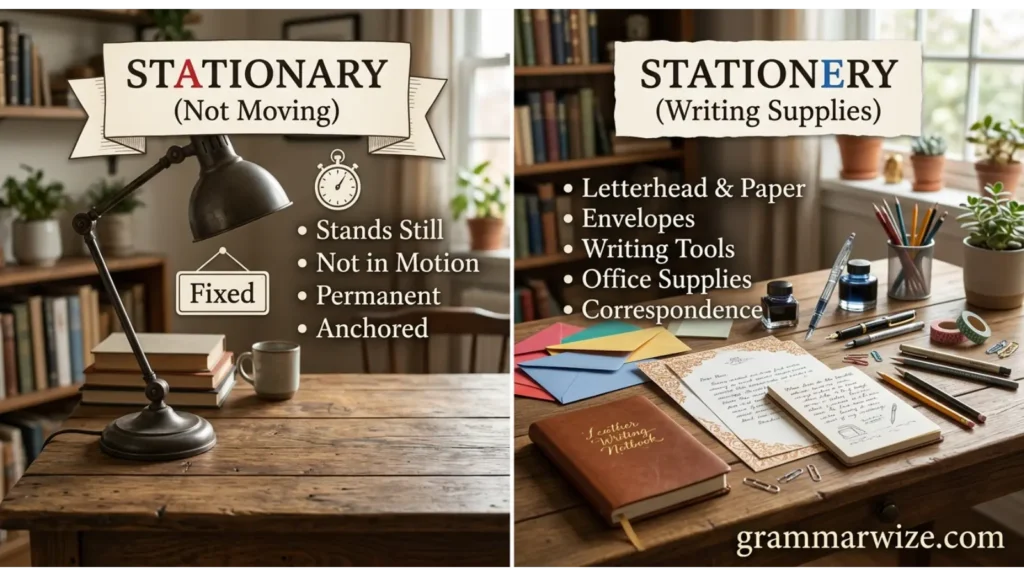
Stationary vs Stationery Comparison
| Word | Part of Speech | Meaning | Example |
|---|---|---|---|
| Stationary | Adjective | Not moving or not changing | The car was stationary. |
| Stationery | Noun | Writing and office materials | I bought new stationery. |
The easiest distinction is simple:
Stationary = still or unchanged
Stationery = writing materials
Why Are Stationary and Stationery Confused?
The main reason is pronunciation. In many varieties of English, stationary and stationery are pronounced alike or very similarly. Oxford lists them as homophones.
Their spellings are also nearly identical. Both begin with station, and only one letter changes near the end.
That small spelling difference creates many errors.
For example, someone might write:
Please bring writing stationary.
The intended word is:
Please bring writing stationery.
The first sentence suggests something related to being still. The second correctly refers to writing supplies.

The Origin of Stationary
Stationary comes from the Latin word stationarius, which was related to a station or a fixed position. Oxford traces the word to Latin stationarius, from statio, meaning standing or a position, and ultimately to stare, meaning to stand.
The word developed in English with the sense of something that does not move. Its meaning later expanded to include something that remains unchanged.
This history explains why stationary is connected with the idea of staying in one place.

The Origin of Stationery
Stationery has a different development, although the two words are historically related.
The word came from stationer, a term for a person who sold books and paper. Oxford traces stationer to Middle English and Medieval Latin, referring to a tradesman working from a fixed location.
The noun stationery later developed for writing materials and related goods. The Online Etymology Dictionary dates the writing-material sense to 1727 and traces it to stationery wares, meaning articles sold by a stationer.
So, although the two words look almost the same, their modern meanings developed along different paths.
When to Use Stationary
Use stationary when you are describing something that is:
- Not moving.
- Staying in one position.
- Not changing.
- Remaining at a fixed point.
Everyday examples
Traffic
The traffic became stationary during the rush hour.
Vehicles
The driver kept the vehicle stationary while waiting.
Objects
The camera remained stationary during the recording.
Conditions
The temperature remained relatively stationary throughout the test.
Exercise equipment
He used a stationary bike at the gym.
When to Use Stationery
Use stationery when you are talking about writing or office materials.
Everyday examples
School
The teacher asked students to bring their own stationery.
Office
The company ordered new stationery for the staff.
Letters
She chose elegant stationery for her personal letters.
Writing supplies
The shop sells notebooks, envelopes, and other stationery.
Business
The company printed its logo on official stationery.
Common Mistakes
Mistake 1: Using stationary for writing supplies
Incorrect:
I bought some new stationary for school.
Correct:
I bought some new stationery for school.
Writing supplies are stationery.
Mistake 2: Using stationery for something that does not move
Incorrect:
The car was stationery at the intersection.
Correct:
The car was stationary at the intersection.
A car that does not move is stationary.
Mistake 3: Confusing stationery with a stationery store
A stationery store sells writing materials.
For example:
I visited the stationery store to buy notebooks and envelopes.
Mistake 4: Using stationery as an adjective for stillness
Stationery is normally a noun referring to writing materials. It should not replace stationary when describing something that remains still.
Correct:
The equipment remained stationary.
Not:
The equipment remained stationery.
A Simple Memory Trick
Use the E in stationery to remember envelope.
Stationery = E for envelope
Use the A in stationary to remember something that stays in a fixed area.
Stationary = A for area
So remember:
Stationary = stays still
Stationery = writing supplies
Another useful sentence is:
The stationery stayed stationary on the desk.
The stationery means the writing materials. Stationary means they did not move.
Dictionary Recommendations
Major English dictionaries recognize both stationary and stationery as correct words with different meanings.
Oxford Learner’s Dictionaries defines stationary as an adjective meaning not moving or not changing. It defines stationery as writing and office materials.
Cambridge Dictionary defines stationary as not moving or not changing and stationery as things needed for writing, including paper, pens, pencils, and envelopes.
These dictionary definitions confirm that neither spelling is simply a wrong version of the other. They are separate words with separate meanings.
Stationary or Stationery in Professional Writing
Choosing the correct word matters in professional communication because the two words can change the meaning of a sentence completely.
Use stationary for movement, position, or change.
Use stationery for paper, envelopes, pens, and other writing materials.
For example:
Correct:
Please keep the equipment stationary during the inspection.
Correct:
Please order additional office stationery before the meeting.
A quick meaning check can prevent the mistake. If you can replace the word with still, use stationary. If you can replace it with writing materials, use stationery.
Real Life Examples
At the Office
The manager ordered new stationery with the company logo.
At School
Students brought notebooks and other stationery to class.
On the Road
The bus remained stationary because of heavy traffic.
At the Gym
She spent twenty minutes on a stationary bicycle.
In Business Writing
The company uses professional stationery for official correspondence.
Are Stationary and Stationery Homophones?
Yes. Stationary and stationery are commonly treated as homophones because they have the same or nearly the same pronunciation while having different meanings and spellings. Oxford specifically identifies them as homophones.
Their meanings, however, are completely different.
Stationary relates to staying still.
Stationery relates to writing materials.
Is Stationery Always About Paper?
Not necessarily. Stationery can refer more broadly to writing materials and office materials.
For example, dictionaries include items such as paper, pens, pencils, and envelopes within the meaning of stationery.
However, stationery is also commonly used for special writing paper, particularly paper designed for letters and paired with matching envelopes.
Is Stationary Only Used for Vehicles?
No. Stationary can describe many things that do not move.
You can describe a person, vehicle, machine, object, population, or condition as stationary when the meaning fits.
Examples include:
- A stationary vehicle.
- A stationary machine.
- A stationary person.
- A stationary population.
- A stationary object.
Cambridge also recognizes the sense of something remaining unchanged, not only something physically still.
Final Verdict
Stationary and stationery are both correct spellings, but they are not interchangeable.
Use stationary when something is not moving or not changing.
Use stationery when you mean writing or office materials.
The easiest memory trick is:
Stationary = still
Stationery = envelopes and writing supplies
Once you connect the E in stationery with envelope, this commonly confused pair becomes much easier to remember.
Frequently Asked Questions
Is stationary or stationery correct?
Both are correct. Stationary means not moving or not changing, while stationery means writing and office materials.
What is the difference between stationary and stationery?
The difference is meaning and grammatical role. Stationary is an adjective describing something that stays still. Stationery is a noun for writing materials.
Is stationery the same as writing materials?
Yes. Stationery commonly refers to materials used for writing, such as paper, pens, pencils, and envelopes.
How can I remember stationery vs stationary?
Remember E for envelope in stationery. Remember A for area in stationary, because something stationary stays in one place.
Are stationary and stationery pronounced the same?
They are commonly pronounced the same or very similarly, which is one reason they are frequently confused. Oxford lists them as homophones.
Conclusion
The choice between stationary or stationery depends on what you want to say. Stationary describes something that remains still or unchanged. Stationery refers to writing materials such as paper, envelopes, pens, and pencils.
Both words have legitimate histories and dictionary entries. The spelling difference is small, but the meanings are clear once you learn the distinction. For professional writing, check the meaning before choosing the spelling. If something stays still, choose stationary. If you are talking about writing supplies, choose stationery.

Olivia Bennett is a grammar expert and language content writer at GrammarWize.com. She specializes in English grammar, word usage, spelling differences, and writing improvement. Through clear explanations and practical examples, Olivia helps students, professionals, and language learners communicate more effectively. Her goal is to make English grammar simple, accessible, and easy to apply in everyday writing.