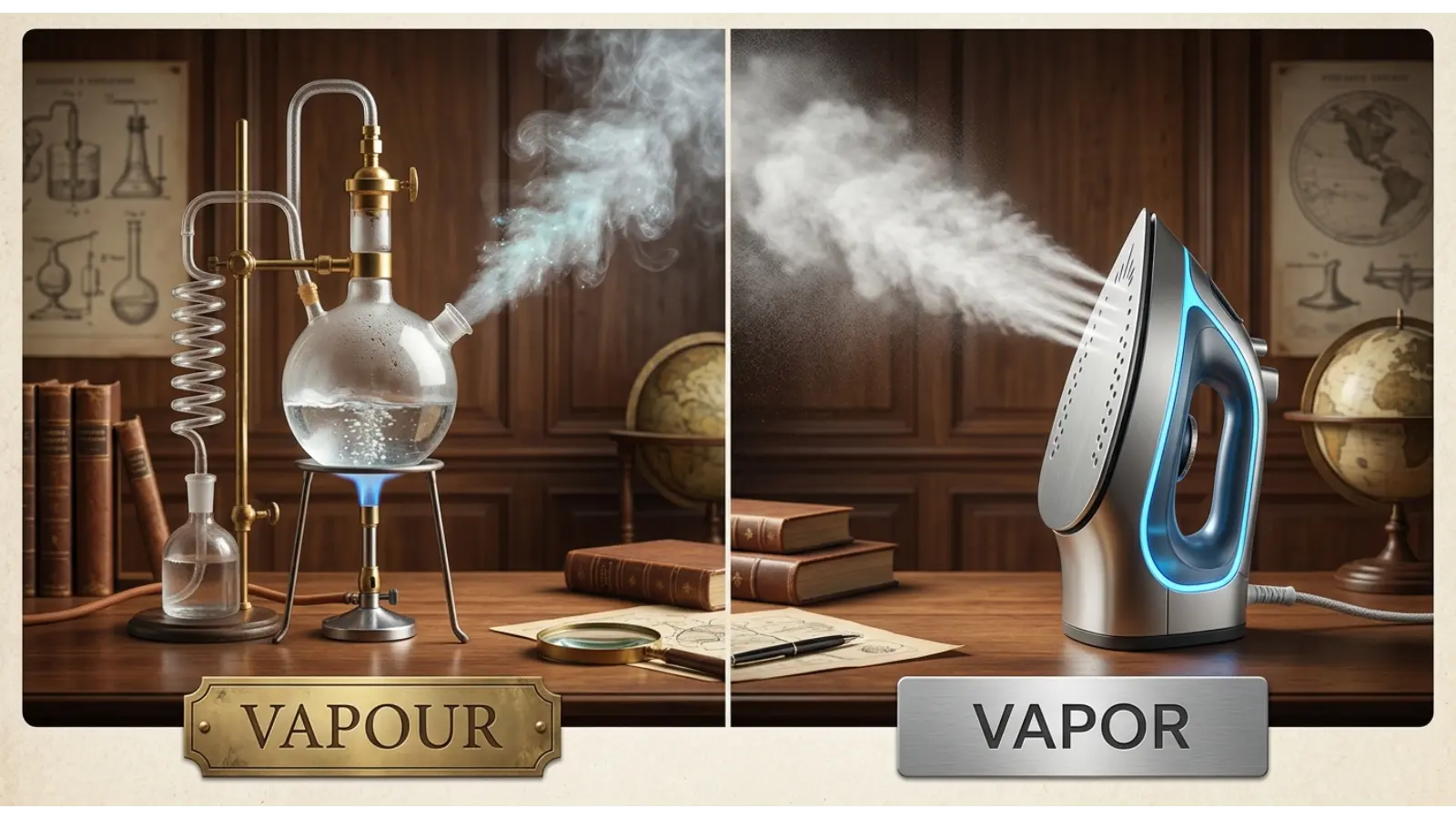
If you are unsure about vapour or vapor, both spellings are correct. The difference is mainly regional, not grammatical. Vapour is the standard British English spelling, while vapor is the standard American English spelling.
Vapour or Vapor is a common spelling confusion for English writers, especially when choosing between British and American English. Both forms are correct, but their use depends on the English variety you follow. Vapour is the standard British spelling, while vapor is preferred in American English. This spelling difference often appears in science, technology, weather, and everyday writing.
This guide explains the difference between vapour and vapor, including their meanings, regional usage, dictionary preferences, and practical examples. If you are unsure which spelling to use, understanding the British and American forms will help you choose the right word for your audience and writing style.
The two words have the same meaning. They describe a gas or very small drops of liquid produced when a substance is heated or changes state. The main difference appears in the spelling used by different English varieties.
Quick Answer
Vapour is preferred in British English.
Vapor is preferred in American English.
For example:
- British English: Water vapour can form on cold surfaces.
- American English: Water vapor can form on cold surfaces.
Neither spelling is inherently wrong. Choose the form that matches your audience and writing style.
Vapour vs Vapor at a Glance
| Feature | Vapour | Vapor |
|---|---|---|
| English variety | British English | American English |
| Meaning | Gas or tiny liquid particles | Gas or tiny liquid particles |
| Spelling pattern | Uses our | Uses or |
| Common example | water vapour | water vapor |
| Dictionary usage | UK form | US form |
| Scientific writing | Common in UK publications | Common in US publications |
| Correct spelling | Yes | Yes |
Cambridge lists vapour as UK English and vapor as US English. Oxford gives the same distinction.

What Does Vapour Mean?
Vapour is the British English spelling of the word.
It refers to gas or extremely small drops of liquid that can result from heating a liquid or solid. Cambridge gives examples such as mercury vapour and poisonous vapours.
Examples of Vapour
- Water vapour collected on the window.
- The machine releases hot vapour.
- Scientists measured the amount of water vapour in the air.
- The chemical produced toxic vapours.
You will commonly see this spelling in British English publications, educational material, and UK government writing.

What Does Vapor Mean?
Vapor has exactly the same basic meaning but is the usual American English spelling.
Cambridge identifies vapor as the US form of vapour. Its American dictionary also uses the spelling in scientific examples involving water vapor and chemical vapors.
Examples of Vapor
- Water vapor formed inside the container.
- The engine produces vapor when the liquid is heated.
- The laboratory measured water vapor levels.
- Chemical vapors escaped from the container.
When Should You Use Vapour?
Use vapour when writing primarily for a British English audience.
This includes audiences in places where British spelling conventions are commonly followed, such as the United Kingdom. Australian English also uses many British spelling conventions, and the ABC Style Guide specifically lists vapour as its preferred form.
For example:
The amount of water vapour increased during the experiment.
British academic, government, and professional documents may therefore use vapour consistently.
When Should You Use Vapor?
Use vapor when writing primarily for an American English audience.
For example:
The amount of water vapor increased during the experiment.
American dictionaries use vapor as the standard spelling. Oxford’s American English dictionary defines vapor and notes that British English uses vapour.
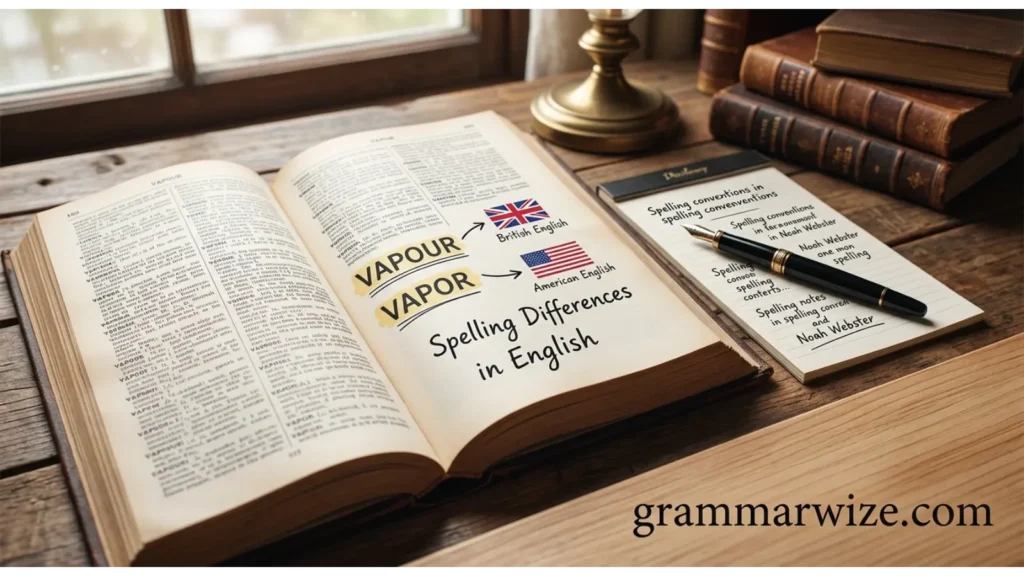
Why Are Vapour and Vapor Spelled Differently?
The difference comes from the broader British and American our/or spelling pattern.
British English retained spellings such as:
- colour
- honour
- flavour
- vapour
American English commonly uses:
- color
- honor
- flavor
- vapor
The spelling history is connected to French and Latin influences and later American spelling reforms. The Online Etymology Dictionary traces vapour to Anglo-French and Latin vapor. It also notes the broader development of -our and -or spellings and Noah Webster’s influence on American spelling.
History of the Spelling
The word has a long history in English. The English form vapour developed through Anglo-French influence from Latin vapor, meaning an exhalation, steam, or heat. The word entered English in the Middle English period.
The difference between vapour and vapor became part of a wider spelling distinction between British and American English. Noah Webster played an important role in popularizing simplified American spellings during the early nineteenth century. His 1828 dictionary used vapor.
This history explains why the two forms exist today. It does not mean that one spelling is a misspelling of the other.
Dictionary Recommendations
Major dictionaries support the regional distinction.
Cambridge Dictionary: Lists vapour as UK English and vapor as US English.
Oxford Learner’s Dictionaries: Lists vapor as American English and identifies vapour as the British form.
Noah Webster’s 1828 Dictionary: Records vapor as the American spelling.
These references show that both forms are established English spellings.
Official Style Guides
Style guides generally expect writers to follow the spelling system appropriate to their publication.
For example, the UK government’s publishing guidance states that its content should use UK English spelling and grammar.
The Australian Broadcasting Corporation’s style guide lists vapour but uses vaporise for the related verb. This is a useful reminder that regional spelling conventions can sometimes differ across related forms.
The safest approach is to follow the style guide used by your organisation, publisher, university, or client.
Vapour or Vapor in Academic Writing
Both forms are acceptable in academic writing when they match the chosen English variety.
A British university publication may use:
Water vapour affects atmospheric conditions.
An American publication may use:
Water vapor affects atmospheric conditions.
The important point is consistency. Do not randomly switch between British and American spelling within the same document unless you are discussing the spelling difference itself.
Scientific terminology does not change simply because the spelling changes.
Vapour or Vapor in Scientific Writing
Both spellings appear in scientific contexts.
British publications may use terms such as:
- water vapour
- vapour pressure
- mercury vapour
- vapour concentration
American publications commonly use:
- water vapor
- vapor pressure
- mercury vapor
- vapor concentration
The underlying scientific concept remains the same. The spelling reflects the English variety used by the publication.
Vapour or Vapor in Business Writing
Your target audience should determine the spelling.
If your company primarily communicates with customers in the UK, vapour may fit your house style.
If your business targets the United States, vapor will normally fit American English conventions.
For international companies, the most important practice is to establish a clear editorial style and use it consistently.
Vapour or Vapor in International Communication
International websites sometimes need to communicate with both British and American readers.
You usually do not need to write both forms every time. Instead, choose one consistent spelling system based on your primary audience.
For example, a British website can use water vapour, while an American website can use water vapor.
If your article specifically discusses language differences, you can explain both forms once and then use the appropriate form consistently.
Common Mistakes
Treating Vapour as Wrong
Incorrect idea: Vapour is an outdated or incorrect spelling.
Correction: Vapour is the standard British English form.
Treating Vapor as Wrong
Incorrect idea: Vapor is simply a spelling mistake.
Correction: Vapor is the standard American English form.
Mixing Both Forms
Using vapour in one paragraph and vapor in another can make your writing look inconsistent.
Choose one spelling system and maintain it throughout the document.
Assuming Pronunciation Changes
The spelling changes, but the pronunciation is essentially the same across British and American English. Cambridge gives UK and US pronunciations that differ mainly in their final vowel sound.
Easy Memory Trick
Think of the spelling pattern:
British English → Vapour → OUR
American English → Vapor → OR
You can connect vapour with British spellings such as colour and flavour.
For American English, remember vapor alongside color and flavor.
Real World Examples
Water
British English:
Water vapour is present in the atmosphere.
American English:
Water vapor is present in the atmosphere.
Chemistry
British English:
The reaction produces a chemical vapour.
American English:
The reaction produces a chemical vapor.
Weather
British English:
Water vapour contributes to atmospheric processes.
American English:
Water vapor contributes to atmospheric processes.
Laboratory Reports
British English:
The vapour was collected for further analysis.
American English:
The vapor was collected for further analysis.
Technical Documents
British English:
Check the vapour pressure before operating the equipment.
American English:
Check the vapor pressure before operating the equipment.
Current Usage
The distinction remains active in modern English dictionaries. Cambridge continues to label vapour as UK and vapor as US, while Oxford identifies vapor as American English and vapour as British English.
This means the difference is still relevant for modern writing. It is not merely a historical spelling variation.
The same distinction appears in technical compounds. For example, British English commonly uses vapour pressure, while American English uses vapor pressure.
Related Keywords
- vapour vs vapor
- vapor or vapour
- British spelling of vapor
- American spelling of vapour
- water vapour or water vapor
- vapour pressure or vapor pressure
- British vs American spelling
Professional Writing Recommendation
Use vapour when following British English conventions.
Use vapor when following American English conventions.
For academic, scientific, business, or professional writing, follow your organisation’s required style guide. Most importantly, remain consistent throughout the document.
If you are writing for an international audience, do not assume that one spelling is universally correct. The choice depends on the English variety you are using.
Frequently Asked Questions
Is vapour or vapor correct?
Both are correct. Vapour is the standard British English spelling, while vapor is the standard American English spelling.
Is vapor American or British?
Vapor is the standard American English spelling. British English generally uses vapour.
Is vapour British English?
Yes. Vapour is the standard British English form of the word.
Does vapour mean something different from vapor?
No. The two spellings have the same basic meaning. The main difference is the regional spelling convention.
Should I use vapour or vapor in scientific writing?
Use the form required by your publication or institution. British English publications generally use vapour, while American English publications generally use vapor.
Conclusion
Use vapour for British English and vapor for American English. The words have the same meaning, so your choice should depend on your audience, publication standards, and preferred English variety. Major dictionaries such as Cambridge and Oxford support this regional distinction.
For professional writing, consistency matters more than choosing one form as universally correct.

Olivia Bennett is a grammar expert and language content writer at GrammarWize.com. She specializes in English grammar, word usage, spelling differences, and writing improvement. Through clear explanations and practical examples, Olivia helps students, professionals, and language learners communicate more effectively. Her goal is to make English grammar simple, accessible, and easy to apply in everyday writing.