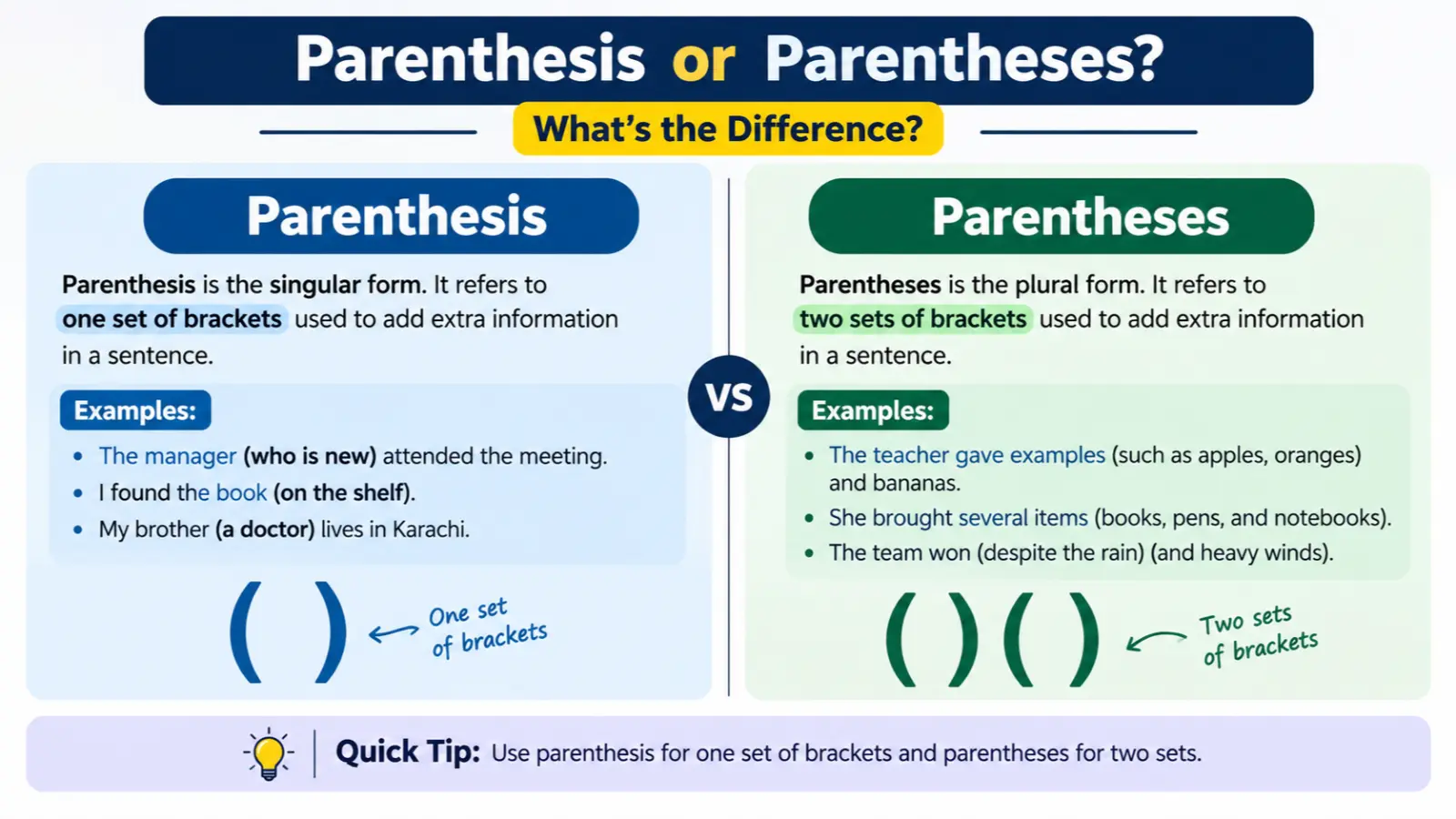
Parenthesis or Parentheses can confuse English learners because both words refer to the same type of punctuation. The key difference is simple: parenthesis is singular, while parentheses is plural. Understanding this difference helps you describe punctuation correctly in everyday, academic, and professional writing.
Parenthesis or Parentheses is a common English grammar question that confuses many writers. Both words are correct, but they have different forms and uses. Parenthesis is the singular form, while parentheses is the plural form.
Knowing the difference between parenthesis or parentheses helps you write clearly and use grammar terms correctly. In this guide, you will learn when to use each word, see simple examples, and discover an easy way to remember the difference.
A parenthesis refers to one item, while parentheses refers to more than one. For example, you can say, “Add a parenthesis here” when discussing one mark. If you are talking about both curved marks around extra information, you normally say, “Use parentheses.” Once you understand the number difference, choosing the right word becomes easy.
Quick Answer
Parenthesis is the singular form.
Parentheses is the plural form.
- One = parenthesis
- More than one = parentheses
Example:
Add a parenthesis after the word.
Put the extra information inside parentheses.
The spelling changes from parenthesis to parentheses because English uses an irregular plural form.
What Does Parenthesis Mean?
Parenthesis is the singular noun used for one parenthetical mark or one parenthetical unit.
In everyday writing, the word often refers to a single curved punctuation mark.
For example:
- The opening parenthesis comes before the extra information.
- Add a closing parenthesis at the end of the expression.
The word can also refer to an inserted statement or section of text.
For example:
- His comment was an interesting parenthesis in the discussion.
In grammar and punctuation discussions, however, parenthesis commonly refers to one of the curved marks used to separate additional information.
What Does Parentheses Mean?
Parentheses is the plural form of parenthesis.
It refers to more than one parenthesis or to the pair of curved punctuation marks used around additional information.
For example:
- Put the date in parentheses.
- The sentence contains two sets of parentheses.
- The writer used parentheses to add extra information.
You will see parentheses much more often than parenthesis when discussing punctuation because a complete pair normally contains an opening mark and a closing mark.
Parenthesis vs Parentheses
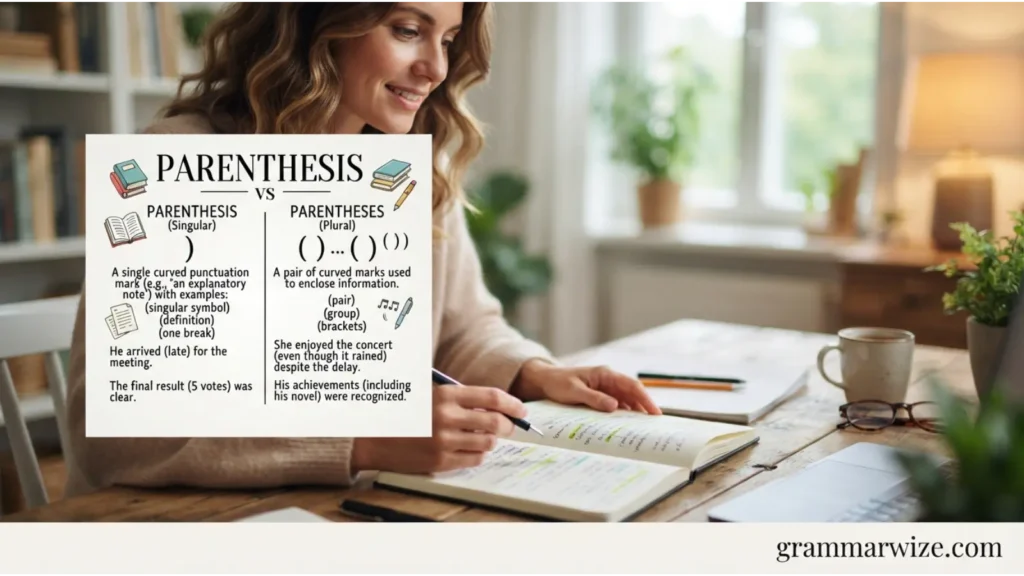
| Word | Form | Meaning | Example |
|---|---|---|---|
| Parenthesis | Singular | One parenthesis | Add a parenthesis here. |
| Parentheses | Plural | More than one parenthesis | Put the words in parentheses. |
The main difference is grammatical number.
Parenthesis = one
Parentheses = more than one
Neither word is incorrect. The correct choice depends on whether you are talking about one or multiple items.
Why Is the Plural Parentheses?
Parentheses is an irregular plural form.
The singular word parenthesis comes from Greek. English uses the plural ending -es in parentheses rather than simply adding an ordinary s.
This pattern appears in several English words that have Greek origins.
For example:
- Analysis → Analyses
- Basis → Bases
- Crisis → Crises
- Thesis → Theses
- Parenthesis → Parentheses
This is why parenthesises is not the standard plural form of parenthesis.
How to Use Parenthesis in a Sentence
Use parenthesis when you are referring to one item.
Example 1
The opening parenthesis is missing.
Here, the writer is talking about one punctuation mark.
Example 2
Add a parenthesis before the number.
Again, only one mark is being discussed.
Example 3
The editor noticed an extra parenthesis.
The sentence refers to one extra punctuation mark.
Example 4
I accidentally deleted a parenthesis from the formula.
Only one mark is missing.

How to Use Parentheses in a Sentence
Use parentheses when you are referring to multiple marks or the pair used around additional information.
Example 1
Put the author’s birth year in parentheses.
The birth year is placed between two curved marks.
Example 2
The sentence contains parentheses around the extra detail.
The sentence contains a pair of punctuation marks.
Example 3
Use parentheses to explain the abbreviation.
The writer is talking about the punctuation system as a whole.
Example 4
The instructions include several words in parentheses.
There are multiple parenthetical items.
Parentheses in Everyday Writing
Parentheses are often used to add information that is useful but not essential to the main sentence.
For example:
Sarah visited London (her favorite city) last summer.
The words her favorite city provide additional information.
Removing them still leaves a complete sentence:
Sarah visited London last summer.
This is one of the most common uses of parentheses.
Parentheses in Academic Writing
Academic writers use parentheses for several purposes.
They can provide dates, references, abbreviations, explanations, and additional details.
For example:
William Shakespeare (1564–1616) wrote many famous plays.
Parentheses can also appear in citations.
For example:
The study found a significant improvement (Smith, 2025).
The exact citation format depends on the academic style being used.
Parentheses in Professional Writing
Parentheses can be useful in business and professional writing, but they should not be overused.
For example:
Please send the final report by Friday (September 18).
They can provide short pieces of additional information without interrupting the main message too much.
However, if the information is important to the main point, a normal sentence may be clearer.
Instead of:
The meeting will take place tomorrow (if everyone is available).
You could write:
The meeting will take place tomorrow if everyone is available.
Clear writing usually works better than unnecessary punctuation.
Common Mistakes
Using Parentheses for One Mark
Incorrect:
Add two parenthesis.
Correct:
Add two parentheses.
Parentheses is plural.
Using Parenthesis for Multiple Marks
Incorrect:
Put the information inside the parenthesis.
Correct:
Put the information inside the parentheses.
When referring to the pair, parentheses is normally the better choice.
Writing Parenthesises
Incorrect:
The sentence contains several parenthesises.
Correct:
The sentence contains several parentheses.
The standard plural of parenthesis is parentheses.
Confusing Parenthesis With Parenthetical
Parenthesis is a noun.
Parenthetical can function as an adjective or noun.
For example:
The parenthesis contains extra information.
The writer added a parenthetical comment.
These words are related but are not interchangeable in every sentence.
Assuming Parentheses Is Always Incorrect
Some writers mistakenly think parentheses is a spelling error because it looks unusual.
It is actually the standard plural form of parenthesis.
Parenthesis or Parentheses in Formal Writing
Both forms are correct in formal English.
Choose the word based on the number you mean.
Use parenthesis for one:
The closing parenthesis is missing.
Use parentheses for multiple marks or a pair:
The phrase is enclosed in parentheses.
For professional, academic, and editorial writing, this distinction should be maintained because it makes your meaning precise.
Parentheses vs Brackets
Round brackets and brackets are related but different punctuation marks.
Parentheses look like this:
( )
Square brackets look like this:
[ ]
Parentheses are often used to add extra information to a sentence.
For example:
The project was completed (after several delays).
Square brackets can be used to add clarification inside quoted material.
For example:
“She [the manager] approved the proposal.”
The exact rules can vary by style guide and context.
Parentheses vs Braces
Braces are another type of punctuation.
They look like this:
{ }
Braces are common in mathematics, programming, and technical writing.
For example:
{1, 2, 3, 4}
Parentheses look like:
(1, 2, 3, 4)
Do not treat these punctuation marks as identical because they have different uses.
A Simple Memory Trick
Remember this easy rule:
Parenthesis = one
Parentheses = more than one
You can also remember the ending:
One parenthesis
Two parentheses
The -es ending in parentheses signals the plural form.
Another useful trick is to connect parentheses with the two curved marks:
( ) = parentheses
When you see the pair, think of the plural form.
Real-Life Examples
In a School Assignment
Put the publication date in parentheses.
In an Email
Please include your department name in parentheses.
A Grammar Lesson
The opening parenthesis comes before the inserted phrase.
Mathematics
Solve the expression inside the parentheses first.
In Editing
The editor removed an unnecessary parenthesis.
In a Research Paper
The source information appears in parentheses.
Technical Writing
Enter the value inside the parentheses.
Parenthesis or Parentheses: Which One Should You Use?
The answer depends on what you are describing.
Use parenthesis when you mean one mark or one parenthetical item.
Use parentheses when you mean two or more marks, especially the pair surrounding additional information.
For example:
The opening parenthesis is missing.
But:
Put the phrase inside parentheses.
Both sentences are correct because they describe different grammatical situations.
Frequently Asked Questions
Is parenthesis singular or plural?
Parenthesis is singular. Parentheses is plural.
Is parentheses the plural of parenthesis?
Yes. Parentheses is the standard plural form of parenthesis.
Is parenthesis correct English?
Yes. Parenthesis is a correct English word used for the singular form.
Is parentheses correct English?
Yes. Parentheses is the correct plural form of parenthesis.
Can I say parenthesises?
No. Parenthesises is not the standard plural form. Use parentheses instead.
What is one parenthesis called?
A single curved mark can be called a parenthesis. The opening mark is ( and the closing mark is ).
What are two parentheses called?
The two curved marks ( ) are called parentheses.
Which is more common, parenthesis or parentheses?
Parentheses is generally more common when discussing punctuation because writers often refer to the pair of curved marks.
Conclusion
Parenthesis and parentheses are both correct words, but they have different grammatical numbers.
Use parenthesis for one.
Use parentheses for more than one or for the pair of curved marks used around additional information.
The easiest rule is:
One parenthesis.
Two or more parentheses.
Once you remember this singular and plural difference, choosing between parenthesis or parentheses becomes simple in everyday, academic, and professional writing.

Olivia Bennett is a grammar expert and language content writer at GrammarWize.com. She specializes in English grammar, word usage, spelling differences, and writing improvement. Through clear explanations and practical examples, Olivia helps students, professionals, and language learners communicate more effectively. Her goal is to make English grammar simple, accessible, and easy to apply in everyday writing.