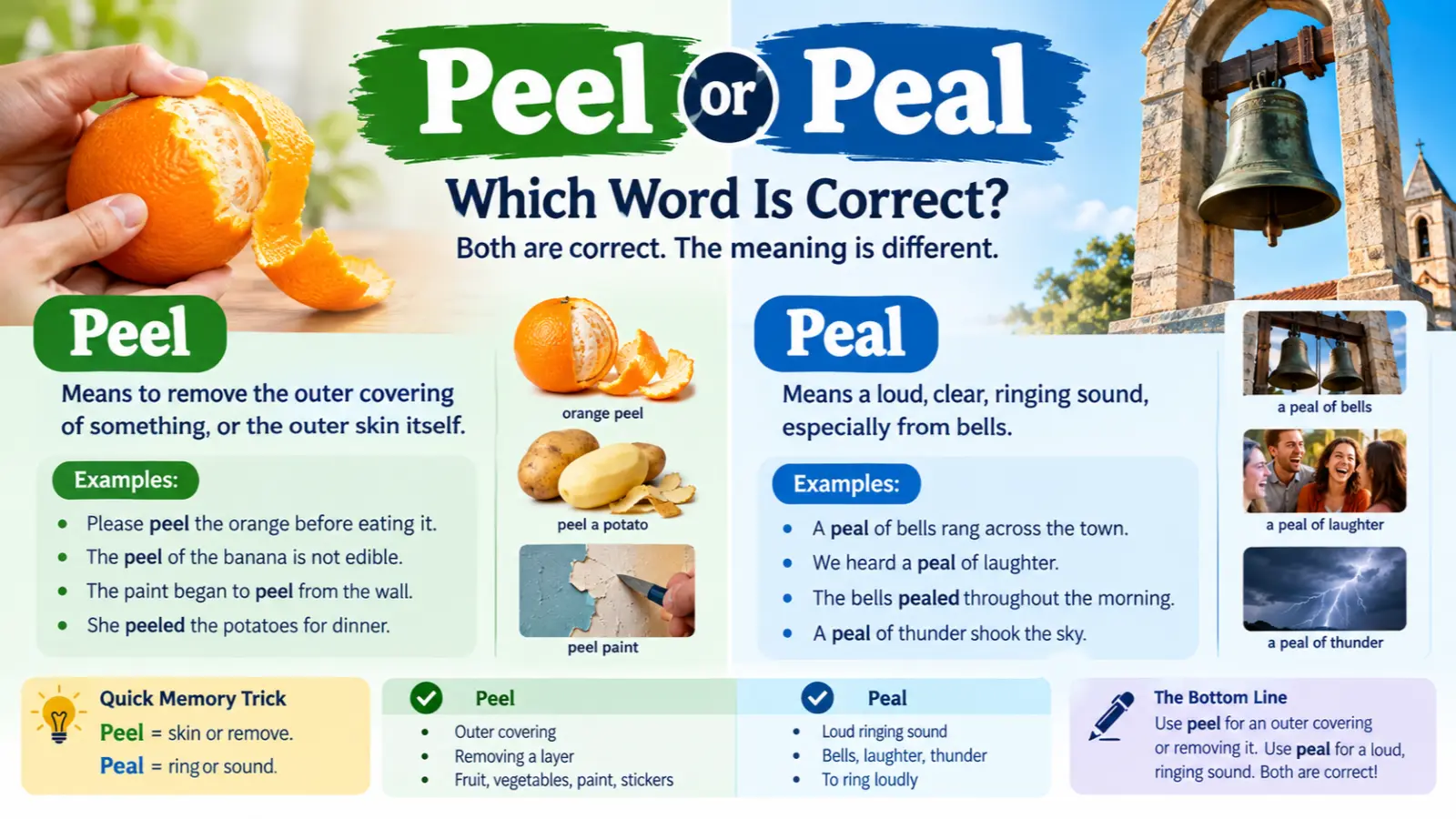
Peel or peal can be confusing because both words have the same pronunciation, but they have completely different meanings. Peel usually refers to removing the outer covering of fruit or vegetables. It can also mean the outer skin or covering itself. Peal usually refers to a loud, clear sound, especially the sound of bells.
Peel or Peal can be confusing because these words sound alike but have different meanings and uses. Peel usually means removing the outer skin of fruit or vegetables, while peal refers to a loud, clear sound, such as thunder or laughter.
Knowing the difference between peel and peal helps you avoid spelling mistakes in everyday writing. In this guide, you’ll learn their meanings, examples, common mistakes, and an easy way to remember which word to use.
Knowing the difference between these two words helps you avoid spelling mistakes in everyday writing. The easiest way to remember them is to connect peel with the skin of a fruit and peal with the ringing sound of a bell.
Quick Answer
Peel is used for removing or referring to the outer skin of something.
Peal is used for a loud, ringing sound, especially from bells.
Examples:
- Please peel the orange before eating it.
- The peal of the church bells filled the street.
Both words are correct. The right choice depends on the meaning you want to express.
What Does Peel Mean?
Peel can be used as a verb or a noun.
As a verb, it means to remove the outer covering of a fruit, vegetable, or another object.
For example:
- Please peel the potatoes before cooking them.
- She peeled an apple for her child.
As a noun, peel means the outer skin or covering of a fruit or vegetable.
For example:
- Orange peel can be used in some recipes.
- Put the banana peel in the compost bin.
The word can also describe removing a layer from something.
For example:
- The paint began to peel from the wall.
- The sticker started to peel away from the box.
What Does Peal Mean?
Peal is mainly used as a noun or verb for a loud, clear, ringing sound.
It is often associated with bells.
For example:
- A peal of bells rang across the town.
- We heard the peal of church bells.
As a verb, peal means to ring loudly and clearly.
For example:
- The bells pealed throughout the morning.
- Laughter pealed from the crowded room.
The word can also describe a burst of loud laughter.
For example:
- A peal of laughter came from the children.
- Her laughter pealed across the room.
Peel vs Peal Comparison
| Word | Meaning | Common Use | Example |
|---|---|---|---|
| Peel | To remove an outer covering | Fruit, vegetables, paint, layers | Peel the apple |
| Peel | Outer skin or covering | Fruits and vegetables | Orange peel |
| Peal | A loud ringing sound | Bells and similar sounds | A peal of bells |
| Peal | To ring loudly | Bells and sounds | The bells pealed |
| Peal | A loud burst of laughter | Human laughter | A peal of laughter |
The main difference is simple. Peel relates to an outer covering, while peal relates to a loud sound.

Why Are Peel and Peal Confused?
The main reason for confusion is pronunciation.
Peel and peal are homophones. This means they sound alike but have different spellings and meanings.
When people hear the words instead of seeing them written, the distinction disappears. A listener must use the surrounding sentence to understand which word the speaker means.
For example:
Peel the orange.
The context clearly relates to removing the fruit’s skin.
Compare it with:
We heard a peal of bells.
Here, the context clearly relates to sound.
The different vowels in the spelling do not change the pronunciation in standard English.
The Origin of Peel
The word peel has a long history in English. It developed from words connected with removing the outer covering of fruits and vegetables.
Its modern uses have expanded beyond food. Today, people can peel paint, labels, stickers, and other layers from surfaces.
The noun peel also refers to the covering that has been removed or remains on something.
This gives the word a broad connection with layers and outer coverings.
The Origin of Peal
Peal developed from older English words connected with ringing and loud sounds.
Its strongest traditional association is with bells. A peal of bells describes a series or burst of ringing sounds.
Over time, the word gained wider uses. Writers can also describe loud laughter, thunder, or another strong sound as a peal when it has a ringing or resonant quality.
The connection with sound remains central to the word.
When Should You Use Peel?
Use peel when you are talking about an outer layer, skin, or the act of removing it.
Common expressions include:
- peel an orange
- peel a potato
- peel an apple
- peel a banana
- peel the paint
- peel off a sticker
- orange peel
- potato peel
Everyday Example
She peeled the potatoes before making dinner.
Here, peeled is correct because the sentence describes removing the outer skin.
When Should You Use Peal?
Use peal when you are talking about a loud, clear, or ringing sound.
Common expressions include:
- a peal of bells
- a peal of laughter
- bells pealed
- thunder pealed
Everyday Example
A peal of bells announced the beginning of the ceremony.
Here, peal is correct because the sentence describes a ringing sound.

Peel or Peal in Different Sentences
Seeing the words in context makes their difference easier to remember.
Food
Peel the mango before cutting it.
The word peel describes removing the skin.
Fruit Skin
The lemon peel added flavor to the dish.
Here, peel means the outer covering.
Bells
A peal of bells echoed through the village.
Here, peal describes a ringing sound.
Laughter
A peal of laughter came from the audience.
Here, peal describes a loud burst of laughter.
Paint
The old paint began to peel from the door.
Again, peel refers to a layer coming away from a surface.
Common Mistakes With Peel and Peal
Writing Peal When You Mean Fruit Skin
Incorrect:
Remove the orange peal.
Correct:
Remove the orange peel.
Fruit skin is called peel, not peal.
Writing Peel for a Bell Sound
Incorrect:
We heard a peel of bells.
Correct:
We heard a peal of bells.
The ringing sound is a peal.
Confusing a Peal of Laughter
Incorrect:
A peel of laughter filled the room.
Correct:
A peal of laughter filled the room.
The word peal can describe a loud burst of laughter.
Using Peal as a Verb for Removing Skin
Incorrect:
She pealed the potato.
Correct:
She peeled the potato.
The verb for removing skin is peel.
Mixing the Two Spellings
Incorrect:
The bells peeled loudly.
Correct:
The bells pealed loudly.
Bells peal, while fruit and vegetables are peeled.
An Easy Memory Trick
A simple trick can help you remember these words.
Think of peel and fruit together.
Peel = skin
Think of peal and bells together.
Peal = sound
You can also remember:
Peel removes a layer.
Peal makes you hear a sound.
This distinction works for most everyday uses.
Peel or Peal in Professional Writing
Use the word that matches the intended meaning.
In professional writing, peel commonly appears in instructions, recipes, product descriptions, gardening content, and technical descriptions involving layers.
Peal appears more often in descriptive or literary writing involving bells, laughter, thunder, or other strong sounds.
For clear writing, do not rely on pronunciation alone. Check the meaning of the sentence before choosing the spelling.
If you are writing for a broad audience, context can also make the intended meaning immediately clear.

Are Peel and Peal Homophones?
Yes. Peel and peal are homophones because they have the same pronunciation but different spellings and meanings.
Other common English homophone pairs include flower and flour, hear and here, and sea and see.
With homophones, the spelling must be chosen according to meaning.
Is Peel Always Related to Food?
No. Peel is not limited to fruits and vegetables.
You can use it for removing layers from many things.
Examples include:
- peel a sticker off
- peel paint from a wall
- peel a label away
- peel back a covering
The central idea is still the removal or separation of an outer layer.
Is Peal Only Used for Bells?
No. Bells are the most familiar use, but peal can describe other loud or ringing sounds.
For example:
- a peal of laughter
- a peal of thunder
- bells pealing in the distance
The word generally carries the idea of a strong, resonant, or ringing sound.
Frequently Asked Questions
Is peel or peal correct?
Both peel and peal are correct English words. Peel relates to an outer covering or removing it. Peal relates to a loud ringing sound.
What is the difference between peel and peal?
Peel means the outer skin of something or the act of removing it. Peal means a loud ringing sound or the act of producing such a sound.
Is orange peel or orange peal correct?
Orange peel is correct. It refers to the outer skin of an orange.
Is it a peel of laughter or a peal of laughter?
A peal of laughter is correct. It describes a loud burst of laughter.
Is it a peel of bells or a peal of bells?
A peal of bells is correct. It refers to the ringing sound made by bells.
Are peel and peal pronounced the same?
Yes. In standard English, peel and peal are pronounced the same, which makes them homophones.
Conclusion
Peel or peal is a classic homophone pair. Both spellings are correct, but they belong in different contexts.
Use peel for an outer covering or the act of removing one. Use peal for a loud, ringing sound, especially the sound of bells.
Remember the simple connection:
Peel means skin or remove.
Peal means ring or sound.
Once you connect each spelling with its meaning, choosing the correct word becomes much easier.

Olivia Bennett is a grammar expert and language content writer at GrammarWize.com. She specializes in English grammar, word usage, spelling differences, and writing improvement. Through clear explanations and practical examples, Olivia helps students, professionals, and language learners communicate more effectively. Her goal is to make English grammar simple, accessible, and easy to apply in everyday writing.