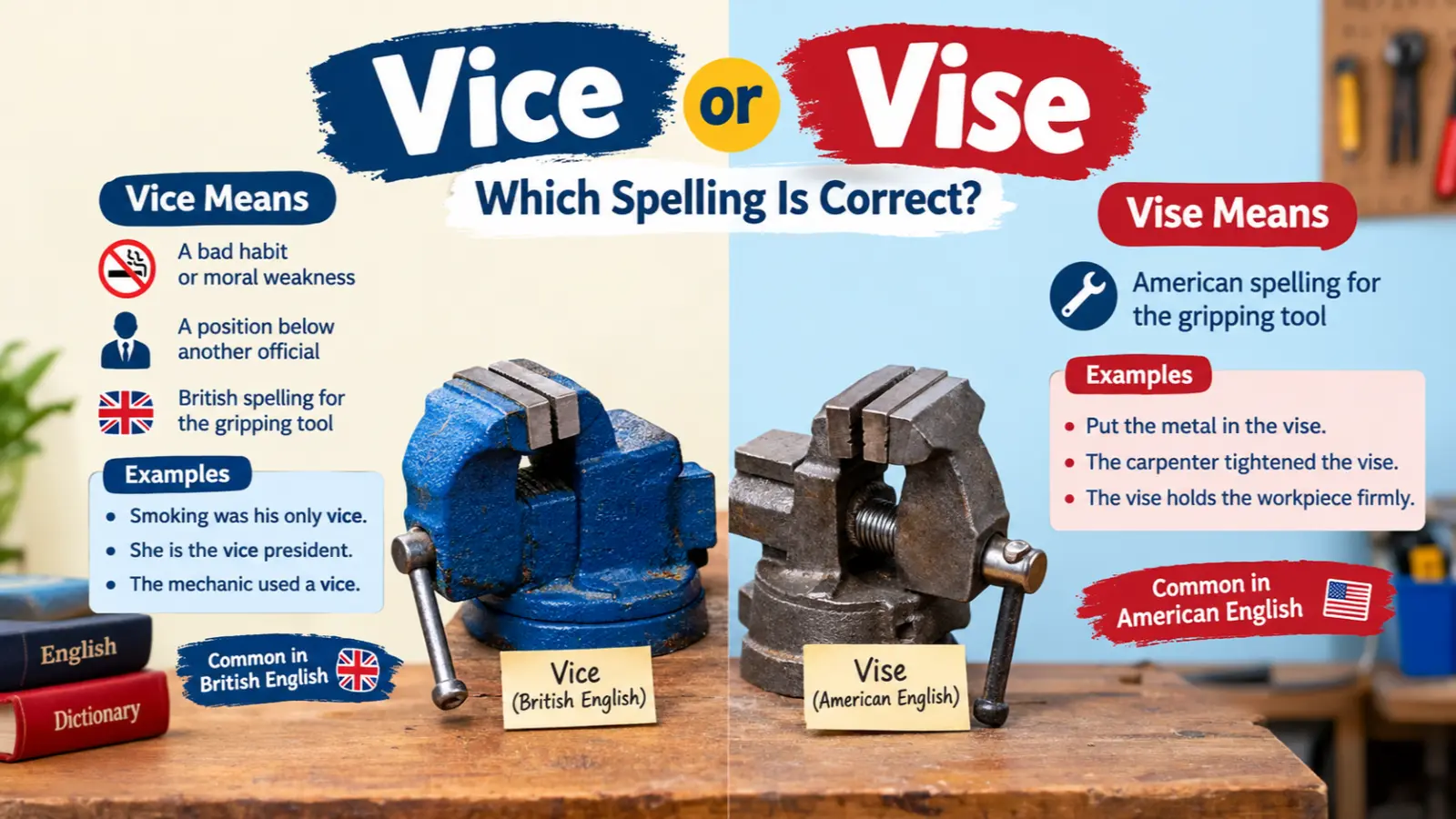
Vice or vise can be confusing because both spellings are correct English words. However, they do not always mean the same thing. Vice usually refers to a bad habit, moral weakness, or a person holding a position below another official. It is also the British spelling for a tool used to hold an object firmly. Vise is mainly the American spelling for that tool.
Vice or Vise is a trending spelling and word-choice question that often confuses English learners and writers. Both words are correct, but they have completely different meanings and uses.
Vice can mean a bad habit or immoral behavior, while vise is a tool used to hold an object firmly in place. Understanding this difference helps you choose the right word in writing and everyday communication.
Understanding the difference can help you avoid mistakes in professional, academic, and everyday writing. The key is to look at the meaning and the English variety you are using.
Quick Answer
Vice is correct when you mean a bad habit, moral weakness, or a deputy position.
Vise is the standard American spelling for the workshop tool that grips an object.
For the tool, British English usually uses vice, while American English usually uses vise.
Examples
- Smoking was his only vice.
- She works as the vice president of the company.
- The carpenter secured the wood in a vise.
What Does Vice Mean?
Vice has several meanings, so its correct use depends on context.
Vice as a Bad Habit
A vice can be a bad habit or a moral weakness.
Examples:
- Gambling became his biggest vice.
- Everyone has a personal vice.
Cambridge defines this meaning as a moral fault or weakness in someone’s character.
Vice in a Job Title
Vice is also used in titles for people who rank directly below another official.
Examples include:
- vice president
- vice chairman
- vice principal
- vice captain
- vice admiral
In these expressions, vice indicates a position immediately below the person holding the main position.
Vice as a Workshop Tool
In British English, vice can also mean a tool with two parts that move together to hold an object firmly.
Example:
- The mechanic placed the metal inside the vice.
Cambridge lists vice as the mainly British form for this tool.
What Does Vise Mean?
Vise is mainly the American English spelling of the workshop tool.
A vise holds an object firmly while someone cuts, shapes, drills, or repairs it.
Examples:
- Put the metal in the vise before drilling it.
- The carpenter tightened the vise around the wooden board.
- The mechanic used a vise to hold the part securely.
In British English, the same tool is generally called a vice.

Vice vs Vise Comparison
| Word | Main Meaning | Common Usage |
|---|---|---|
| Vice | Bad habit or moral weakness | British and American English |
| Vice | Position below a senior official | British and American English |
| Vice | Workshop gripping tool | Mainly British English |
| Vise | Workshop gripping tool | Mainly American English |
The important point is that vice and vise are not simply alternative spellings in every situation. Their meanings and regional uses determine which form you should choose.
Is Vice or Vise Correct?
Both are correct, but they are correct in different contexts.
Use vice when you mean:
- a bad habit
- a moral weakness
- an official ranking below another person
- the workshop tool in British English
Use vise when you mean the workshop tool in American English.
So, neither word is always wrong. The intended meaning and regional style determine the correct choice.
British vs American English
The tool meaning creates the biggest spelling difference.
British English
British English generally uses vice for the workshop tool.
Example:
The engineer placed the pipe in the vice.
American English
American English generally uses vise for the same tool.
Example:
The engineer placed the pipe in the vise.
Cambridge specifically identifies vise as the US form and vice as the UK form for this meaning.
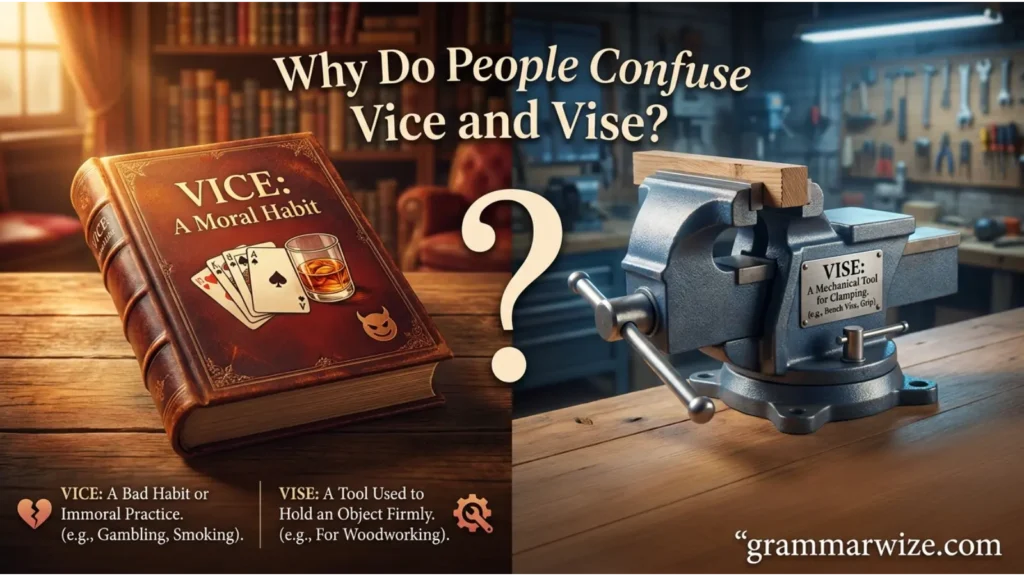
Why Do People Confuse Vice and Vise?
The confusion is understandable because the two words have the same pronunciation.
Both are pronounced approximately /vaɪs/.
The spelling difference becomes noticeable when someone writes about a workshop tool. A British writer may use vice, while an American writer may use vise.
The problem becomes greater because vice has several other established meanings, including bad behavior and official titles.
Origin and History
The word vice has a long history in English and is connected with ideas of moral fault or wrongdoing. Over time, the word developed several uses, including the modern meanings associated with bad habits and official positions.
The workshop meaning also has a long history in English. American English eventually developed the spelling vise for the tool, helping distinguish it from other meanings of vice.
Today, both forms remain established, but their regional preferences are different for the tool.
Dictionary Recommendations
Major dictionaries recognize both forms.
Cambridge Dictionary lists vice as the British form for the gripping workshop tool and identifies vise as the US spelling.
About American writing, vise is the safer choice when referring to the tool.
For British writing, vice is the standard choice for the same tool.
For meanings such as a bad habit or a professional title, use vice regardless of whether you are writing in British or American English.
Real Life Examples of Vice
A Bad Habit
- Chocolate is my only vice.
- He admitted that impatience was his biggest vice.
A Professional Position
- She became the vice president of the organization.
- The vice chairman opened the meeting.
A Moral Weakness
- The story explores the conflict between virtue and vice.
- The character struggles with several personal vices.
Real Life Examples of Vise
Workshop Use
- Clamp the board in the vise.
- The technician tightened the vise before cutting the metal.
- A bench vise can keep a workpiece stable.
These examples use vise because they follow American spelling for the workshop tool.
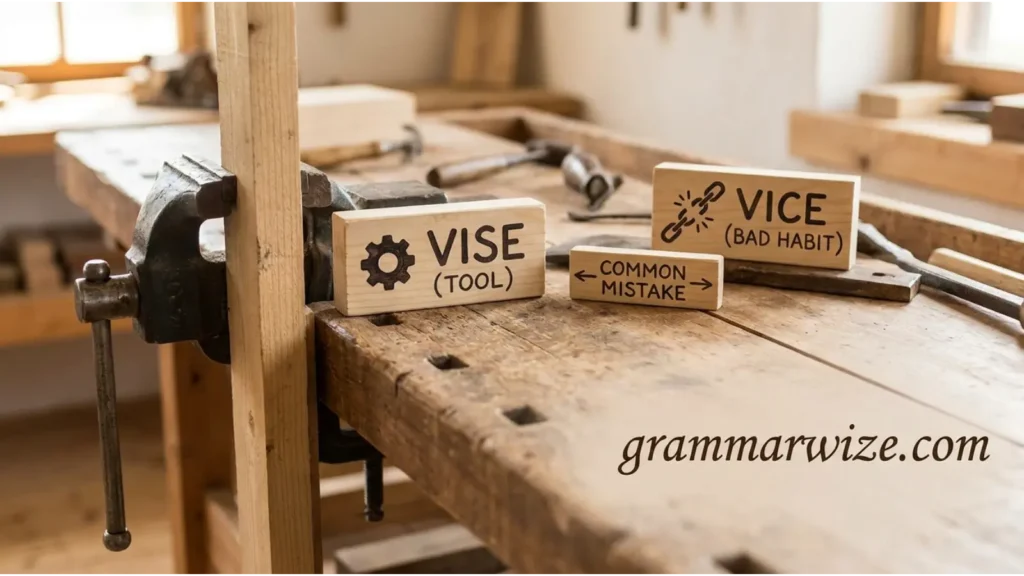
Common Mistakes
Using Vise for a Bad Habit
Incorrect:
- Laziness is his biggest vise.
Correct:
- Laziness is his biggest vice.
Using Vise in Vice President
Incorrect:
- She is the vise president.
Correct:
- She is the vice president.
Assuming Vice Is Always Wrong in American English
American English still uses vice for meanings such as bad habits and official titles.
Correct:
- He became vice president.
- Smoking was his only vice.
Assuming Vise Is a British Spelling
Vise is mainly the American spelling for the workshop tool. British English generally uses vice for that meaning.
Mixing Regional Styles
Avoid switching between vice and vise when discussing the same tool in one document.
Choose the spelling that matches your target variety of English.
Easy Memory Trick
Remember:
Vice = vice president, bad habit, or British workshop tool.
Vise = American workshop tool.
A simple trick is to connect the s in vise with shop. If you are writing for an American audience and talking about a workshop tool, think vise.
Professional Writing Recommendation
For professional writing, always consider the meaning first.
Use vice for titles such as vice president, vice chairman, and vice principal. Use vice for bad habits or moral weaknesses as well.
When referring to the workshop tool, follow your chosen English variety. Use vise for American English and vice for British English. This keeps your spelling consistent with the audience and style guide.
Frequently Asked Questions
Is vice or vise correct?
Both are correct. Vice has meanings such as a bad habit and an official position. Vise is mainly the American spelling of the workshop tool.
Is a workshop tool called a vice or vise?
Both spellings are used. Vice is standard in British English, while vise is standard in American English.
Is vice president spelled with vice or vise?
It is always vice president. The spelling vise president is incorrect.
Is vise British or American?
Vise is mainly the American spelling for the workshop tool. British English generally uses vice for the same tool.
Does vice mean a bad habit?
Yes. Vice can mean a bad habit, moral weakness, or character flaw.
Conclusion
Vice and vise are both correct words, but you cannot use them interchangeably in every sentence.
Use vice for bad habits, moral weaknesses, and titles such as vice president. For the workshop tool, use vise in American English and vice in British English.
The easiest rule is simple: vice has several meanings, while vise is mainly the American spelling for the gripping workshop tool.

Olivia Bennett is a grammar expert and language content writer at GrammarWize.com. She specializes in English grammar, word usage, spelling differences, and writing improvement. Through clear explanations and practical examples, Olivia helps students, professionals, and language learners communicate more effectively. Her goal is to make English grammar simple, accessible, and easy to apply in everyday writing.