H2O Polar or Nonpolar is a trending chemistry question among students and science enthusiasts. Water is one of the most important compounds in everyday life, but its molecular structure makes it especially interesting. So, is H2O polar or nonpolar? The answer is simple: water is a polar molecule because it has an uneven distribution of electrical charge.
Water’s molecular shape also plays an important role. Each water molecule contains two hydrogen atoms bonded to one oxygen atom. These atoms form a bent shape rather than a straight line. As a result, the individual bond polarities do not cancel each other out.
Understanding why H2O is polar helps explain many everyday phenomena. Water dissolves many ionic and polar substances, forms hydrogen bonds, and shows strong attraction between its molecules. These properties make water essential for many chemical and biological processes.
Quick Answer: Is H2O Polar or Nonpolar?
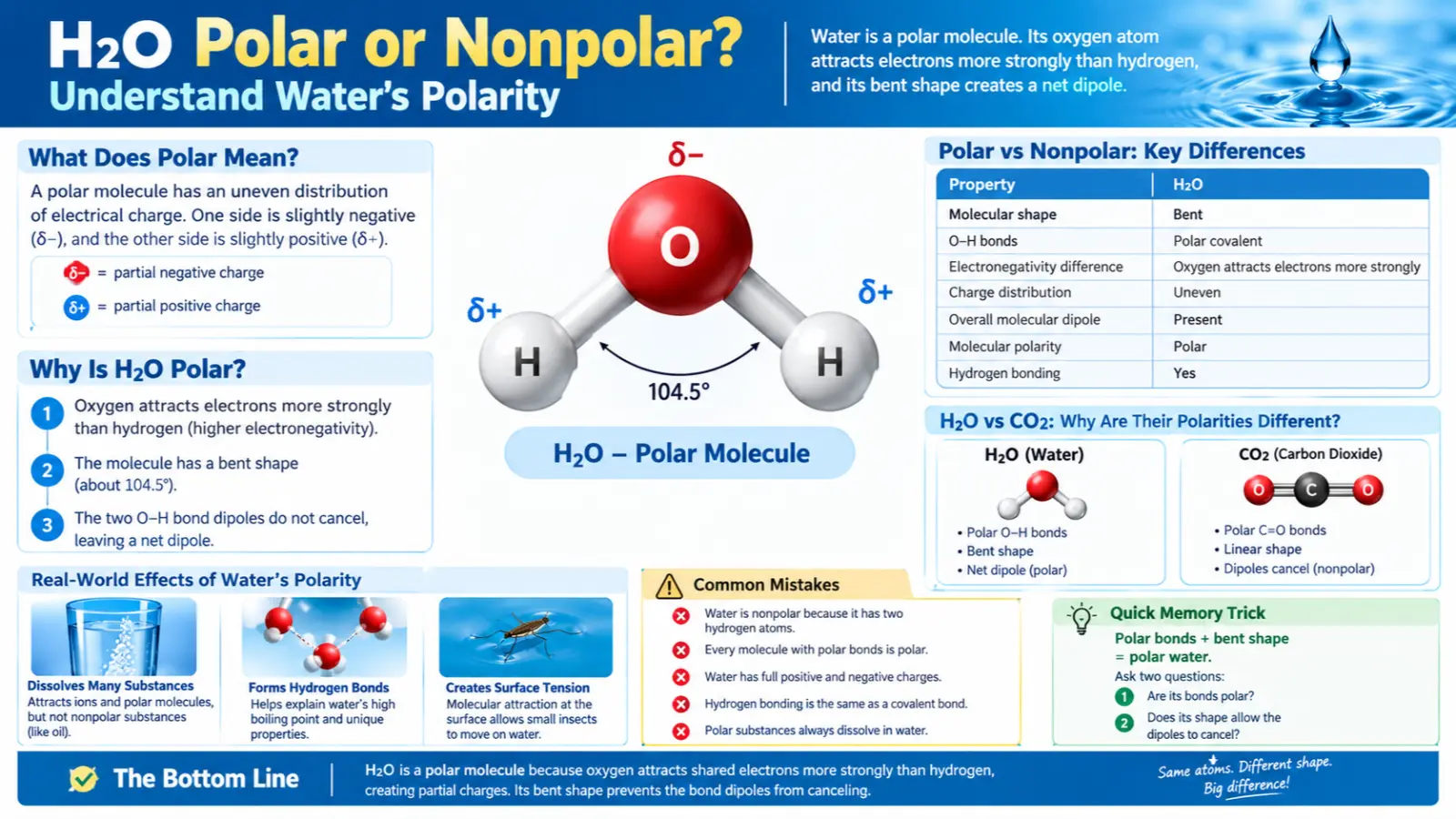
H2O is a polar molecule. Its oxygen atom attracts electrons more strongly than its hydrogen atoms, creating partial charges. Its bent molecular shape allows these charges to produce an overall dipole.
For example, water can dissolve table salt because its polar molecules attract the positively charged sodium ions and negatively charged chloride ions.
What Does Polar Mean in Chemistry?
A polar molecule has an uneven distribution of electrical charge. One region becomes slightly negative, while another becomes slightly positive.
These charges are partial charges, not necessarily full electrical charges. Chemists represent them using the symbols δ− and δ+.
In water, oxygen carries a partial negative charge, and both hydrogen atoms carry partial positive charges. This uneven distribution makes water polar.
A nonpolar molecule has no overall permanent dipole. Its charge distribution may be balanced because its bonds are nonpolar or because the effects of its polar bonds cancel.
Why Is H2O Polar?
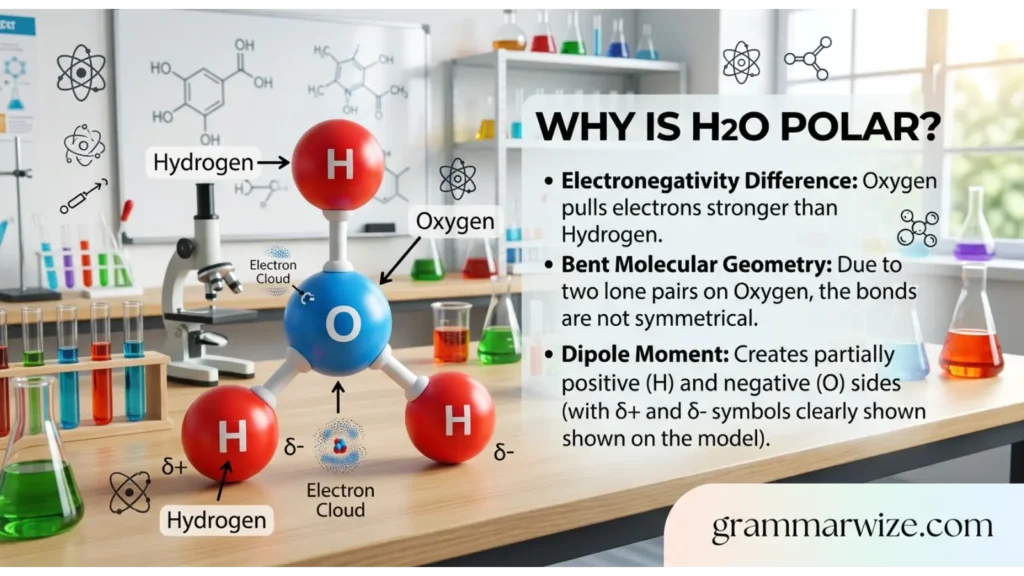
Three main factors explain water’s polarity.
Oxygen Attracts Electrons More Strongly
Oxygen is more electronegative than hydrogen. Electronegativity describes an atom’s ability to attract shared electrons in a chemical bond.
When oxygen bonds with hydrogen, the shared electrons spend more time near oxygen. This creates a polar covalent bond.
Each O–H bond therefore has an uneven distribution of charge.
Water Has a Bent Molecular Shape
A water molecule is not linear. Its two O–H bonds form a bent shape with a bond angle of approximately 104.5 degrees.
This arrangement matters because the two bond dipoles point in different directions. They do not cancel each other out.
Instead, their combined effect produces a net molecular dipole.
The Bond Dipoles Do Not Cancel
Water contains two polar O–H bonds. However, having polar bonds alone does not automatically make every molecule polar.
The molecule’s shape determines how the bond dipoles combine. In H2O, the bent structure leaves an overall dipole, making the molecule polar.
H2O Polar vs Nonpolar: Key Differences
| Property | H2O |
|---|---|
| Molecular formula | H2O |
| Molecular shape | Bent |
| O–H bonds | Polar covalent |
| Electronegativity difference | Oxygen attracts electrons more strongly |
| Charge distribution | Uneven |
| Overall molecular dipole | Present |
| Molecular polarity | Polar |
| Hydrogen bonding | Yes, between suitable water molecules |
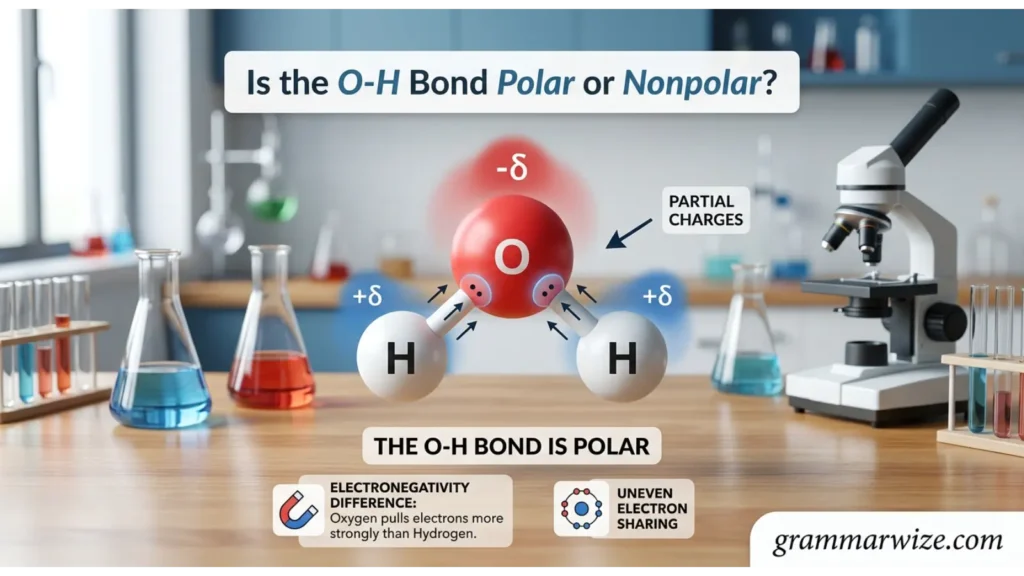
Is the O–H Bond Polar or Nonpolar?
The O–H bond is polar covalent. Oxygen attracts the shared electrons more strongly than hydrogen, so the electrons are not distributed equally.
Oxygen becomes partially negative, while hydrogen becomes partially positive. Because water contains two such bonds in a bent arrangement, the molecule has an overall dipole.
This distinction is important: bond polarity describes an individual chemical bond, while molecular polarity describes the charge distribution across the entire molecule.
How Does Water’s Shape Affect Its Polarity?
Water has two bonding pairs and two lone pairs of electrons around its central oxygen atom. These electron pairs influence the molecule’s geometry.
The electron-pair arrangement is approximately tetrahedral, but the positions of the atoms create a bent molecular shape.
If the two O–H bond dipoles pointed in exactly opposite directions, they could cancel. In water, they do not. Their combined dipole points toward the oxygen-rich side of the molecule.
This is why molecular shape is essential when determining polarity.
H2O vs CO2: Why Are Their Polarities Different?
Water and carbon dioxide provide a useful comparison.
Water (H2O) has two polar O–H bonds and a bent molecular shape. Its bond dipoles do not cancel, so water is polar.
Carbon dioxide (CO2) contains polar C=O bonds, but its molecular shape is linear. The two bond dipoles point in opposite directions and cancel each other out.
Therefore, CO2 is nonpolar overall, even though its individual bonds are polar.
This comparison shows why you must consider both bond polarity and molecular geometry.

What Does Water’s Polarity Explain in Everyday Life?
Water’s polarity helps explain several familiar properties.
Water Dissolves Many Substances
Water dissolves many ionic and polar substances because its partial charges can attract charged or polar particles.
For example, the oxygen side of water attracts positive ions, while its hydrogen side attracts negative ions. These interactions help water separate and surround ions in a solution.
However, water does not dissolve every substance. Many nonpolar materials, such as oil, do not mix well with it.
Water Forms Hydrogen Bonds
The partially positive hydrogen atoms in one water molecule can attract the partially negative oxygen atom of another water molecule.
This attraction is called hydrogen bonding. It helps explain water’s relatively high boiling point and many of its unusual physical properties.
Hydrogen bonds are intermolecular attractions, not the covalent O–H bonds within a water molecule.
Water Has Surface Tension
Water molecules attract one another through intermolecular forces, including hydrogen bonding. These attractions contribute to water’s surface tension.
This property helps explain why some small insects can move across the water’s surface without sinking under suitable conditions.
Common Mistakes When Identifying H2O Polarity
- Mistake: Water is nonpolar because it has two hydrogen atoms. The number of hydrogen atoms does not determine polarity. Molecular shape and bond dipoles matter.
- Mistake: Every molecule with polar bonds is polar. Some molecules, such as CO2, have bond dipoles that cancel because of their geometry.
- Mistake: Water has full positive and negative charges on its atoms. The oxygen and hydrogen atoms have partial charges within a neutral molecule.
- Mistake: Hydrogen bonding is the same as a covalent bond. Hydrogen bonding is an intermolecular attraction, while O–H bonds hold the atoms together within water.
- Mistake: Polar substances always dissolve in water. Solubility also depends on other factors, including molecular structure and the strength of intermolecular interactions.
An Easy Memory Trick for Water’s Polarity
Remember this simple rule: polar bonds plus a bent shape make polar water.
Oxygen pulls the shared electrons toward itself. The bent shape prevents the two bond dipoles from canceling. Together, these features give water an overall dipole.
When checking another molecule, ask two questions:
- Are its bonds polar?
- Does its molecular shape allow the bond dipoles to cancel?
These questions help you distinguish polar molecules from nonpolar ones.
Frequently Asked Questions
Is H2O polar or nonpolar?
H2O is polar. Oxygen attracts shared electrons more strongly than hydrogen, and water’s bent shape prevents the bond dipoles from canceling.
Why is water polar if it is electrically neutral?
Electrical neutrality means water has no overall net charge. Polarity means its electrical charge is distributed unevenly. A molecule can be neutral and still have partial positive and negative regions.
Is the O–H bond polar covalent?
Yes. The O–H bond is polar covalent because oxygen attracts the shared electrons more strongly than hydrogen.
Does water’s shape make it polar?
Water’s bent shape is essential to its polarity. The two O–H bond dipoles do not cancel, leaving a net molecular dipole.
Is CO2 polar like H2O?
No. CO2 is nonpolar overall because its linear shape causes its two polar C=O bond dipoles to cancel. H2O is bent, so its bond dipoles do not cancel.
Why does water dissolve salt?
Water’s partial charges attract the sodium and chloride ions in salt. These interactions help separate the ions and surround them in solution.
Conclusion
H2O is a polar molecule because oxygen attracts shared electrons more strongly than hydrogen, creating partial charges. Water’s bent shape prevents its two O–H bond dipoles from canceling.
This polarity explains important properties, including water’s ability to dissolve many ionic and polar substances, form hydrogen bonds, and exhibit surface tension.
To determine whether a molecule is polar or nonpolar, examine both its bond polarity and its molecular shape. Water is a clear example of how these two factors work together.

Olivia Bennett is a grammar expert and language content writer at GrammarWize.com. She specializes in English grammar, word usage, spelling differences, and writing improvement. Through clear explanations and practical examples, Olivia helps students, professionals, and language learners communicate more effectively. Her goal is to make English grammar simple, accessible, and easy to apply in everyday writing.