Many writers hesitate when choosing between weeks and week’s. The words look almost identical, yet they serve different grammatical purposes.
The confusion usually comes from the apostrophe. Some people add it automatically when writing a plural word, while others remove it from possessive phrases. Understanding the difference helps you write more clearly and professionally.
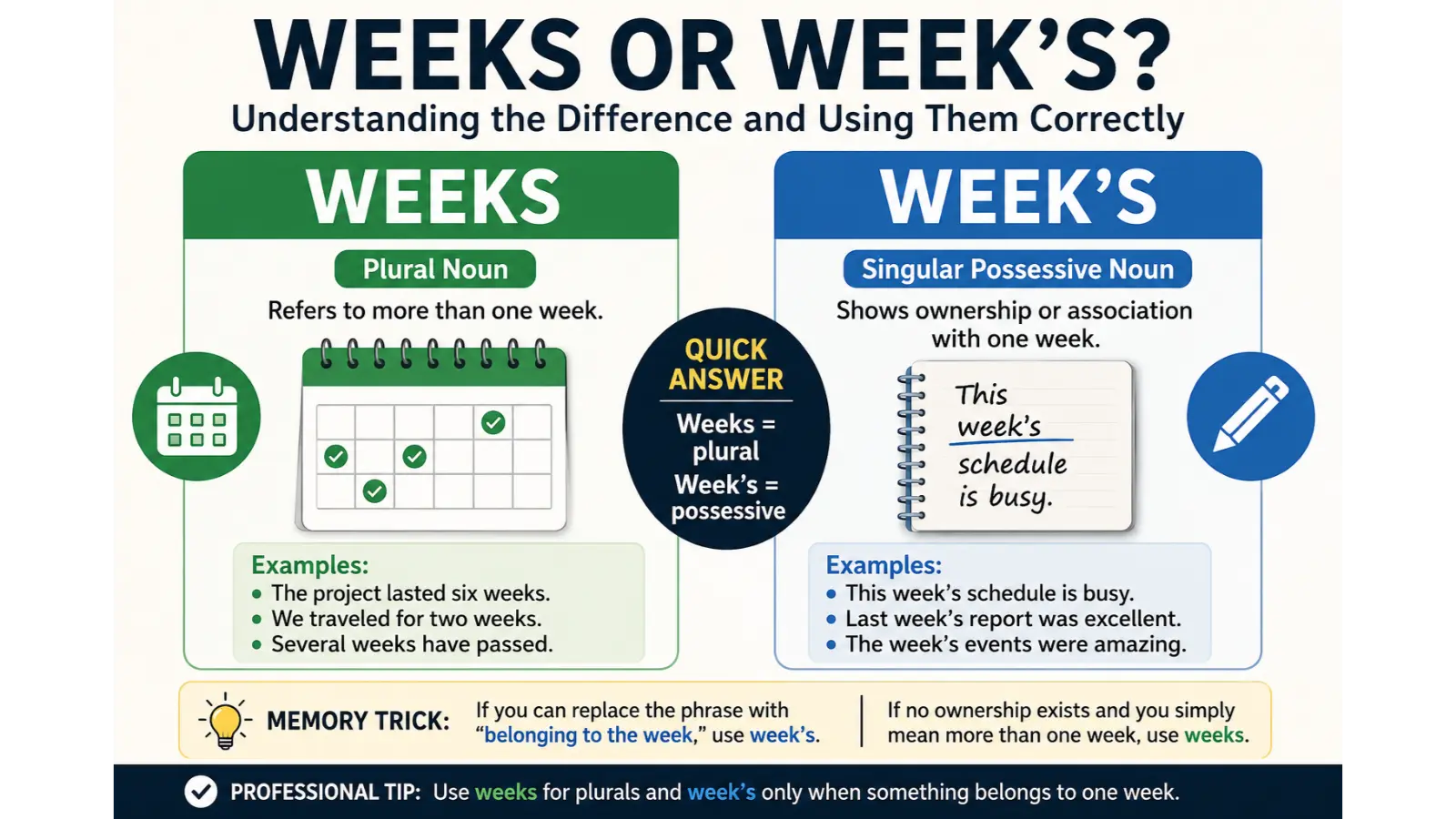
Quick Answer
- Weeks = plural form of week.
- Week’s = singular possessive form of week.
Examples
✅ Three weeks passed quickly.
✅ This week’s meeting starts at 10 a.m.
❌ Three week’s passed quickly.
❌ This weeks meeting starts at 10 a.m.
Meaning of Both Forms
Weeks
Weeks simply means more than one week.
Examples:
- The project lasted six weeks.
- We traveled for two weeks.
- Several weeks have passed since the event.
Week’s
Week’s shows ownership or association with one week.
Examples:
- This week’s schedule is busy.
- Last week’s report was excellent.
- The week’s events attracted thousands of visitors.
Weeks vs Week’s Comparison Table
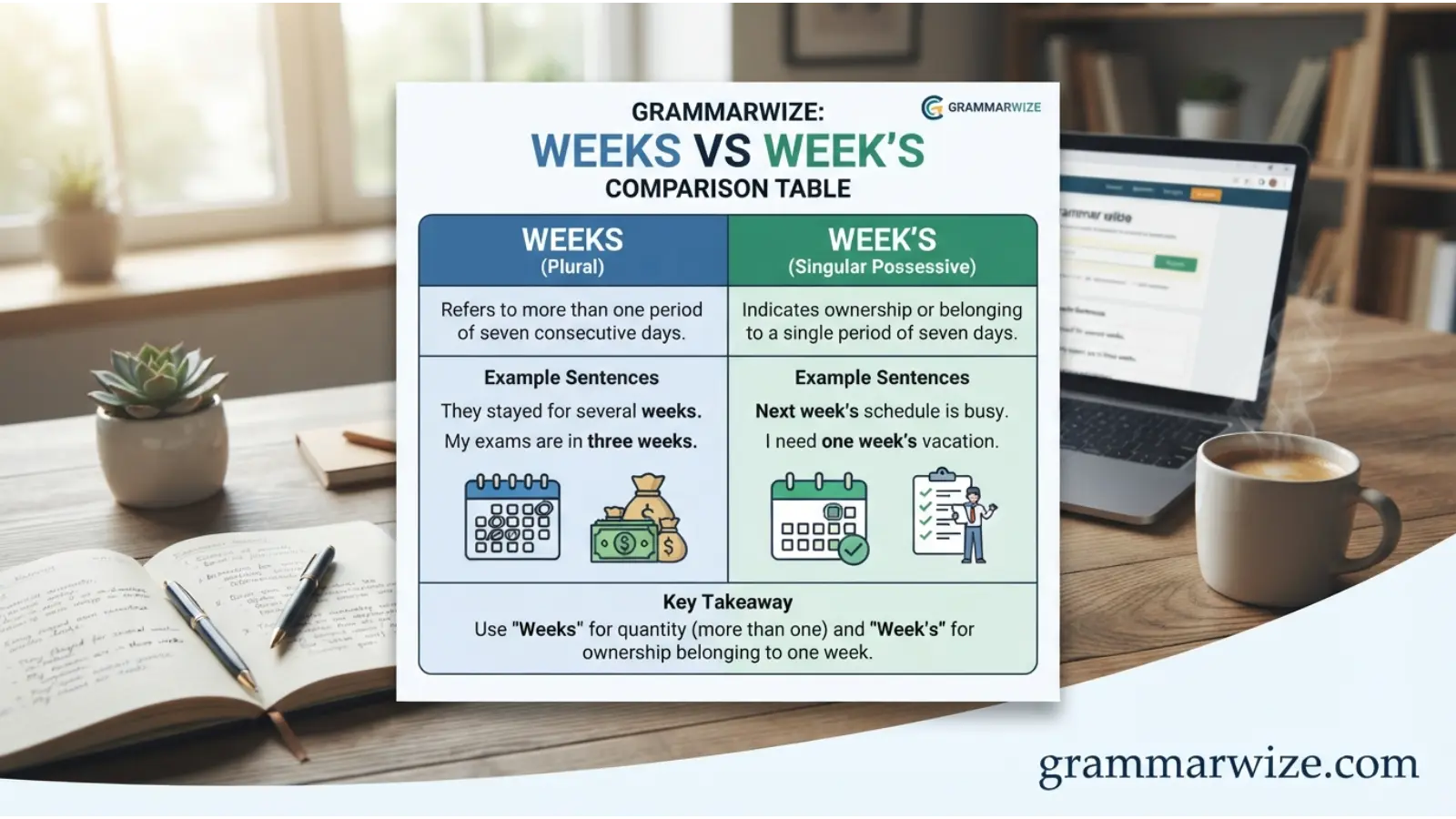
| Form | Function | Meaning | Example |
|---|---|---|---|
| Weeks | Plural noun | More than one week | The course lasts eight weeks. |
| Week’s | Singular possessive noun | Belonging to one week | This week’s agenda is ready. |
Where These Forms Come From
The word week comes from Old English wice, referring to a period of seven days.
Over time, English developed two separate grammatical forms:
- Add s to create a plural noun: weeks.
- Add ’s to show possession: week’s.
This pattern is common throughout English.
Examples:
- Days / day’s
- Months / month’s
- Years / year’s
Why the Confusion Exists
Many people learn that adding s changes a word, but they are less confident about apostrophes.
The mistake often happens because:
- Apostrophes and plurals both involve the letter s.
- Possessive forms are taught later than basic plurals.
- Some writers mistakenly believe apostrophes make words plural.
In reality, apostrophes generally indicate possession, not plurality.
Dictionary Recommendations
Major dictionaries and style guides agree on the distinction:
- Weeks is the standard plural noun.
- Week’s is the standard singular possessive noun.
Professional references consistently treat them as different grammatical forms rather than alternative spellings.
Real-Life Examples of Weeks or Week’s

Using Weeks Correctly
- The renovation took four weeks.
- We waited several weeks for approval.
- Classes continue for twelve weeks.
Using Week’s Correctly
- This week’s weather looks promising.
- The week’s highlights were shared online.
- Last week’s announcement surprised everyone.
Common Mistakes
Mistake 1: Using an Apostrophe for a Plural
❌ The event lasts three week’s.
✅ The event lasts three weeks.
Mistake 2: Forgetting Possession
❌ This weeks schedule is full.
✅ This week’s schedule is full.
Mistake 3: Confusing Singular and Possessive Forms
❌ Last weeks report was incomplete.
✅ Last week’s report was incomplete.
Memory Trick
A simple rule helps:
If you can replace the phrase with “belonging to the week,” use week’s.
Example:
- This week’s schedule
- The schedule belongs to this week
If no ownership exists and you simply mean more than one week, use weeks.
Example:
- Three weeks passed.
No possession is involved, so no apostrophe is needed.
Professional Writing Recommendation
For business writing, academic papers, websites, and professional communication:
- Use weeks when referring to multiple weeks.
- Use week’s only when showing ownership or association.
Before adding an apostrophe, ask yourself:
Does something belong to the week?
If the answer is no, use weeks.
Frequently Asked Questions
Is weeks or week’s correct?
Both are correct, but they have different meanings. Weeks is plural, while week’s is singular possessive.
What does week’s mean?
Week’s means something belongs to or relates to one week.
Example: This week’s newsletter.
Is three week’s correct?
No. The correct form is three weeks because you are referring to multiple weeks, not possession.
How do I know when to use week’s?
Use week’s when the following noun belongs to, relates to, or is associated with a specific week.
Example: Last week’s presentation.
Is weeks a possessive word?
No. Weeks is only a plural noun. The possessive plural form would be weeks’.
Example: Three weeks’ notice.
Conclusion
The choice between weeks and week’s is a grammar issue, not a spelling issue. Weeks refers to more than one week, while week’s shows possession or connection to a single week. Understanding the role of the apostrophe makes the distinction easy. In professional writing, use weeks for plurals and week’s only when something belongs to one week. This simple rule will help you avoid one of the most common apostrophe mistakes in English.

Olivia Bennett is a grammar expert and language content writer at GrammarWize.com. She specializes in English grammar, word usage, spelling differences, and writing improvement. Through clear explanations and practical examples, Olivia helps students, professionals, and language learners communicate more effectively. Her goal is to make English grammar simple, accessible, and easy to apply in everyday writing.