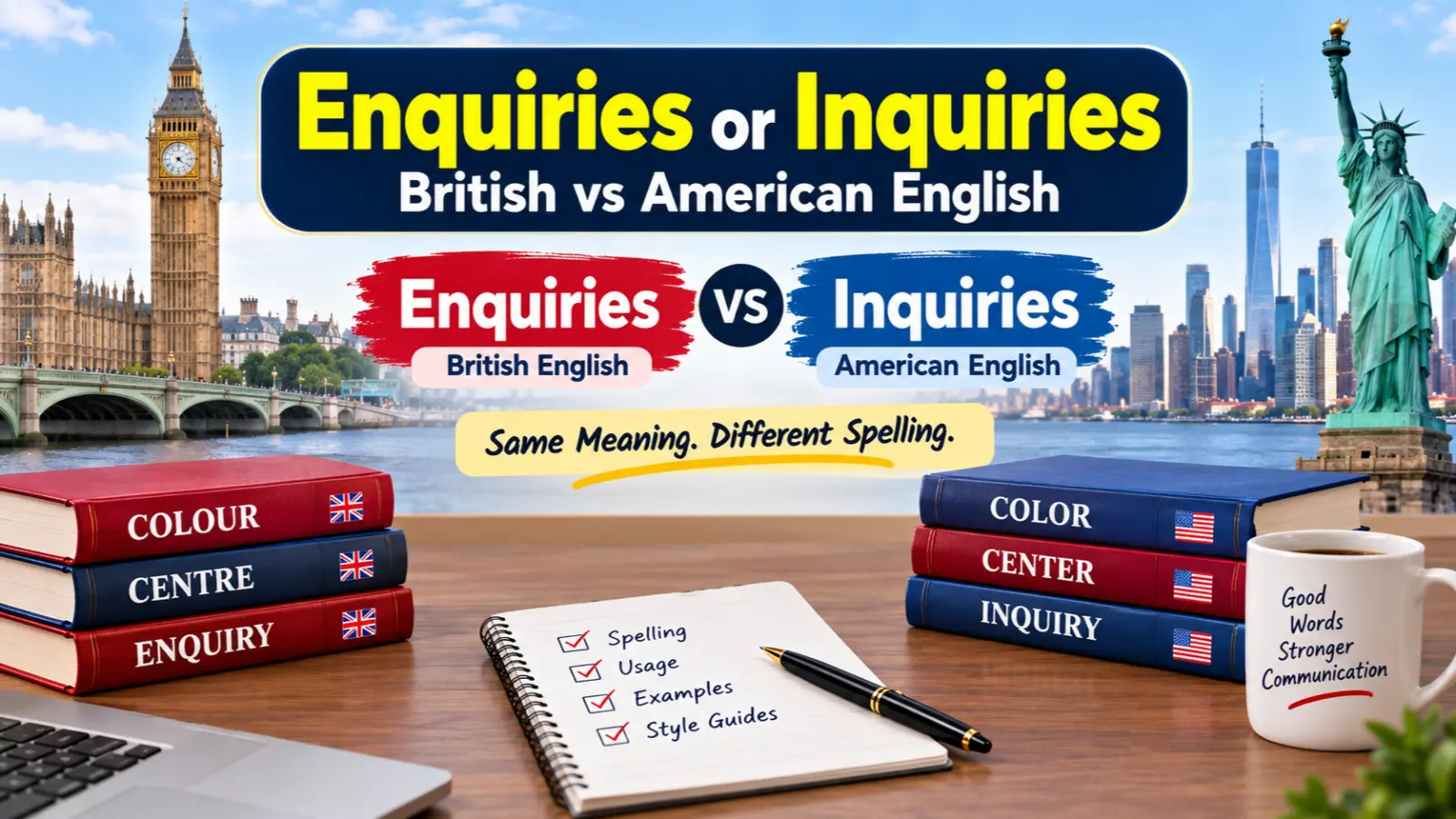
Enquiries or inquiries are both correct spellings, but their use often depends on the variety of English you are writing. Enquiries is strongly associated with British English, while inquiries is the standard spelling in American English.
Enquiries or Inquiries can be confusing because both words have the same meaning. The main difference comes from the type of English you use. “Enquiries” is more common in British English, while “inquiries” is preferred in American English.
If you are unsure which spelling fits your sentence, this guide will make the choice simple. We will explain the meaning, spelling, pronunciation, and correct usage of Enquiries or Inquiries with clear examples.
The two forms have the same basic meaning. They can describe requests for information, questions, or formal investigations. Cambridge lists enquiry as a UK spelling of inquiry, confirming that the difference is mainly regional rather than a difference between right and wrong English.
Enquiries or Inquiries at a Glance
| Spelling | Common usage | Example |
|---|---|---|
| enquiries | British English | We received several enquiries about the service. |
| inquiries | American English | We received several inquiries about the service. |
Quick answer: Use enquiries for British English and inquiries for American English. However, inquiry is also accepted in British English, especially in formal and official contexts.

Is Enquiries British English?
Yes. Enquiries is the traditional British spelling of the plural noun enquiry.
British writers commonly use it when referring to questions or requests for information.
For example:
- The office received several enquiries.
- Please direct all enquiries to the customer service team.
- We are answering enquiries from local residents.
- The website provides information for general enquiries.
Cambridge identifies enquiry as a UK form and gives inquiry as the alternative spelling.

Is Inquiries American English?
Yes. Inquiries is the standard plural form of inquiry in American English.
American businesses, universities, newspapers, and organizations commonly use phrases such as:
- customer inquiries
- media inquiries
- sales inquiries
- public inquiries
- further inquiries
- online inquiries
Cambridge’s American Dictionary examples use inquiries for requests for information and official investigations.
Are Enquiries and Inquiries Both Correct?
Yes. Neither spelling is simply a misspelling.
The main distinction is regional spelling:
British English: enquiry → enquiries
American English: inquiry → inquiries
British English can also use inquiry, particularly in formal or official writing. Cambridge specifically records inquiry as the main form and enquiry as a UK alternative.
A UK government style resource also notes that inquiry and enquiry have the same meanings and should not automatically be treated as words with different applications.
Enquiry and Inquiry in British English
British usage is slightly more complicated than a simple UK versus US rule.
You may encounter both forms in Britain:
- enquiry for a general request for information.
- inquiry for a formal investigation in some established usage.
- inquiry can also appear as a general request for information.
Modern dictionaries do not require a strict meaning difference. Cambridge defines inquiry as both a request for information and an official process of discovering facts. It also lists enquiry as a UK form.
Therefore, do not assume that every British text must use enquiry.

Enquiries in British Business Writing
British businesses often use enquiries in customer service and commercial communication.
Common examples include:
- product enquiries
- customer enquiries
- sales enquiries
- telephone enquiries
- email enquiries
- general enquiries
For a British audience, enquiries will usually look natural and familiar.
For example:
Please contact our team with any further enquiries.
An American business would normally write:
Please contact our team with any further inquiries.
The meaning remains unchanged.
Inquiries in American Business Writing
American businesses normally use inquiries in professional communication.
Common examples include:
- customer inquiries
- sales inquiries
- media inquiries
- product inquiries
- billing inquiries
- general inquiries
For example:
Please contact customer support with any further inquiries.
This spelling follows standard American usage and is especially common in business and institutional writing.
Usage in Academic Writing
Academic writers should follow the spelling conventions of their target publication, university, or style guide.
An American academic paper will generally use inquiry and inquiries.
For example:
The study raises several important inquiries about educational policy.
British academic writing may use enquiry and enquiries, but inquiry is also established in British academic contexts.
The important rule is consistency. If a journal or institution specifies a particular variety of English, follow its requirements.
Usage in Publishing Standards
Publishers normally establish a house style that determines spelling, punctuation, capitalization, and regional English.
A British publisher may prefer:
- enquiry
- enquiries
An American publisher may prefer:
- inquiry
- inquiries
The correct choice therefore depends on the publication’s audience and editorial standards.
For international publications, editors should choose one variety and apply it consistently rather than mixing regional spellings.
Official Style and Editorial Guidance
Official writing guidance generally emphasizes clarity, consistency, audience, and established house style.
The UK government writing guidance recommends clear English, short sentences, active construction, and writing with the audience in mind.
This matters when choosing enquiries or inquiries. The spelling should match the English variety used by the publication.
For example, a British government publication should normally follow its established British style. An American publication should normally follow its American style.
Dictionary Recommendations
Reliable dictionaries recognize both forms.
Cambridge Dictionary identifies enquiry as a UK spelling and inquiry as the broader form used in British and American English.
Cambridge also lists enquiries as the plural of enquiry and inquiries as the plural of inquiry.
This supports the practical rule:
British English: enquiries is common.
American English: inquiries is standard.
British English: inquiry is also acceptable.
Real World Examples
Here are simple examples showing how the spellings change across varieties.
British English
We have received several enquiries about the new service.
American English
We have received several inquiries about the new service.
British English
Please send all enquiries to the main office.
American English
Please send all inquiries to the main office.
Formal investigation
The government announced an inquiry into the incident.
In British English, inquiry can be especially natural in names and formal references to official investigations. Cambridge gives examples of official inquiries into accidents and other incidents.
History of the Spelling
The difference comes from the historical development of English spelling rather than from two completely different words.
The forms inquiry and enquiry developed alongside the related verbs inquire and enquire. Over time, regional preferences became stronger.
British English retained wider use of enquire and enquiry, while American English generally standardized inquire and inquiry.
Today, the distinction is primarily associated with regional usage. Modern dictionaries recognize the overlap instead of treating the forms as completely separate words.
International Communication
For international communication, the safest approach is consistency.
If your audience is mainly in the United States, use:
inquiry → inquiries
If your audience is mainly in the United Kingdom, use:
enquiry → enquiries
However, British organizations may also use inquiry, particularly for formal investigations or established names.
For websites serving a global audience, either form can work. The key is to follow the spelling system used throughout the rest of the content.
Common Mistakes to Avoid
Do not assume enquiries is always correct simply because the writer is using English.
Do not assume inquiries is always the only correct form.
Avoid mixing regional styles without a reason.
For example, using enquiries in one section and inquiries in another can make an otherwise polished document look inconsistent.
Also remember the singular forms:
- enquiry → enquiries
- inquiry → inquiries
The spelling changes from y to ies when forming the plural.
Which One Should You Use?
Choose enquiries when writing in a British English style and your organization prefers that traditional spelling.
Choose inquiries when writing in American English.
Choose inquiry when following an established British expression, official name, publication style, or formal usage where that spelling is preferred.
The best choice is not about declaring one spelling wrong. It is about matching the language variety and editorial style of your audience.
Frequently Asked Questions
Is enquiries British or American?
Enquiries is primarily associated with British English. American English normally uses inquiries. Cambridge identifies enquiry as a UK spelling of inquiry.
Is inquiries British English?
Yes. Inquiry and inquiries are also used in British English. However, enquiry and enquiries are strongly associated with British usage.
Which is correct, enquiries or inquiries?
Both are correct. Enquiries is common in British English, while inquiries is standard in American English.
What is the plural of enquiry?
The plural of enquiry is enquiries.
What is the plural of inquiry?
The plural of inquiry is inquiries.
Do enquiries and inquiries mean the same thing?
Generally, yes. Both can mean requests for information or formal investigations. Modern dictionary sources recognize the forms as spelling variants rather than completely different words.
Should I use enquiries for a UK audience?
Usually, yes, especially if your organization follows traditional British spelling. However, check the organization’s house style because inquiry is also established in British English.
Should I use inquiries for a US audience?
Yes. Inquiries is the normal American English spelling and is widely used in American business, academic, and professional writing.
Conclusion
Enquiries and inquiries are both correct spellings. The main difference is regional preference. Enquiries is strongly associated with British English, while inquiries is standard in American English.
British English also uses inquiry, especially in formal and official contexts. The best approach is to identify your audience, follow the appropriate dictionary or house style, and remain consistent throughout your writing.
For a quick rule, remember: British English often uses “enquiries,” while American English uses “inquiries.”

Olivia Bennett is a grammar expert and language content writer at GrammarWize.com. She specializes in English grammar, word usage, spelling differences, and writing improvement. Through clear explanations and practical examples, Olivia helps students, professionals, and language learners communicate more effectively. Her goal is to make English grammar simple, accessible, and easy to apply in everyday writing.