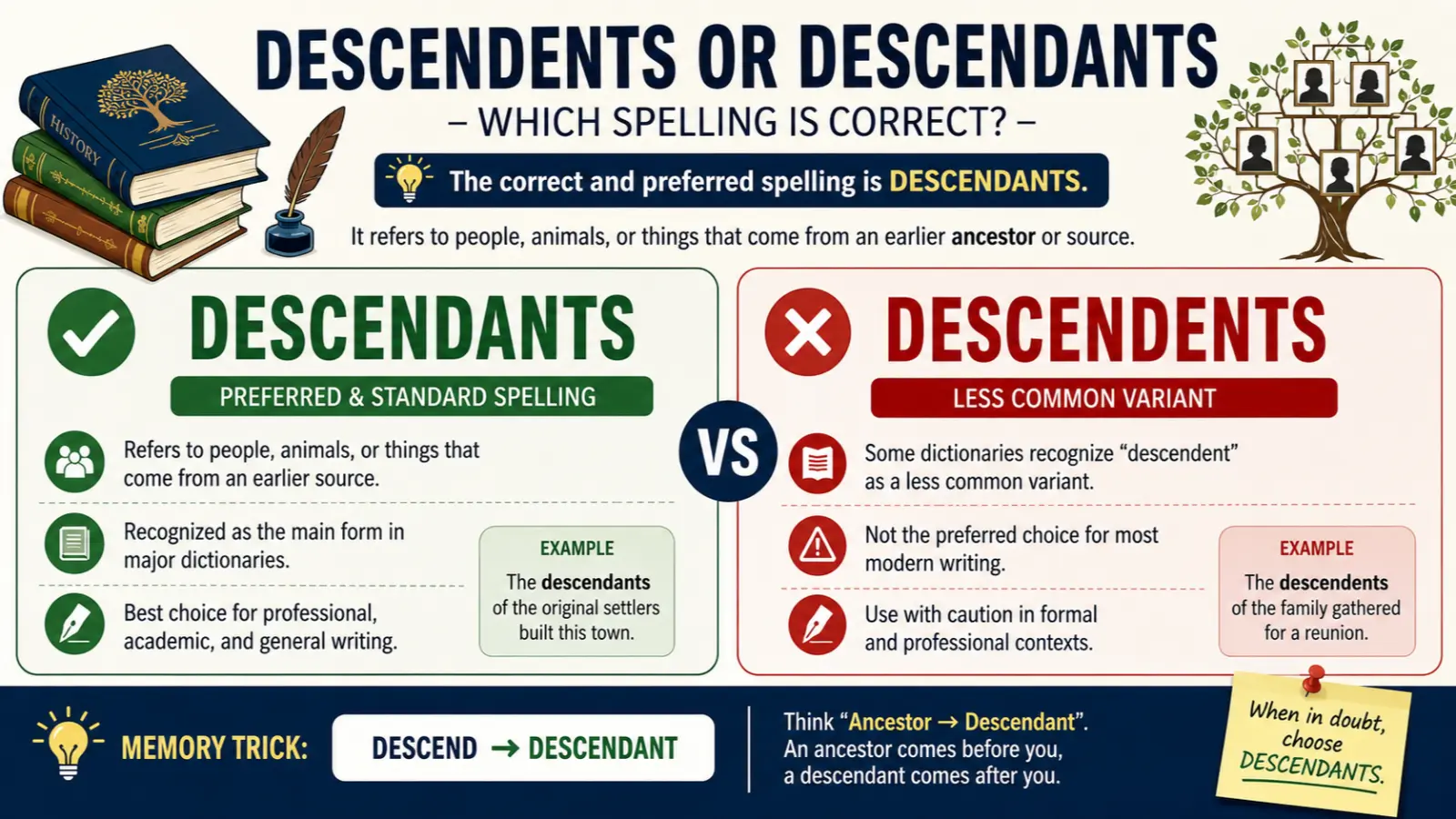
Descendents or descendants can cause confusion because both forms are seen in English writing. The key difference is that descendants is the standard spelling for people, animals, or things that come from an earlier ancestor or source.
Descendents or Descendants is a common spelling confusion in English. The correct spelling is descendants, with an a after the “d.” It refers to people, animals, or living things that come from a particular ancestor. “Descendents” is an incorrect spelling and should be avoided in formal and everyday writing.
Understanding the difference can help you write more accurately and confidently. In this guide, you will learn the correct spelling, meaning, pronunciation, and simple examples of descendants.
Major dictionaries recognize descendant as the main form. Merriam Webster also lists descendent as a less common variant, while Cambridge uses descendant as its standard headword.
Quick tip: For professional and general writing, use descendants.
Quick Answer
Descendants is the preferred spelling in standard modern English.
Descendents is not simply a spelling error in every context. Some dictionaries recognize descendent as a variant, especially as an adjective. However, descendants is the safest and most widely accepted choice when you mean people or things descended from an ancestor or earlier source.
At a Glance
| Word | Status | Best use |
|---|---|---|
| Descendants | Preferred standard form | People, animals, groups, or things descended from an earlier source |
| Descendents | Less common variant | Limited usage, mainly where a dictionary accepts the variant |
What Does Descendants Mean?
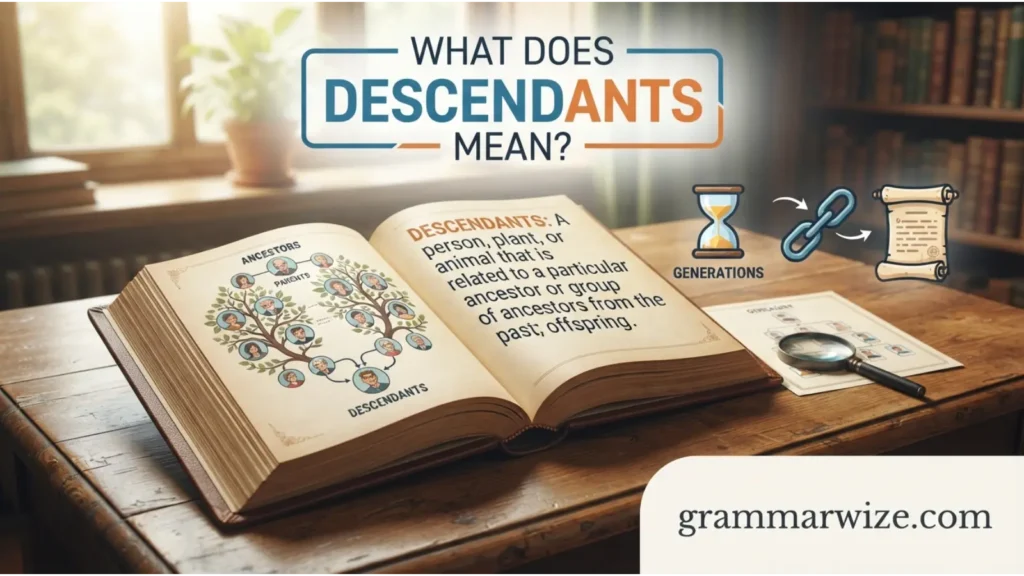
Descendants is the plural form of descendant.
A descendant is someone who comes from an earlier generation. This can mean a child, grandchild, or a more distant member of a family line. The word can also describe an animal, plant, group, idea, or object that developed from an earlier source. Cambridge gives examples involving family members, animals, and things influenced by earlier forms.
For example:
- The king’s descendants still live in the region.
- These horses are descendants of an older breed.
- Modern smartphones are descendants of earlier mobile devices.
The word can therefore describe both biological relationships and things that develop from earlier forms.
What Does Descendents Mean?
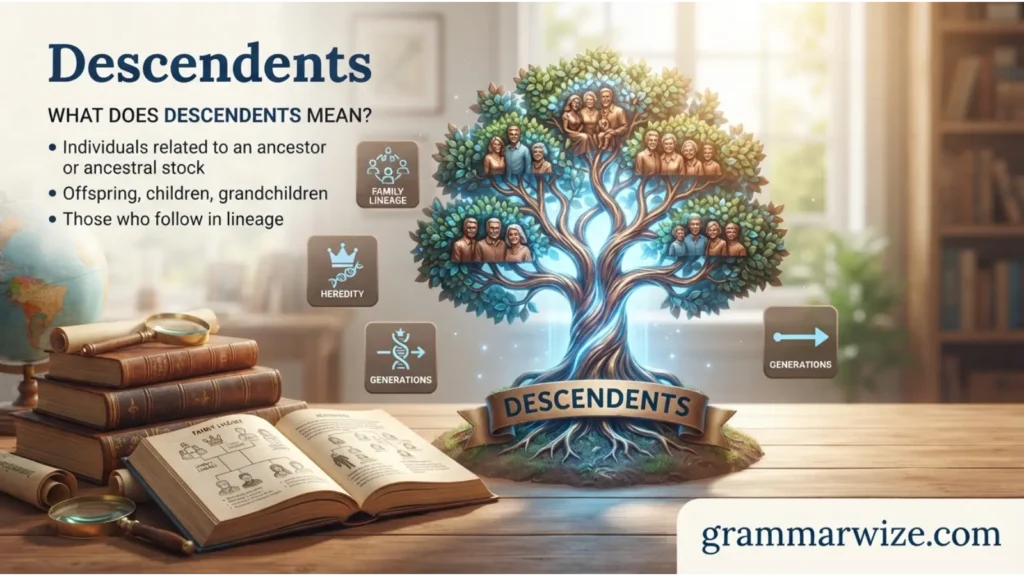
Descendents uses the same basic pronunciation as descendants, but the spelling contains ent instead of ant.
Some dictionaries recognize descendent as a variant of descendant. Merriam Webster lists descendent as a less common variant for both the adjective and noun. Collins also recognizes descendent as a variant.
However, usage differs between dictionaries and contexts. Cambridge’s main entry uses descendant, making it the clearer choice for ordinary modern writing.
This means you should not automatically treat every appearance of descendent as meaningless. It is a recognized form in some dictionaries, but it is much less useful as your default spelling.
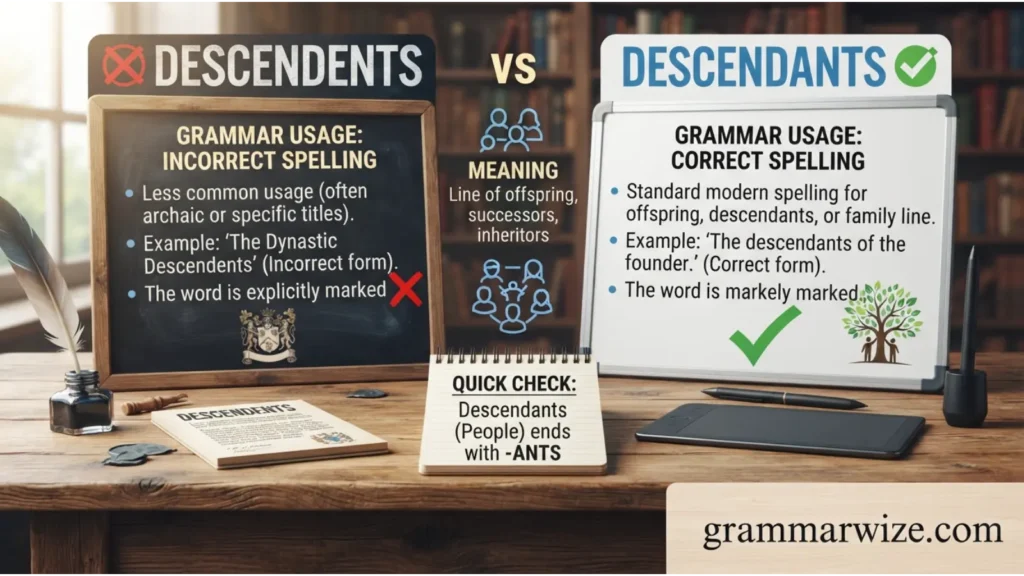
Descendents vs Descendants Comparison
| Feature | Descendants | Descendents |
|---|---|---|
| Standard spelling | Yes | Less common variant |
| Plural form | Yes | Possible variant usage |
| Refers to family members | Yes | Less preferred |
| Refers to things derived from earlier forms | Yes | Variant usage exists |
| Common in dictionaries | Yes | Recognized by some dictionaries |
| Recommended for professional writing | Yes | Usually avoid |
| Pronunciation | /dɪˈsen.dənt/ | Generally the same |
The important point is that the two forms are not always treated identically by every dictionary. Merriam Webster explicitly identifies descendent as a less common variant, while Cambridge’s standard entry is descendant.
Why Does the Confusion Exist?
The confusion comes partly from the word’s history and partly from the spelling pattern.
Descendant comes through French and Latin sources connected with the verb descend, meaning to go downward. Merriam Webster traces it to Middle English and ultimately to Latin descendere.
The endings ant and ent also appear in many English words. This makes it easy to choose the wrong ending when writing from memory.
There is another reason for the confusion. Dictionaries do record descendent as a variant. Merriam Webster, for example, lists it as less common. Collins likewise recognizes the form.
So the confusion is understandable, but descendants remains the better default.
Dictionary Recommendations
Dictionary evidence strongly supports descendant as the main form.
Cambridge Dictionary defines descendant as a person related to someone from an earlier generation. It also uses the plural descendants in its examples.
Merriam Webster gives descendant as the main entry and lists descendent as a less common variant. Its noun definition includes someone descended from another person or from a common ancestral source.
Collins Dictionary also recognizes descendant and notes descendent as a variant.
The practical conclusion is simple: descendants is the safest spelling for general English writing.
Real Life Examples
Family History
- The descendants of the original settlers formed a large community.
- Researchers contacted the descendants of the historical figure.
- His descendants preserved the family records.
Animals and Plants
- Modern horses are descendants of earlier horse populations.
- These plants are descendants of a rare wild variety.
- Scientists studied the descendants of the original breeding population.
Technology and Ideas
- Modern tablets are descendants of earlier portable computers.
- The new system is a descendant of an older design.
- Many modern theories are descendants of earlier scientific ideas.
These uses match the broader dictionary meaning of the word. A descendant can be something that comes from an earlier biological or conceptual source.
Common Mistakes
Using Descendents in Formal Writing
The spelling may appear in dictionaries as a variant, but it is not the strongest choice for most professional writing.
Better:
The descendants of the author donated his papers.
Confusing Descendant With Descent
These words are related but have different meanings.
Descent refers to the act or fact of coming down or being related to an earlier family line.
Descendant refers to a person, animal, or thing that comes from an earlier source.
For example:
She is of Irish descent.
But:
She is a descendant of Irish immigrants.
Adding the Wrong Ending
Because descendent looks natural in English, writers may choose it automatically. For a person or family member, descendant is the better standard choice.
An Easy Memory Trick
Remember this simple connection:
Descend → Descendant
The word descendant keeps the ant ending found in the standard noun.
You can also remember:
Ancestor → Descendant
An ancestor comes before you in a family line. A descendant comes after you.
So when talking about future generations, think descendants.
Professional Writing Recommendation
For essays, business documents, websites, academic writing, genealogy articles, and general communication, use descendants.
It is clear, familiar, and supported as the standard headword by major dictionaries. Cambridge uses descendant as its main form, while Merriam Webster identifies descendent as less common.
If you are editing a formal document, changing descendents to descendants will usually make the wording more conventional.
There is one important qualification. If you are quoting a historical document or following a specific dictionary or house style that permits descendent, you may preserve that form. Otherwise, descendants is the safest option.
Frequently Asked Questions
Is descendants the correct spelling?
Yes. Descendants is the preferred standard plural spelling of descendant.
Is descendents a real word?
It can be found as a recognized variant in some dictionaries. Merriam Webster lists descendent as a less common variant.
Should I use descendents in an essay?
It is better to use descendants. It is the more standard and widely recognized form.
What is the singular of descendants?
The singular form is descendant.
What is the difference between descent and descendant?
Descent refers to a person’s family origin or the act of coming down. Descendant refers to someone or something that comes from an earlier person, group, species, or source.
Are descendants and descendents pronounced the same?
They are generally pronounced the same. Cambridge gives the pronunciation of descendant as /dɪˈsen.dənt/ in both British and American English.
Is descendant used only for people?
No. A descendant can also be an animal, plant, group, idea, technology, or other thing that developed from an earlier source.
Conclusion
Descendents or descendants can be confusing because descendent is recognized as a variant by some dictionaries. Still, descendants is the preferred spelling for most modern English writing.
Use descendants when referring to later generations, animals from an earlier population, or things derived from an earlier source. It is the clearest choice for professional, academic, and everyday writing.
When in doubt, choose descendants.

Olivia Bennett is a grammar expert and language content writer at GrammarWize.com. She specializes in English grammar, word usage, spelling differences, and writing improvement. Through clear explanations and practical examples, Olivia helps students, professionals, and language learners communicate more effectively. Her goal is to make English grammar simple, accessible, and easy to apply in everyday writing.