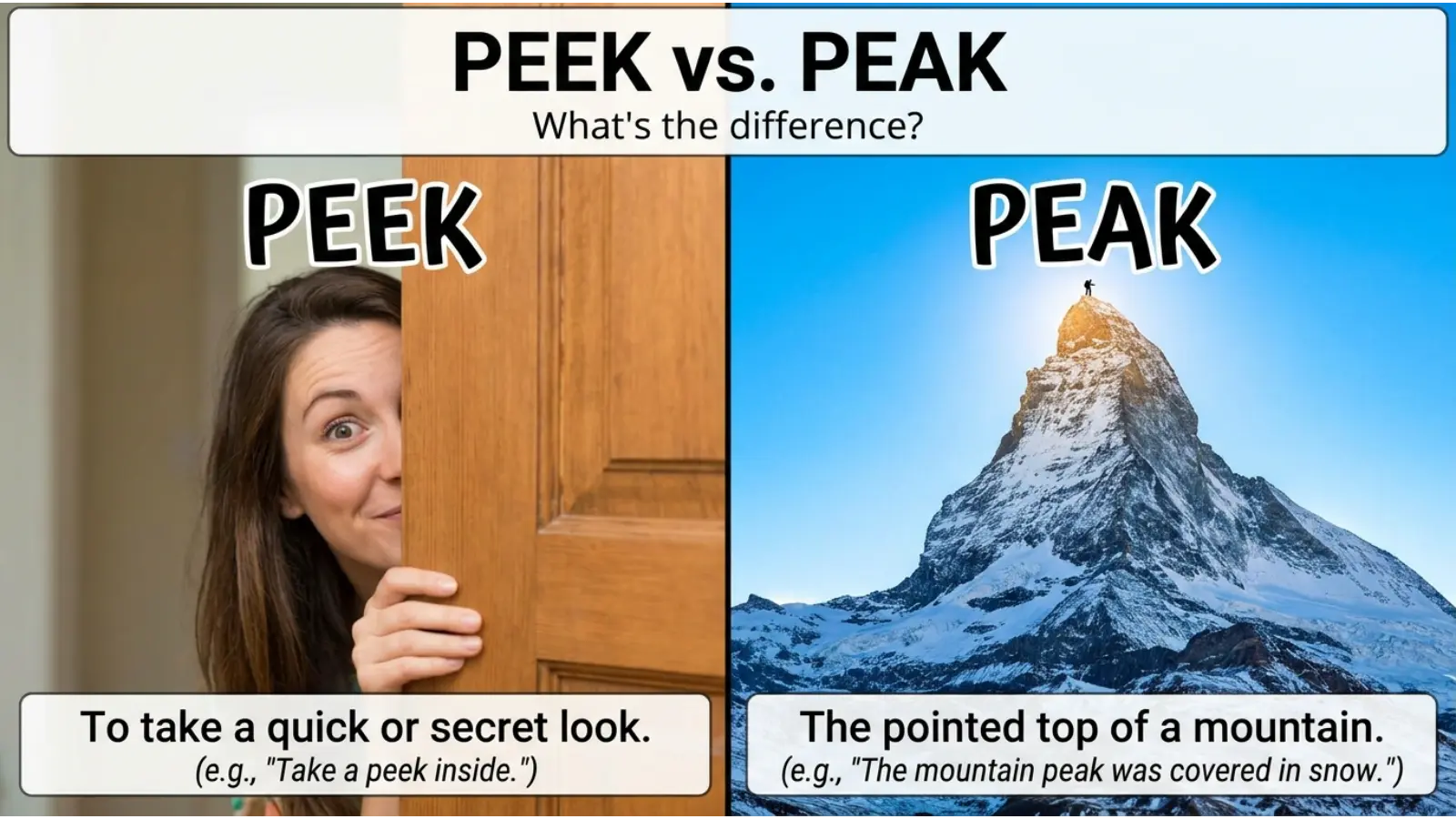
Peek or peak can confuse English learners because both words sound alike but have different meanings. The correct choice depends on what you want to say. Peek means to look quickly or secretly at something. Peak means the highest point, level, or stage of something.
For example, you might peek through a window to see what is happening inside. A mountain peak, however, is its highest point. These words also work differently in sentences because peek usually describes an action, while peak often names a place, level, or stage.
Learning the difference between peek and peak can improve your emails, school assignments, conversations, and professional writing. This guide explains their meanings, grammar rules, sentence structures, and common mistakes. You will also learn a simple memory trick to choose the right word confidently.
Quick Answer:
- Peek: To look quickly, secretly, or through a small opening.
- Peak: The highest point, greatest level, or most successful stage.
Examples:
- I took a peek through the door.
- The climbers finally reached the mountain peak.
Remember that you peek with your eyes, while a peak is the top of something.

What Does Peek Mean?
Peek is a verb that means to look at something quickly, secretly, or from a hidden position. It can also be a noun that describes a quick or secret look.
People often use this word when they do not want to be noticed or when they only want a brief view.
Examples of peek as a verb:
- The child peeked through the curtains.
- She peeked inside the gift box before opening it.
Examples of peek as a noun:
- I took a quick peek at the results.
- He gave us a peek at his new artwork.
How to Use Peek in a Sentence
Peek commonly appears with words such as at, through, and inside. These words explain what someone looks at or where they look.
For example, “She peeked through the window” describes looking through an opening. “He took a peek at the letter” describes a brief look at something.
You can also use peek in the phrase sneak peek, which means an early or limited look at something before its official release.
What Does Peak Mean?
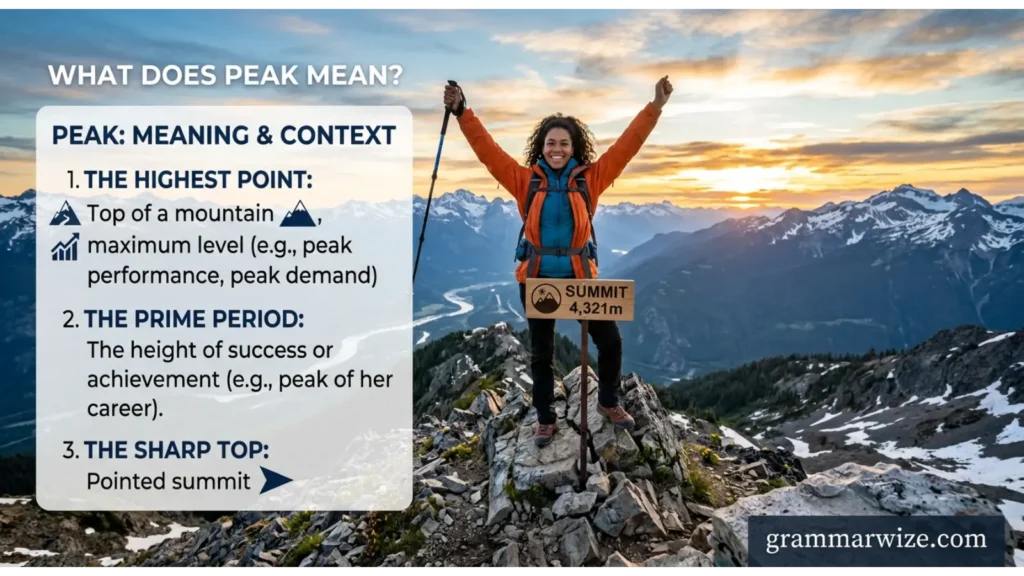
Peak is a noun or verb related to the highest point, greatest level, or most intense stage of something.
As a noun, peak can describe the top of a mountain, the busiest time of day, or the highest level of performance. As a verb, it means to reach the highest point or level.
Examples of peak as a noun:
- The hikers reached the peak before sunset.
- Traffic reaches its peak during the evening rush hour.
Examples of peak as a verb:
- Her athletic performance peaked at age twenty-five.
- Demand for the product peaks during the holiday season.
How to Use Peak in a Sentence
Use peak when you describe a maximum level, a summit, or the strongest stage of an activity or process.
For example, “Sales reached their peak in December” means sales were at their highest level that month. “The mountain peak was covered in snow” refers to the mountain’s top.
Peak can also describe a period of excellent performance. Someone at the peak of their career is performing at or near their highest professional level.
Peek vs Peak: Key Differences
| Feature | Peek | Peak |
|---|---|---|
| Main meaning | A quick or secret look | The highest point or level |
| Part of speech | Noun and verb | Noun, verb, and adjective |
| Common phrase | Take a peek | Reach a peak |
| Related idea | Looking or observing | Height or maximum level |
| Example | She peeked through the door. | They climbed to the peak. |
| Memory clue | Eyes looking | Top of a mountain |
The main difference is the idea each word expresses. Peek involves looking, while peak involves a top or maximum.
Grammar Rules for Peek and Peak
Both words can appear in different sentence structures. Understanding their grammatical roles makes choosing between them easier.
Peek as a Verb
Use peek when someone performs the action of looking briefly or secretly.
Common structures include:
- Subject + peek: The baby peeked.
- Subject + peek at + object: I peeked at the message.
- Subject + peek through + opening: She peeked through the curtains.
The verb changes according to tense. Its common forms are peek, peeked, and peeking.
Peek as a Noun
When peek acts as a noun, it usually refers to a brief look.
Common structures include:
- Take a peek at the photograph.
- Get a peek inside the building.
- Give someone a sneak peek.
In these examples, peek names the act of looking rather than describing it as a verb.
Peak as a Noun
Peak names a highest point or level.
Common structures include:
- The peak of the mountain.
- The peak of her career.
- Demand reached its peak.
You can use peak with of to identify what has reached its highest point.
Peak as a Verb
Peak can describe something reaching its highest level.
Examples include:
- Prices peaked last summer.
- The athlete peaked at the right time.
- Tourist numbers peak during the holidays.
Unlike peek, this verb does not describe looking. It describes reaching a maximum.
Peak as an Adjective
Peak can also describe the busiest or most active period.
Examples include:
- We traveled during peak season.
- The road is crowded during peak hours.
- The hotel charges more during peak periods.
In these phrases, peak modifies a noun and identifies a time of high demand or activity.
Peek or Peak in Everyday Examples
The following examples show how context changes the correct word.
At Home
- Peek: The little boy peeked into the kitchen.
- Peak: The heating system uses more energy during peak hours.
At School
- Peek: Maya took a peek at her friend’s drawing.
- Peak: The student’s performance peaked during the final term.
At Work
- Peek: The manager gave us a sneak peek at the new design.
- Peak: The company’s sales reached their peak in June.
While Traveling
- Peek: We peeked through the train window.
- Peak: The mountain peak disappeared behind the clouds.
In Sports
- Peek: The player peeked around the corner before moving forward.
- Peak: The runner reached peak fitness before the competition.

Common Mistakes When Using Peek and Peak
Using Peak When You Mean a Quick Look
Incorrect: I took a peak at the report.
Correct: I took a peek at the report.
The sentence describes looking briefly, so peek is the right word.
Using Peek for the Top of a Mountain
Incorrect: We reached the peek of the mountain.
Correct: We reached the peak of the mountain.
A mountain’s highest point is its peak.
Confusing Sneak Peek With Sneak Peak
Incorrect: The company released a sneak peak of its new product.
Correct: The company released a sneak peek of its new product.
The expression means an early look, so it uses peek.
Using Peek to Describe Maximum Performance
Incorrect: The athlete peeked in performance last year.
Correct: The athlete peaked in performance last year.
The second sentence describes reaching the highest level of performance.
Choosing a Word Without Checking Its Meaning
Incorrect: The mountain’s peek was difficult to reach.
Correct: The mountain’s peak was difficult to reach.
When describing height, use peak. When describing an act of looking, use peek.
Peek vs Peak in Formal and Professional Writing
Both words are acceptable in formal writing, but they serve different purposes.
Use peek when describing a brief look at a document, presentation, product, or private area. For example, “The client requested a sneak peek at the proposed design.”
Use peak when discussing performance, sales, demand, productivity, or physical height. For example, “Customer demand reached its peak during the holiday season.”
In reports and business documents, peak often appears in phrases such as peak demand, peak performance, and peak hours. Peek is more common in conversational writing, marketing copy, and descriptions of early access.
Neither word is inherently informal. The meaning and context determine which one fits.
Easy Memory Trick for Peek and Peak
Use these simple reminders to remember the difference.
Peek has two e’s, like eyes. Think of someone peeking through a keyhole to see what is happening.
Peak has an a, like apex. Both peak and apex refer to a top or highest point.
Try this quick test:
- If someone is looking, choose peek.
- If something is at the top or highest level, choose peak.
For example, you can peek at a mountain through binoculars, but the mountain itself has a peak.
Real-Life Conversations Using Peek and Peak
Conversation 1: Looking at a gift
Anna: Can I take a peek at your present?
Sam: Not yet. You have to wait until your birthday.
Conversation 2: Planning a hike
Leo: How long will it take to reach the peak?
Mia: About three hours if we keep a steady pace.
Conversation 3: Marketing a product
Manager: Can we share a sneak peek of the new collection?
Designer: Yes, but we should wait until the images are approved.
Conversation 4: Discussing business results
Ali: When did our sales reach their peak?
Sara: They reached their highest level in December.
Conversation 5: Talking about a busy road
Driver: Why is traffic so heavy right now?
Passenger: We are traveling during peak hours.
Frequently Asked Questions
Is peek or peak correct?
Both words are correct. Peek means to look quickly or secretly, while peak refers to the highest point or level.
What is the difference between peek and peak?
Peek describes a quick look or the act of looking. Peak describes a summit, maximum level, or highest stage.
Is it sneak peek or sneak peak?
The correct expression is sneak peek. It means an early or limited look at something before its full release.
Can peak be used as a verb?
Yes. Peak means to reach the highest point or level. For example, “Sales peaked in December.”
What is the past tense of peek?
The past tense is peeked. For example, “She peeked through the window.”
What is the past tense of peak?
The past tense is peaked. For example, “Demand peaked last month.”
Conclusion
Peek and peak sound alike, but they communicate different ideas. Peek refers to looking briefly or secretly, while peak describes the highest point, level, or stage.
Use peek in sentences about looking through a window, checking a message, or getting an early look at a product. Use peak when discussing a mountain summit, peak performance, or maximum demand.
Remember the simple rule: You peek with your eyes, and you reach a peak at the top. This distinction will help you use both words correctly in everyday conversations and professional writing.

Olivia Bennett is a grammar expert and language content writer at GrammarWize.com. She specializes in English grammar, word usage, spelling differences, and writing improvement. Through clear explanations and practical examples, Olivia helps students, professionals, and language learners communicate more effectively. Her goal is to make English grammar simple, accessible, and easy to apply in everyday writing.