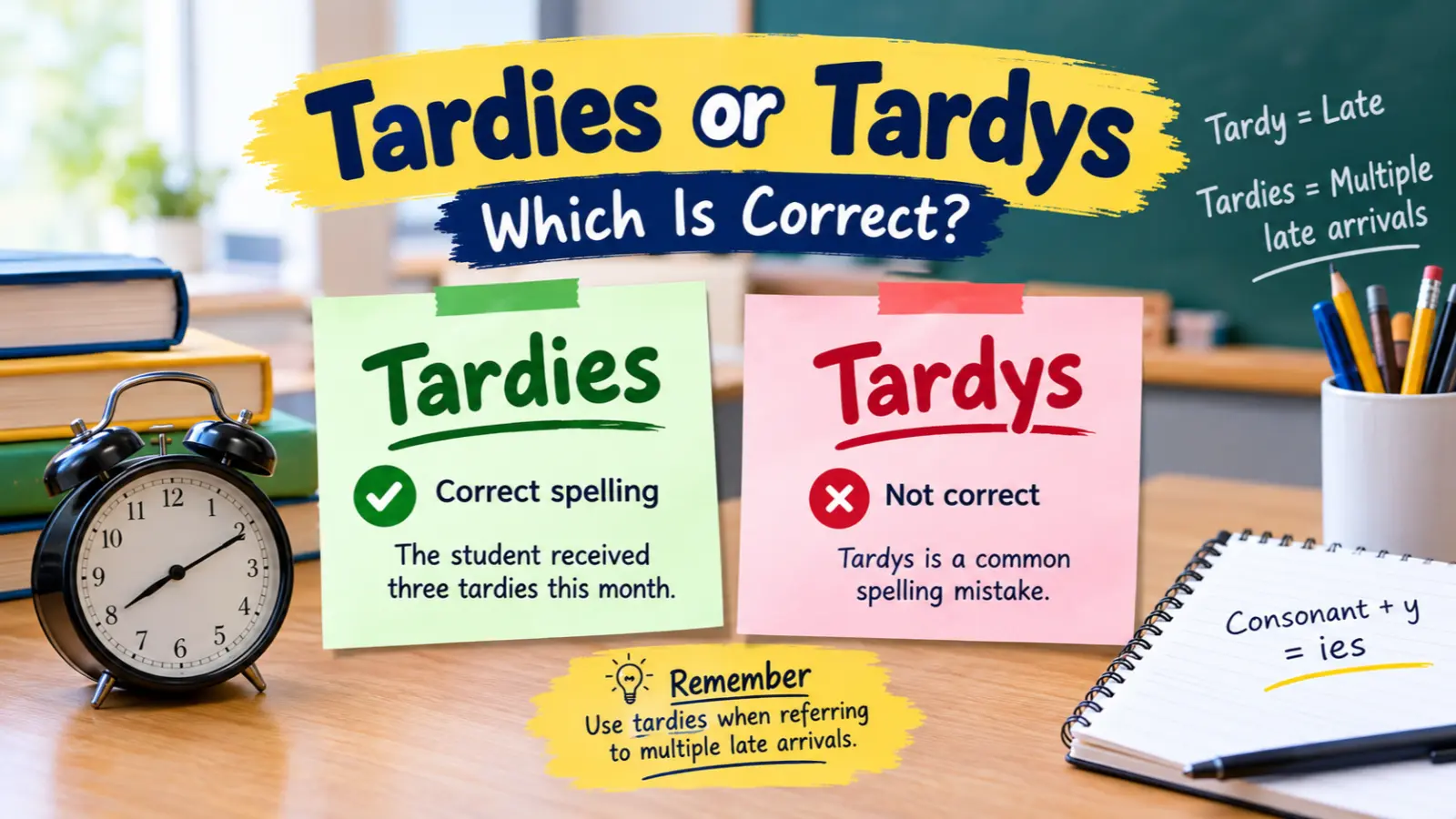
Tardies or tardys is a common spelling question for students, teachers, and writers. Both forms look similar, but only one follows standard English spelling rules. The correct plural spelling is tardies.
Tardies or Tardys is a common spelling confusion when writing about late arrivals at school or work. The correct spelling is tardies, the plural form of tardy. It refers to situations when someone arrives late or fails to be on time. Although “tardys” may look like a possible spelling, it is incorrect in standard English.
If you are searching for the correct spelling, meaning, and usage of these words, you are in the right place. Learn why “tardies” is correct, how to use it in sentences, and how to remember its spelling easily. This guide will help you write confidently in school assignments, workplace emails, and everyday conversations.
The word “tardy” describes someone or something that is late. When you need to talk about multiple late arrivals, you change the ending from y to ies. This simple rule helps you write accurately in school reports, attendance records, emails, and everyday conversations. Use tardies when referring to multiple instances of being late. The spelling “tardys” is not standard English.
Quick Answer
- Tardies is the correct plural of “tardy.”
- Tardys is a common spelling mistake.
- Example: The student received three tardies this month.
What Does Tardy Mean?
“Tardy” means late or delayed. It often describes someone who does not arrive at the expected time.
The word can function as an adjective or, in school attendance contexts, as a noun.
Examples:
- The student was tardy for class.
- The teacher recorded a tardy on the attendance sheet.
When schools use “tardy” as a noun, it refers to an instance of arriving late.
Tardies vs Tardys: Key Differences
|
Feature
|
Tardies
|
Tardys
|
| — | — | — |
|
Spelling
|
Correct
|
Incorrect
|
|
Grammar
|
Plural noun
|
Nonstandard spelling
|
|
Singular form
|
Tardy
|
Tardy
|
|
Usage
|
Standard English
|
Avoid in formal writing
|
|
Example
|
Five tardies
|
Five tardys
|
The important difference is the ending. Standard English changes the consonant-plus-y ending to ies when forming this plural.

Why Is Tardies the Correct Spelling?
English has a common plural rule for nouns ending in a consonant followed by y.
You usually remove the y and add ies.
Examples include:
- Tardy → Tardies
- Baby → Babies
- City → Cities
- Party → Parties
- Activity → Activities
Since “tardy” ends in a consonant followed by y, its plural is “tardies.”

When Should You Use Tardies?
Use “tardies” when referring to more than one late arrival or recorded instance of lateness.
School Attendance
Teachers and administrators commonly use the word in attendance records.
- The student has four tardies this semester.
- The school tracks tardies every week.
Workplace Attendance
The word can also appear in workplace policies or attendance discussions.
- The employee received two tardies this month.
- The manager reviewed the team’s tardies.
Everyday Conversations
People may use “tardies” informally when discussing lateness.
- I already have three tardies this week.
- How many tardies did you get last semester?
Common Mistakes to Avoid
Writing Tardys Instead of Tardies
Incorrect: She received two tardys.
Correct: She received two tardies.
Remember to replace the final y with ies.
Using Tardies as an Adjective
Incorrect: The tardies student missed the bus.
Correct: The tardy student missed the bus.
Use “tardy” to describe one student who is late. Use “tardies” for multiple recorded instances of lateness.
Confusing Tardies With Tardy
Incorrect: He was three tardy this month.
Correct: He received three tardies this month.
Use the plural noun when counting separate late arrivals.

Tardy, Tardier, and Tardiest
“Tardies” is not the comparative or superlative form of “tardy.”
|
Word
|
Meaning
|
Example
|
| — | — | — |
|
Tardy
|
Late
|
The student was tardy.
|
|
Tardier
|
More late
|
His arrival was tardier than usual.
|
|
Tardiest
|
Most late
|
That was her tardiest arrival yet.
|
|
Tardies
|
Multiple recorded late arrivals
|
He has two tardies.
|
“Tardier” and “tardiest” are grammatically possible, but people often use “later” and “latest” instead.
Easy Memory Trick
Remember this simple rule:
Consonant + y = ies for many English plurals.
Think of “baby” becoming “babies.” The same spelling pattern applies to “tardy.”
- One tardy.
- Two tardies.
- Three tardies.
Avoid “tardys” because it does not follow the standard plural pattern.
Real-Life Conversation Examples
Conversation 1: At School
Student: How many tardies do I have?
Teacher: You have three tardies this month.
Conversation 2: Talking About Attendance
Parent: Did you arrive late today?
Student: Yes, but it was only my second tardy.
Conversation 3: Discussing School Records
Teacher: Your attendance record shows four tardies.
Student: I’ll make sure to arrive on time.
Frequently Asked Questions
1. Is tardies or tardys correct?
“Tardies” is correct. It is the standard plural spelling of “tardy.” “Tardys” is a spelling mistake.
2. What is the plural of tardy?
The plural is “tardies.” Replace the final y with ies.
3. Is tardies a real word?
Yes. “Tardies” is a standard plural noun, especially in school attendance contexts.
4. Can tardy be used as a noun?
Yes. In attendance contexts, “a tardy” can mean one recorded instance of arriving late.
5. Is tardies formal or informal?
“Tardies” is acceptable in both formal and informal writing when used correctly. Schools may use it in official attendance records.
Conclusion
The correct spelling is tardies, not “tardys.” Use “tardy” for one late arrival and “tardies” for multiple instances.
Remember the simple spelling rule: when a word ends in a consonant followed by y, its plural often changes to ies. This will help you avoid the mistake in school records, emails, and everyday writing.

Olivia Bennett is a grammar expert and language content writer at GrammarWize.com. She specializes in English grammar, word usage, spelling differences, and writing improvement. Through clear explanations and practical examples, Olivia helps students, professionals, and language learners communicate more effectively. Her goal is to make English grammar simple, accessible, and easy to apply in everyday writing.