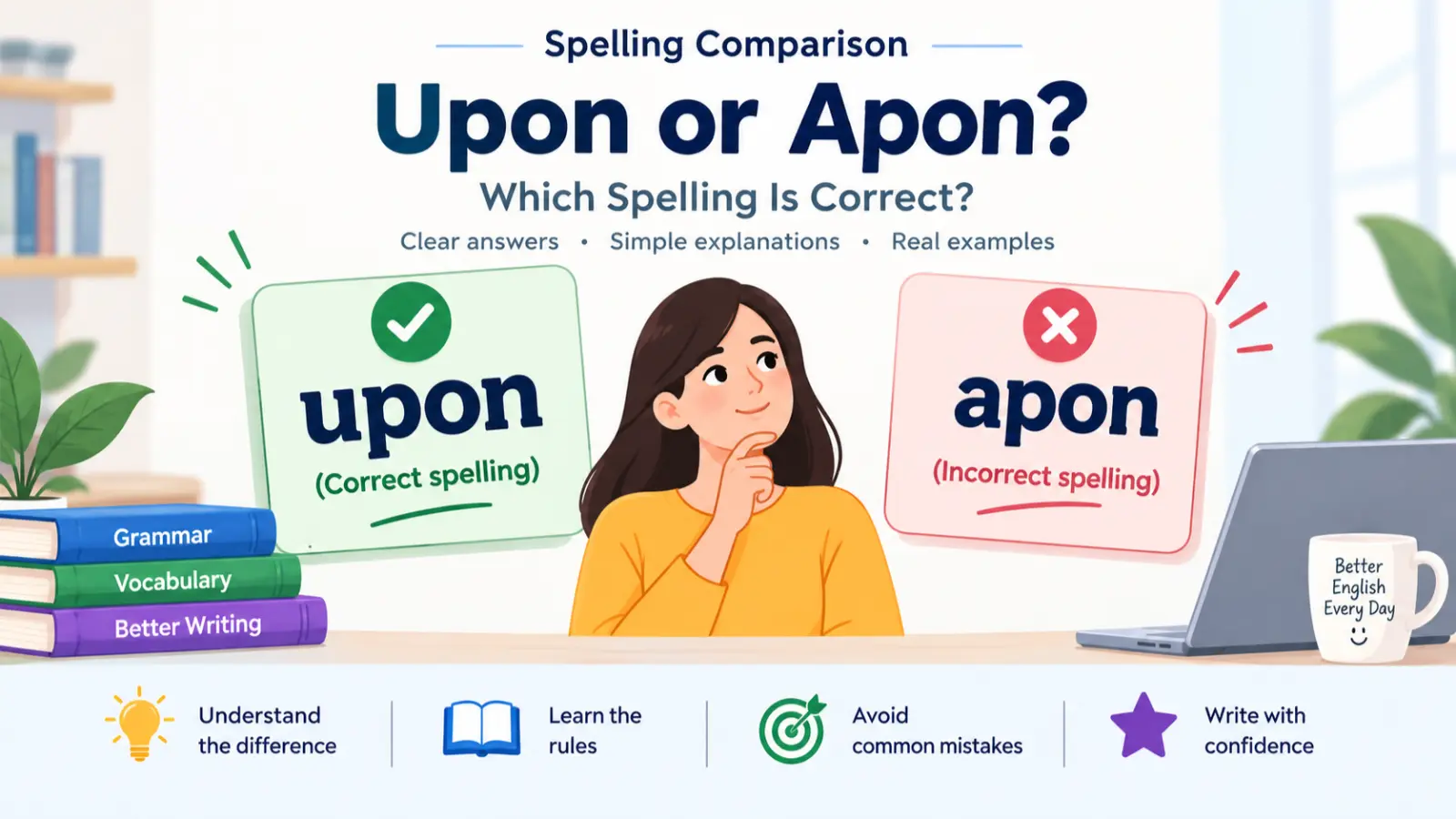
Upon or Apon can be confusing because both forms may sound similar in speech. However, only upon is the standard English spelling used in dictionaries and professional writing.
Upon or Apon can be confusing when you are unsure which spelling is correct. Upon is the correct standard English word, while Apon is generally considered a misspelling. After is commonly used in formal writing and means on, immediately after, or at the time of something.
In this guide, we will explain Upon or Apon with clear meanings, examples, and simple usage tips. You will quickly learn the correct spelling and how to use upon naturally in everyday and professional English.
Apon is usually a spelling mistake. Once you understand the meaning and common uses of upon, it becomes much easier to choose the right form.
Quick Answer
Upon is the correct spelling.
Apon is not the standard spelling of this English word. In most cases, you should use upon in formal, academic, business, and everyday writing.

What Does Upon Mean?
Upon is a preposition that can mean on, immediately after, or at the time of something.
Examples:
- The cat jumped upon the table.
- Upon arrival, please check in at the front desk.
- She smiled upon hearing the good news.
The exact meaning depends on the sentence.

Why Do People Write Apon?
The confusion usually comes from pronunciation. In natural speech, upon can sound less distinct, especially when spoken quickly.
People may also spell it as apon because they associate the sound with the letters they hear. However, pronunciation does not change the standard spelling.
Upon vs Apon
| Word | Correct? | Meaning | Recommended Use |
|---|---|---|---|
| Upon | Yes | On, after, or at the time of | All standard writing |
| Apon | No | Usually a misspelling of upon | Avoid |
Examples of Upon in Sentences
Here are some natural examples of upon:
- The decision was made upon careful review.
- Upon entering the room, he greeted everyone.
- The flowers opened upon receiving sunlight.
- She called me upon her arrival.
- The agreement takes effect upon signing.
- He acted upon the advice of his teacher.
These examples show how upon can express time, position, or the basis for an action.
Is Apon Ever Correct?
In standard modern English, apon is generally not the correct spelling for the word upon.
If you are writing an email, essay, report, article, application, or other professional text, use upon.
Apon may appear as a name, place name, surname, or other proper term in specific contexts. That does not make it an alternative spelling of the English preposition upon.

Common Mistakes With Upon
A common mistake is replacing upon with apon because the two forms sound similar.
Incorrect: Apon arrival, call the office.
Correct: Upon arrival, call the office.
Another mistake is assuming that upon always means exactly “on.” Its meaning can change according to context.
For example:
- Upon arrival means when or after arriving.
- Upon the table can mean on the table.
Easy Memory Trick
Remember this simple rule:
Upon has U after the first letter.
Think of the phrase:
U = Upon
Whenever you mean on, after, or at the time of, check if upon fits the sentence.
Professional Writing Recommendation
Use upon whenever you need this word in standard English writing.
It is suitable for:
- Academic writing.
- Business documents.
- Emails.
- Reports.
- Websites.
- Formal letters.
- Everyday writing.
Avoid apon unless it is being used as a specific name or proper term.
Frequently Asked Questions
Is Upon the correct spelling?
Yes. Upon is the standard and correct spelling.
Is Apon a word?
Apon is generally not the standard spelling of the English preposition upon. It is usually a misspelling.
What is the meaning of upon?
Upon can mean on, after, or at the time of, depending on context.
Should I use upon in formal writing?
Yes. Upon is appropriate in formal, academic, business, and professional writing.
Is upon the same as on?
Sometimes. For example, upon the table can mean on the table. In phrases such as upon arrival, it means when or after arrival.
Conclusion
Upon is the correct spelling, while apon is generally a misspelling. The confusion mainly comes from the similar sound of the two forms. For clear and professional English, always choose upon when you mean “on,” “after,” or “at the time of.”

Olivia Bennett is a grammar expert and language content writer at GrammarWize.com. She specializes in English grammar, word usage, spelling differences, and writing improvement. Through clear explanations and practical examples, Olivia helps students, professionals, and language learners communicate more effectively. Her goal is to make English grammar simple, accessible, and easy to apply in everyday writing.