Will or Would can be confusing because both words talk about the future, choices, and possible actions. However, they do not always work in the same situations.
Will or Would can be confusing because both modal verbs talk about the future, choices, and possibilities. However, they are used differently depending on certainty, time, and the situation.
In this guide, you will learn the simple difference between will and would, with clear examples and practical rules. If you often wonder when to use will or would in everyday English, this comparison will help you choose the right word with confidence.
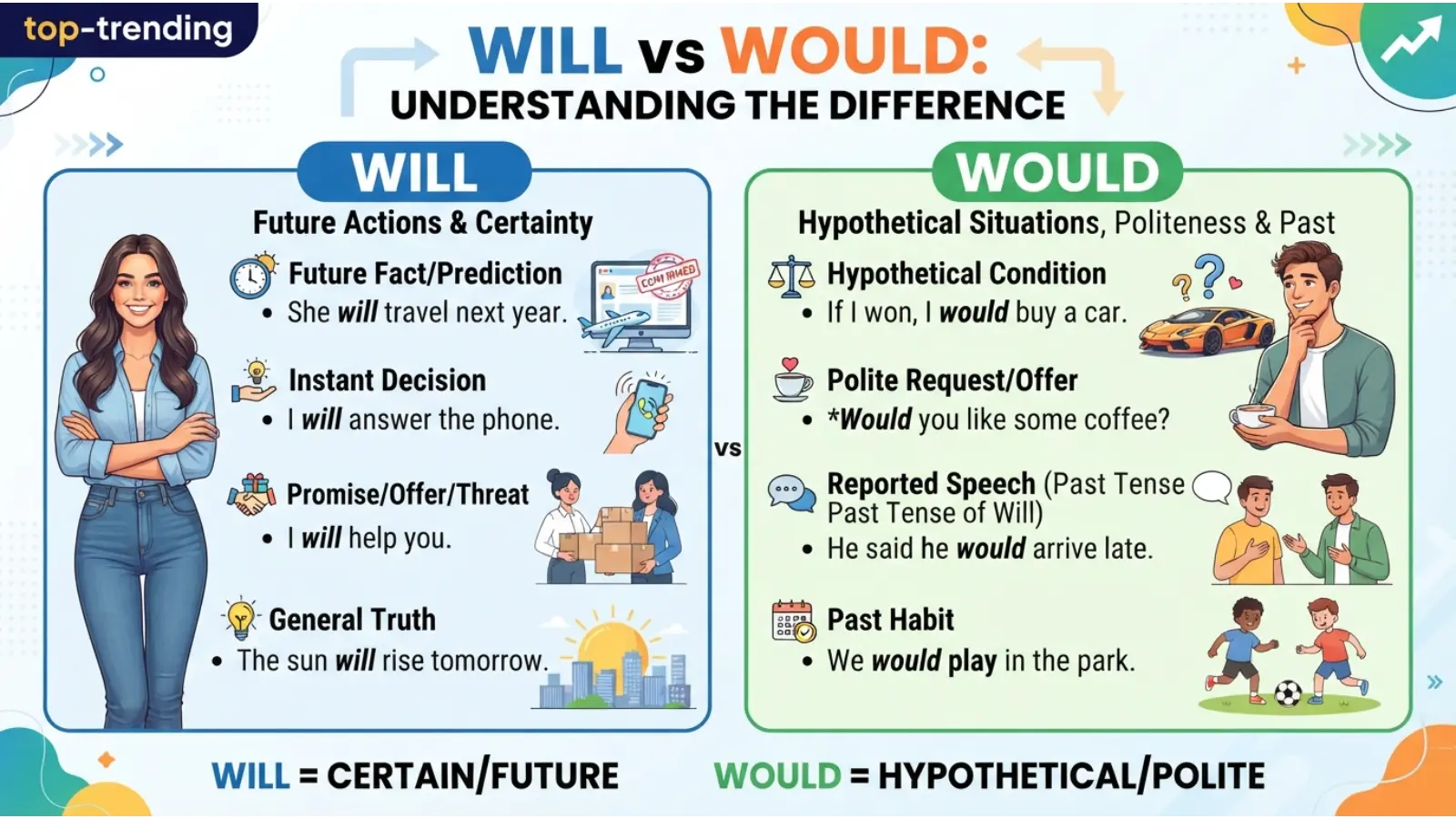
The main difference is simple. Will often expresses a future action, decision, promise, or strong expectation. Would often describes a conditional situation, a polite request, a repeated past action, or something viewed from the past. Learning this difference can help you write and speak English more naturally.
Quick Answer
Use will when you talk about a future action, promise, decision, or expected event.
Use would for conditional situations, polite requests, imagined results, and some past habits.
Examples:
- I will call you tomorrow.
- I would call you if I had your number.
What Does Will Mean?
Will is a modal verb that commonly refers to the future. It can also show willingness, promises, decisions, predictions, and offers.
Examples
- She will visit us next week.
- I will help you with your project.
- They will arrive soon.
In these examples, will connects the action with a future time or intention.
What Does Would Mean?
Would is the past form of will in some grammatical contexts. However, it has several uses that are different from simple past tense.
It can express hypothetical situations, polite requests, preferences, and repeated actions in the past.
Examples
- I would travel more if I had enough money.
- Would you help me with this?
- When we were children, we would play outside every evening.
The correct meaning depends on the sentence.

Will vs Would Grammar Rules
The easiest way to understand these words is to look at what the speaker wants to express.
| Use | Will | Would |
|---|---|---|
| Future action | Yes | Sometimes |
| Promise | Yes | No |
| Quick decision | Yes | No |
| Prediction | Yes | Sometimes |
| Conditional situation | No | Yes |
| Polite request | Less common | Common |
| Imaginary situation | No | Yes |
| Past repeated action | No | Yes |
| Polite preference | Less common | Common |
When Should You Use Will?
Use will when you are talking about something expected or planned in the future.
Future Actions
- I will finish the work tonight.
- She will start school next month.
Promises
- I will never forget your help.
- We will support you.
Decisions Made at the Moment
Use will when you decide to do something while speaking.
Example:
“I am tired.”
“I will make you some tea.”
The decision happens at the moment of speaking.
Predictions
- It will rain tomorrow.
- The team will finish the project on time.
Here, the speaker believes the event will happen.
When Should You Use Would?
Use would when the situation is conditional, imagined, polite, or connected to the past.
Conditional Situations
- I would buy that car if I had enough money.
- She would travel more if she had more free time.
The action depends on a condition.
Polite Requests
Would can make a request sound more polite.
- Would you open the window?
- Would you please wait here?
Imaginary Situations
- I would live near the beach if I could.
- He would become a doctor if he had the opportunity.
These situations are imagined rather than presented as certain.
Repeated Past Actions
Would can describe actions that happened repeatedly in the past.
- When I was young, I would visit my grandparents every summer.
- My father would read to us before bed.

Will and Would in Conditional Sentences
One of the most important differences appears in conditional sentences.
Will
Use will in many first conditional sentences for a likely future result.
Example:
If it rains, we will stay home.
The speaker sees the condition as a real possibility.
Would
Use would in second conditional sentences for hypothetical or unlikely situations.
Example:
If I won the lottery, I would buy a new house.
The speaker is imagining a situation.
Compare Them
If I study hard, I will pass the exam.
This describes a realistic future possibility.
If I studied harder, I would pass the exam.
This presents a hypothetical situation based on the speaker’s wording and context.
Will vs Would in Everyday Conversations
These words appear frequently in normal conversations.
Making a Future Plan
“I will call you after work.”
This tells someone about a future action.
Making a Polite Request
“Would you pass me the salt?”
This makes the request polite.
Talking About a Hypothetical Choice
“What would you do in my situation?”
This asks about an imagined response.
Offering Help
“I will carry that bag for you.”
This shows willingness to help.
Common Mistakes With Will and Would
Using Would for Every Future Sentence
Incorrect:
“I would visit you tomorrow.”
This can sound unnatural if you simply mean a definite future plan.
Better:
“I will visit you tomorrow.”
Using Will After If in Every Conditional Sentence
Incorrect:
“If I had more money, I will buy a car.”
Better:
“If I had more money, I would buy a car.”
The second sentence describes a hypothetical situation.
Confusing Politeness With Future Meaning
“Would you help me?”
This is normally a polite request, not simply a future statement.
Using Would for a Certain Future Event
If you are making a straightforward future statement, will is usually the natural choice.
- She will arrive at 8 p.m.
- We will meet tomorrow.
Will or Would in Professional Writing
Both words are useful in professional English, but their meanings must remain clear.
Use will for commitments, plans, expectations, and definite future actions.
Example:
“Our team will complete the report by Friday.”
Use would for polite requests, hypothetical outcomes, and conditional proposals.
Example:
“Would you please review the attached document?”
Another example:
“We would appreciate your feedback.”
The choice depends on the intended meaning rather than formality alone.
A Simple Memory Trick
Remember this:
Will = future or willingness.
Would = condition, politeness, or imagined situation.
Think of will as something the speaker expects or intends to happen.
Think of would as something dependent on a condition or expressed more indirectly.
Will vs Would: Real-Life Examples
At Work
“I will send the report this afternoon.”
This shows a future commitment.
“Would you review the report before the meeting?”
This is a polite request.
With Friends
“I will meet you at the restaurant.”
This describes a future plan.
“I would go with you if I were free.”
This describes a condition.
At Home
“I will clean the kitchen.”
This expresses a future action or willingness.
“I would help, but I have an appointment.”
The second sentence explains a conditional limitation.
While Shopping
“I will buy this jacket.”
This expresses a decision.
“I would buy it if it were cheaper.”
The purchase depends on a condition.
Talking About Childhood
“When I was young, I would play football after school.”
Here, would describes a repeated past action.
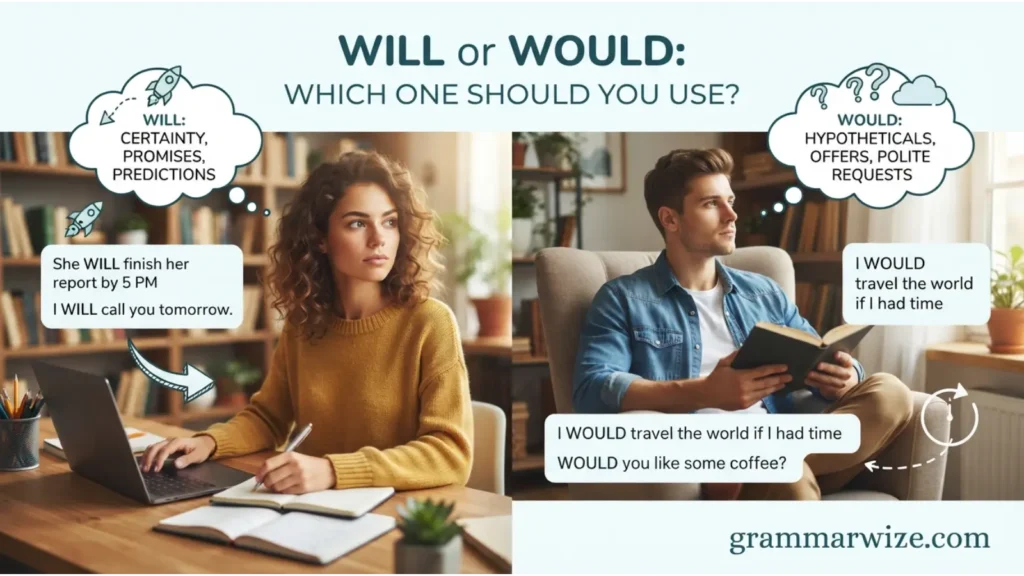
Will or Would: Which One Should You Use?
Choose will when you mean:
- A future action.
- A promise.
- A quick decision.
- A willingness to help.
- A prediction.
Choose would when you mean:
- A hypothetical action.
- A conditional result.
- A polite request.
- A preference.
- A repeated past action.
- An indirect statement.
Neither word is simply the “correct” version in every sentence. The correct choice depends on the meaning you want to express.
Frequently Asked Questions
Is would the past tense of will?
Would is the past form of will in some reported and past contexts, but it has many other uses. It can also express conditions, politeness, preferences, and repeated past actions.
Should I use will or would after if?
It depends on the conditional structure. For a likely future condition, will often appears in the result clause. For a hypothetical condition, would is commonly used.
Is would more polite than will?
Often, yes. Would can make requests and offers sound more polite or less direct.
Can would talk about the past?
Yes. Would can describe repeated actions in the past, especially when the context clearly establishes a past time.
Which is correct: I will help or I would help?
Both can be correct. I will help expresses a willingness or future intention. I would help usually needs a condition or context, such as “I would help if I had time.”
Conclusion
Will or Would have different grammatical roles even though they are closely related. Use will for future actions, promises, decisions, willingness, and predictions. Use would for hypothetical situations, conditional results, polite requests, preferences, and repeated past actions.
The easiest way to choose is to focus on the meaning of the sentence. If the action is presented as a future intention or expectation, will is often appropriate. If the action depends on a condition or is expressed as a polite or imagined idea, would is usually the better choice.

Olivia Bennett is a grammar expert and language content writer at GrammarWize.com. She specializes in English grammar, word usage, spelling differences, and writing improvement. Through clear explanations and practical examples, Olivia helps students, professionals, and language learners communicate more effectively. Her goal is to make English grammar simple, accessible, and easy to apply in everyday writing.