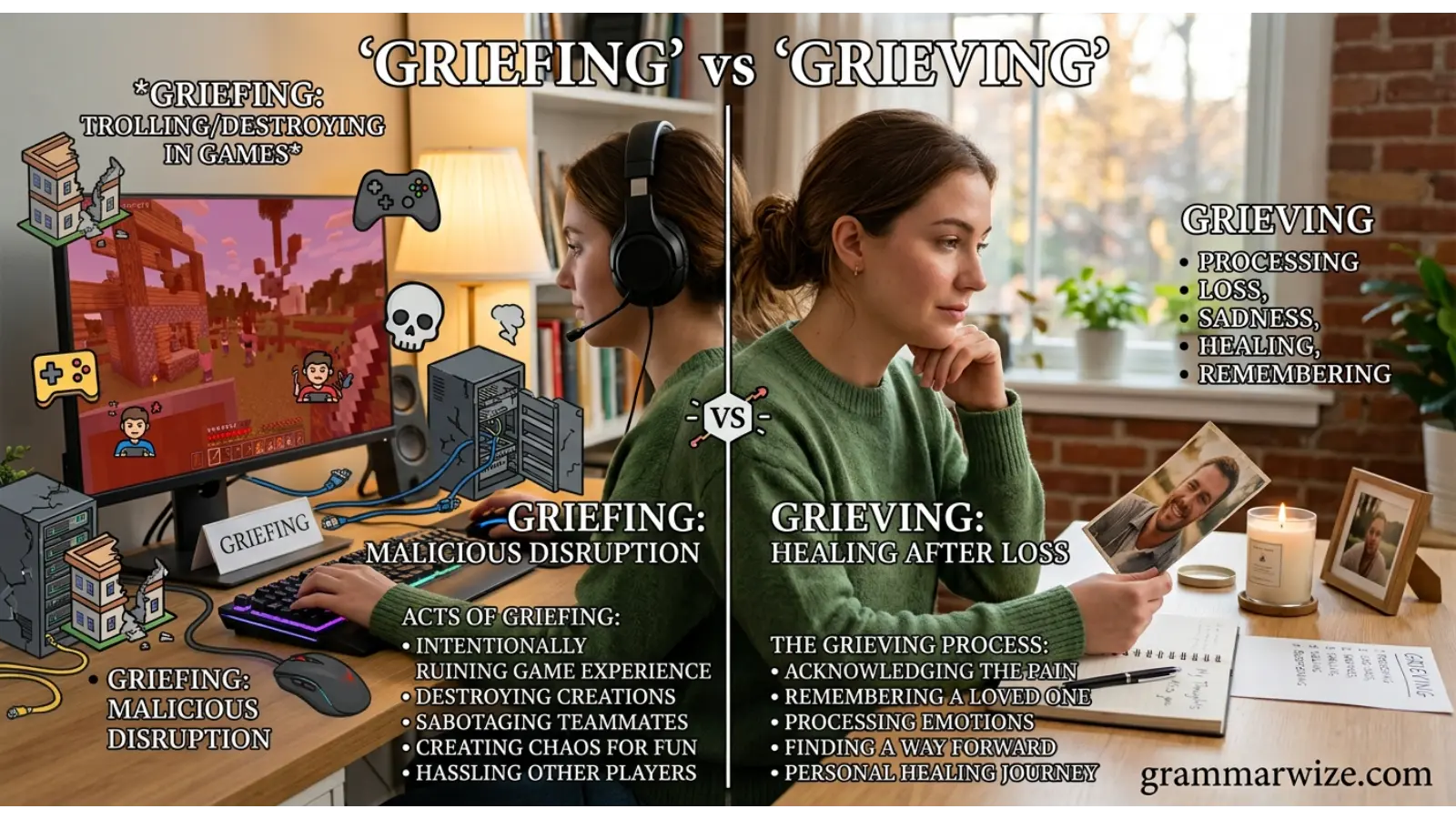
Griefing or grieving can be confusing because these words look and sound similar. However, they have different meanings and uses. Griefing describes intentional disruptive behavior, while grieving means experiencing deep sadness or mourning a loss. Knowing the difference helps you choose the right word in conversations, online gaming, and professional writing.
Griefing or Grieving can be confusing because both words look similar, but they have very different meanings. Grieving is the standard word for feeling or expressing deep sadness after a loss, while griefing is mainly used in online gaming to describe deliberately annoying or disrupting other players.
Understanding the difference between griefing and grieving helps you choose the right word in writing and everyday communication. In this guide, we will explain their meanings, usage, examples, and common mistakes so you can use each term correctly.
Both words come from different base words and follow different grammatical patterns. Griefing comes from grief or grief as a verb in gaming contexts, while grieving comes from grieve, which means to feel or express sorrow. This guide explains their meanings, sentence structures, common mistakes, and practical examples so you can use each word confidently.
Quick Answer: Griefing vs. Grieving
|
Word
|
Meaning
|
Example
|
| — | — | — |
|
Griefing
|
Deliberately annoying or disrupting others, especially in games
|
He was griefing other players.
|
|
Grieving
|
Feeling deep sadness after a loss
|
She is grieving her father’s death.
|
Quick rule: Use griefing for disruptive behavior and grieving for sadness or mourning.
What Does Griefing Mean?
Griefing means intentionally disturbing, frustrating, or harassing other people. The term is especially common in online gaming.
A player who repeatedly destroys another player’s work, blocks their progress, or deliberately ruins a game may be called a griefer.
Examples of griefing
- The player was griefing everyone on the server.
- He kept destroying our buildings for fun.
- The moderators banned the user for griefing.
- Stop griefing your teammates during the match.
Is griefing always related to gaming?
The term is most strongly associated with online games and virtual communities. It can also describe similar deliberate disruptive behavior in other online spaces.
For example, someone might repeatedly interfere with another person’s online activity to frustrate them.
What Does Grieving Mean?
Grieving means experiencing or expressing deep sadness, especially after someone’s death or another significant loss.
It is the present participle of the verb grieve. People may grieve a loved one, a relationship, a lost opportunity, or another meaningful part of their lives.
Examples of grieving
- She is grieving the loss of her grandmother.
- He spent months grieving after his friend’s death.
- The family is grieving together.
- Everyone grieves in their own way.
Can grieving describe a loss other than death?
Yes. Although people often use grieving when someone dies, the word can also describe sorrow after other significant losses.
For example, someone may grieve the end of a relationship, the loss of a home, or a major life change.

Key Differences Between Griefing and Grieving
|
Feature
|
Griefing
|
Grieving
|
| — | — | — |
|
Base word
|
Grief / grief (verb in gaming usage)
|
Grieve
|
|
Main meaning
|
Deliberate disruption or harassment
|
Experiencing sorrow
|
|
Common context
|
Online games and communities
|
Loss, death, and emotional hardship
|
|
Typical role
|
Verb form or activity noun
|
Verb form
|
|
Example
|
They are griefing the team.
|
They are grieving their loss.
|
Grammar Rules: How to Use Each Word
Griefing in a sentence
In gaming contexts, griefing commonly functions as a verb form.
It often appears with forms of be to describe an ongoing action.
Examples:
- He is griefing the other players.
- They were griefing the server.
- The moderators are investigating griefing.
It can also function as a noun when describing the behavior itself.
Example:
– Griefing is against the server rules.
Grieving in a sentence
Grieving is the -ing form of grieve. It commonly appears in continuous verb tenses.
Examples:
- She is grieving her brother.
- They were grieving after the loss.
- He has been grieving for several weeks.
It can also describe someone who is experiencing sorrow.
Example:
– The grieving family received support from friends.
Sentence Structure and Examples
The easiest way to understand these words is to look at how they fit into sentences.
Griefing sentence patterns
Subject + be + griefing + object
- The player is griefing his teammates.
- They were griefing other users.
Griefing + be + description
- Griefing is prohibited on this server.
- Griefing can ruin the experience for others.
Grieving sentence patterns
Subject + be + grieving + loss or person
- She is grieving her mother.
- He is grieving the loss of his job.
Subject + have been + grieving
- They have been grieving since the accident.
- I have been grieving for a long time.
The grieving + noun
- The grieving family gathered at home.
- A grieving friend may need emotional support.
Common Mistakes to Avoid
1. Using griefing when you mean sadness
Incorrect: She is griefing after her father’s death.
Correct: She is grieving after her father’s death.
Use grieving when someone experiences sorrow.
2. Using grieving for disruptive gaming behavior
Incorrect: He is grieving other players by destroying their bases.
Correct: He is griefing other players by destroying their bases.
Use griefing when describing deliberate disruption in gaming.
3. Confusing the base words
- Griefing comes from grief in its gaming-related verb use.
- Grieving comes from the verb grieve.
Remember that grieve already contains the letter combination “ie.”
4. Treating the words as interchangeable
Incorrect: The player was grieving the server.
Correct: The player was griefing the server.
The intended meaning determines which word fits.
5. Assuming grieving only means mourning a death
Grieving can describe sadness after many kinds of significant loss, not only death.

Griefing or Grieving in Professional Writing
The right word depends on the subject and audience.
|
Situation
|
Word to use
|
| — | — |
|
Reporting disruptive online behavior
|
Griefing
|
|
Explaining gaming community rules
|
Griefing
|
|
Writing about bereavement
|
Grieving
|
|
Discussing emotional support after loss
|
Grieving
|
|
Describing a player’s intentional harassment
|
Griefing
|
In formal writing
Use griefing when discussing online misconduct, moderation, or player behavior.
Use grieving when writing about mourning, emotional recovery, or the effects of loss.
Both words are appropriate in formal writing when their meanings match the context.
In informal conversations
People often use griefing in gaming chats and online discussions.
People use grieving in personal conversations about loss and emotional experiences.
Neither word is inherently informal. The subject determines the appropriate use.

Memory Trick: Griefing vs. Grieving
Here is a simple way to remember the difference.
Griefing = Gaming trouble
Think of someone causing problems for other players.
Grieving = Grief and sadness
Think of someone mourning a meaningful loss.
Remember: griefing disrupts others, while grieving describes sorrow.
Real-Life Conversations
Conversation 1: Online gaming
Alex: Why did the moderator remove that player?
Sam: He was griefing everyone and destroying their builds.
Conversation 2: Talking about loss
Mia: How is your friend doing?
Sara: She is still grieving her mother’s death.
Conversation 3: Gaming rules
Player: Why did I receive a warning?
Moderator: You were griefing other players. Please follow the server rules.
Conversation 4: Offering support
Friend: I heard about your loss. How are you feeling?
Jamie: I’m grieving, but my family has been helping me.
Conversation 5: Explaining the difference
Student: Are griefing and grieving the same thing?
Teacher: No. Griefing means deliberately disrupting others, while grieving means feeling deep sadness.
Related Keywords
- Griefing meaning
- Grieving meaning
- Griefing in gaming
- Grieving after a loss
- Griefing vs grieving difference
- How to use grieving in a sentence
- What does griefing mean in Minecraft
Frequently Asked Questions
1. Is griefing or grieving correct?
Both are correct words, but they have different meanings. Griefing usually describes deliberate disruption, especially in online games. Grieving means experiencing deep sadness or mourning a loss.
2. Is griefing a real word?
Yes. Griefing is an established term used to describe intentionally disruptive behavior, particularly in online gaming communities.
3. Is grieving the same as mourning?
The meanings overlap. Grieving describes experiencing sorrow after a loss, while mourning often refers to expressing or observing that loss.
4. Can you use grieving for a breakup?
Yes. People can grieve the end of a relationship or another significant loss, even when no one has died.
5. What is a person who griefs called?
In online gaming, a person who deliberately disrupts or harasses other players is commonly called a griefer.
Conclusion
The difference between griefing or grieving comes down to meaning and context. Griefing describes deliberate disruptive behavior, especially in online games. Grieving describes the sadness someone experiences after a meaningful loss.
Use griefing when discussing harmful gameplay or online disruption. Choose grieving when describing sorrow, mourning, or emotional hardship. Understanding their meanings and sentence patterns will help you use both words correctly in everyday conversations and professional writing.

Olivia Bennett is a grammar expert and language content writer at GrammarWize.com. She specializes in English grammar, word usage, spelling differences, and writing improvement. Through clear explanations and practical examples, Olivia helps students, professionals, and language learners communicate more effectively. Her goal is to make English grammar simple, accessible, and easy to apply in everyday writing.