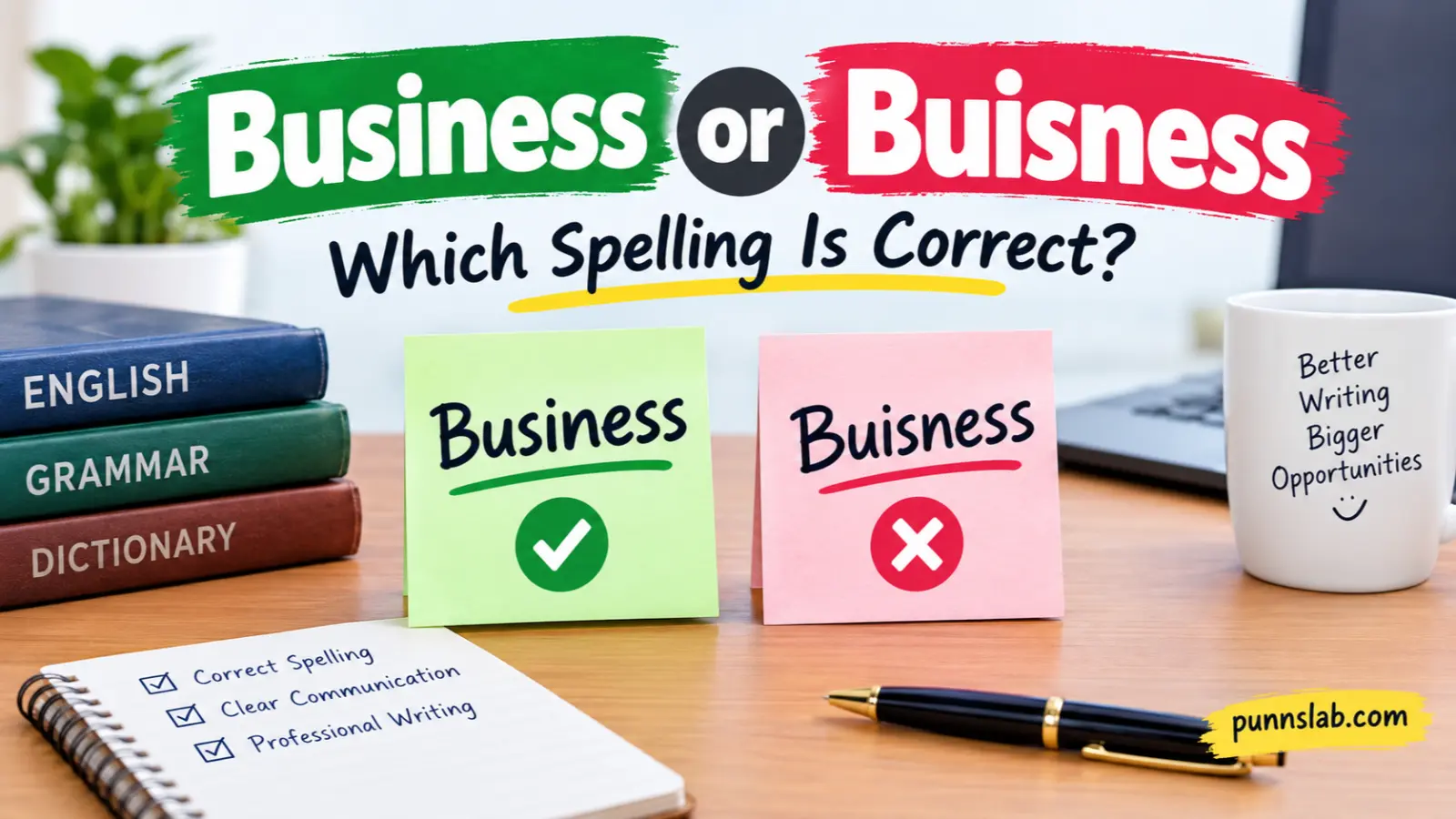
Business or buisness is a common spelling confusion in English. The correct spelling is business. Buisness is a misspelling and should not be used in standard English.
Business or Buisness is a common spelling confusion for English learners and everyday writers. Business is the correct spelling, while Buisness is a common misspelling caused by the word’s pronunciation. If you often wonder which form to use in emails, resumes, websites, or professional writing, this guide will make the difference clear.
In this comparison, you will learn the correct spelling, meaning, pronunciation, common mistakes, and easy ways to remember Business. You will also see simple examples that help you use the word confidently in everyday and professional English.
The confusion usually happens because the word contains the letters u, i, and s in an unusual order. Its pronunciation also does not clearly show how the word is spelled. Learning the correct form can help you avoid this mistake in emails, resumes, schoolwork, websites, and professional documents.
Quick Answer
Business is the correct spelling.
Buisness is incorrect.
Example:
She started a small business last year.
Remember that the correct spelling is business, not buisness.
What Does Business Mean?
The word business is a noun with several related meanings. It commonly refers to an organization or activity that sells goods or services to make money.
For example:
- My family owns a small business.
- The business sells handmade furniture.
Business can also mean someone’s work, responsibility, or matter that needs attention.
For example:
- I have some business to discuss with you.
- It is none of your business.
The meaning depends on how the word is used in the sentence.
Why Is Buisness Incorrect?
Buisness is simply a spelling error. English dictionaries recognize business as the standard spelling.
The mistake often occurs because writers remember the sound of the word rather than its letter sequence. The pronunciation of business is closer to biz-nis than the way its letters might suggest.
This makes it easy to place the u and i in the wrong order.
The correct sequence is:
b u s i n e s s
The incorrect form changes the middle letters:
b u i s n e s s
That small difference makes buisness incorrect.
Business vs Buisness
| Feature | Business | Buisness |
|---|---|---|
| Spelling | Correct | Incorrect |
| Dictionary standard | Yes | No |
| Part of speech | Noun | Not a standard English word |
| Professional writing | Recommended | Avoid |
| Example | She runs a business. | She runs a buisness. |
The key difference is the placement of s and i.

How Do You Spell Business Correctly?
Spell the word this way:
B U S I N E S S
A useful way to break it down is:
bus + iness
Although this is not a pronunciation guide, it can help you remember the written form.
The most important point is that business has bus at the beginning.
It does not begin with bui.
Correct
Business
Incorrect
Buisness

Why Do People Spell Business as Buisness?
Several factors can cause this mistake.
The Pronunciation Is Different From the Spelling
Business is pronounced approximately like biz-nis in common English. The written word does not closely match its pronunciation.
Because of this difference, people may remember the sound but struggle with the spelling.
The Letters Appear in an Unusual Order
The middle of the word contains s-i, not i-s.
That small detail is easy to overlook when typing quickly.
It Looks Similar to Other Words
Words such as build, built, and builder begin with bui. This familiar pattern may contribute to accidental spellings such as buisness.
The Origin of Business
The word business developed from busy, with the older form referring to a state or condition of being busy or occupied.
Over time, its meaning expanded. It became associated with matters that occupy someone’s attention and later with commercial activity, trade, and professional work.
This history also helps explain why the modern spelling is not simply based on how the word sounds.
The modern spelling business has been established in standard English for a long time.
Dictionary Recommendation
Major English dictionaries list business as the standard spelling.
When checking a spelling question, reliable dictionaries such as Merriam-Webster, Cambridge Dictionary, and the Oxford English Dictionary can help confirm the accepted form.
For standard English writing, use business.
Buisness should be treated as a spelling error rather than an alternative spelling.
Real-Life Examples of Business
Here are some natural examples showing how business works in different contexts.
Commercial Activity
The business sells organic food.
Here, business refers to a company or commercial operation.
Professional Work
She is traveling for business.
Here, business refers to work-related activity.
Personal Matters
That is none of your business.
Here, business means someone’s personal affairs or concerns.
Responsibility
It is your business to make sure the report is complete.
Here, business refers to a responsibility or duty.
General Matter
We need to discuss some important business.
Here, business means a matter that needs attention.
Common Mistakes With Business
Writing Buisness
Incorrect:
He owns a buisness.
Correct:
He owns a business.
Mixing Up the Middle Letters
Some writers remember the beginning and ending but reverse the middle letters.
Incorrect:
b-u-i-s-n-e-s-s
Correct:
b-u-s-i-n-e-s-s
Using the Wrong Spelling in Professional Documents
A spelling mistake in a resume, business proposal, or formal email can make the writing look careless.
Always check business before submitting important documents.
Confusing Business With Busy
The words are related historically, but they do not have the same meaning.
Busy describes someone or something occupied with activity.
Business can refer to commercial activity, work, or a matter that needs attention.
A Simple Memory Trick
Use this memory trick:
Business starts with BUS.
Think:
BUS + INESS = BUSINESS
The important part is BUS, not BUI.
You can also remember:
Business has S before I.
So write:
BUSINESS
not:
BUISNESS

Business in Professional Writing
Use business in all standard professional writing.
This includes:
- Business emails
- Resumes
- Cover letters
- Reports
- Academic assignments
- Websites
- Business plans
- Marketing materials
- Job applications
Avoid buisness because it is not the standard spelling.
If you are unsure, use a dictionary or spell-checking tool before publishing or submitting your work.
Business in British and American English
Business is spelled the same in both British and American English.
There is no British spelling buisness and no American spelling buisness.
The standard spelling in both varieties is:
Business
This makes the word straightforward for international writing.
Frequently Asked Questions
Is business or buisness correct?
Business is correct. Buisness is a misspelling.
Why do people spell business as buisness?
The error often happens because the pronunciation does not clearly match the spelling. People may also reverse the s and i in the middle.
Is buisness a word?
No. Buisness is not the standard spelling of the English word. The correct form is business.
How do you remember the spelling of business?
Remember that business starts with BUS. Think of the spelling as BUS + INESS.
Is business spelled the same in British and American English?
Yes. Business has the same spelling in both British and American English.
Conclusion
Buisness is a common spelling mistake, not an accepted alternative. The error usually comes from the unusual relationship between the word’s pronunciation and spelling.
For professional, academic, and everyday writing, always use business.
The easiest memory trick is simple: business starts with BUS, not BUI.

Olivia Bennett is a grammar expert and language content writer at GrammarWize.com. She specializes in English grammar, word usage, spelling differences, and writing improvement. Through clear explanations and practical examples, Olivia helps students, professionals, and language learners communicate more effectively. Her goal is to make English grammar simple, accessible, and easy to apply in everyday writing.