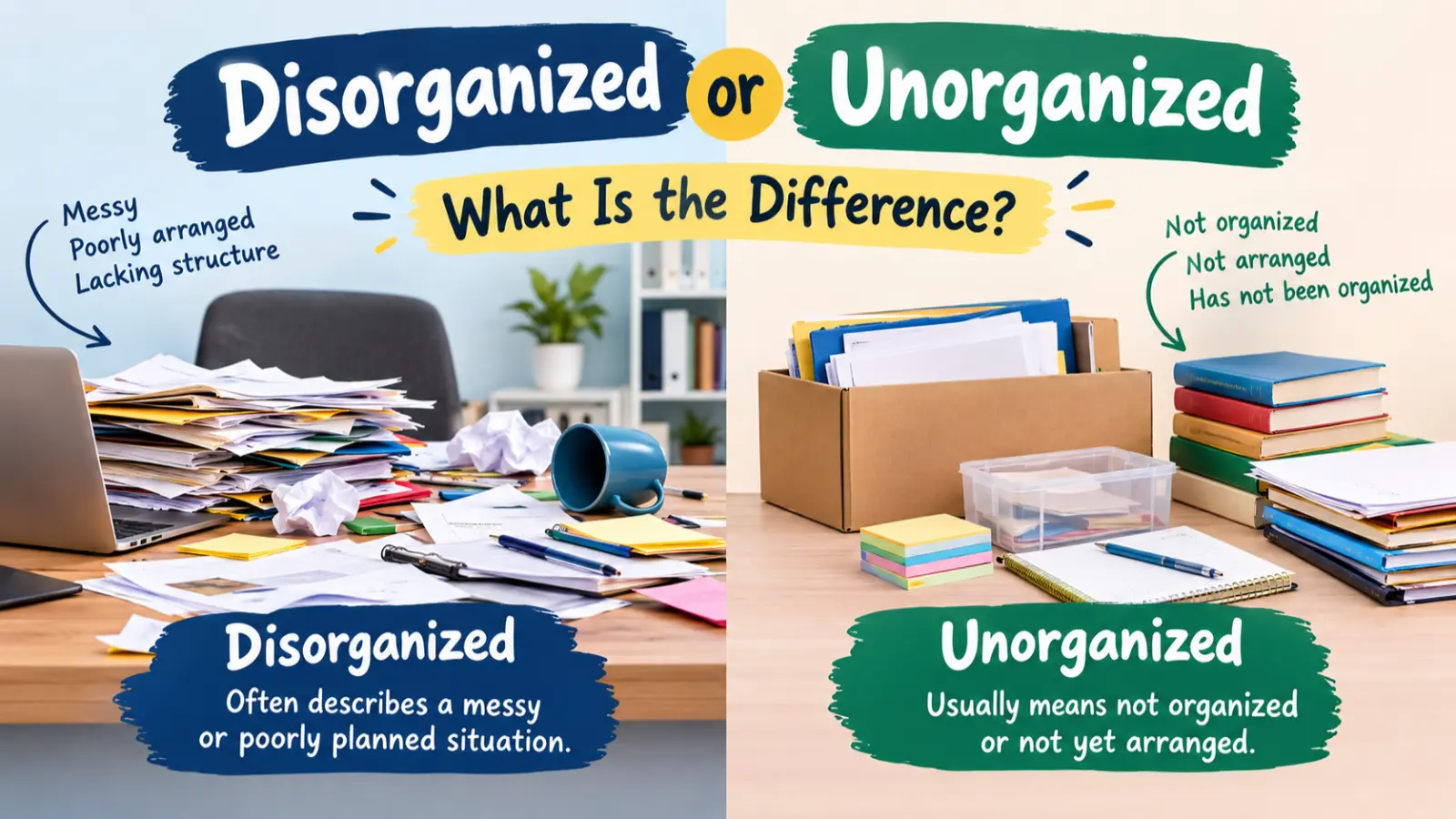
Disorganized and unorganized can both describe something that lacks order, but people do not always use them in the same way.
Disorganized usually describes something that is messy, poorly arranged, or lacking a clear system. People generally use “unorganized” to describe something they have not arranged or placed in an organized system.
Disorganized or Unorganized is a common word choice question in English, especially when describing messy spaces, poor planning, or a lack of order. Both words appear in English, but their meanings can vary slightly based on the context and how you use them in a sentence.
Disorganized usually describes something that lacks order, structure, or proper planning. Unorganized can also describe something that someone has not yet arranged or organized.
Understanding this small difference can help you choose the right word for professional writing, everyday conversations, and online content.
Both words are correct, so the choice depends on the context. For example, you might describe a messy desk as disorganized, while you might describe a group that has not formed an official structure as unorganized.
Quick Answer
Disorganized is usually the more natural choice when describing a person, room, plan, workplace, or system that lacks order.
Unorganized describes something that lacks organization or that people have not organized.
Examples:
- Her desk is disorganized because papers are everywhere.
- The volunteers remained unorganized during the early planning stage.
What Does Disorganized Mean?
Disorganized means lacking order, structure, planning, or proper arrangement. It often suggests that something should have a better system.
You can use it for people, places, activities, documents, schedules, plans, and organizations.
For example:
- He is too disorganized to keep track of his appointments.
- The office looked disorganized after the move.
- Their project became disorganized because nobody followed the plan.
It often points to a problem with how people arrange or manage something.
Disorganized in a Sentence
Here are some natural examples:
- My files are disorganized, so I cannot find the report.
- The meeting became disorganized after the manager left.
- She felt disorganized after changing her daily routine.
- The team had a disorganized approach to the project.
What Does Unorganized Mean?
Unorganized means not organized or not arranged into an organized structure. It can describe something that has not been organized yet.
For example:
- The documents are still unorganized.
- The workers formed an unorganized group.
- The information remained unorganized in several folders.
The word can focus more directly on the absence of organization.
In some contexts, writers can use “unorganized” and “disorganized” interchangeably.
However, disorganized often sounds more natural when describing disorder or poor planning.

Disorganized vs Unorganized: Key Difference
| Word | Main idea | Common use | Example |
|---|---|---|---|
| Disorganized | Lacking order or structure | People, plans, rooms, systems | The office is disorganized. |
| Unorganized | Not organized | Groups, materials, information | The files are unorganized. |
The difference is often subtle.
Disorganized can describe something that someone arranges or manages poorly.
Unorganized can simply state that organization is absent.
This difference is not absolute, though. Native speakers may use both words in overlapping situations.
When Should You Use Disorganized?
Use disorganized when you want to describe disorder, poor planning, or a lack of structure.
It works especially well when describing a person’s habits or the condition of a place, plan, or activity.
For People
- He is very disorganized at work.
- I become disorganized when I have too many tasks.
- She is creative but sometimes disorganized.
About Places
- My bedroom is disorganized.
- The storage room looks disorganized.
- Their office became disorganized during renovations.
For Plans
- The event was disorganized.
- Their approach seemed disorganized.
- The project became disorganized after several changes.
When Is Unorganized More Appropriate?
Use the unorganized form when you mean that someone or something has not organized it.
This can work well for information, materials, groups, and situations where organization has not yet happened.
For example:
- The data is still unorganized.
- The books were unorganized on the shelves.
- The workers formed an unorganized group.
- The notes were completely unorganized.
In these examples, the word highlights the absence of organization.

Can You Interchange Disorganized and Unorganized?
Sometimes, yes.
Consider this sentence:
The files are disorganized.
You could also say:
The files are unorganized.
Both can communicate that the files lack proper order.
However, the first sentence may suggest that the files are arranged poorly. The second can simply mean that nobody has organized them.
Context determines which word sounds more natural.
Sentence Structure and Grammar
Both disorganized and unorganized are adjectives.
They can appear before a noun or after a linking verb.
Before a Noun
- a disorganized office
- a disorganized schedule
- an unorganized group
- unorganized information
After a Linking Verb
- The office is disorganized.
- His schedule became disorganized.
- The information is unorganized.
- The group remained unorganized.
Both forms can also appear with adverbs.
- She is very disorganized.
- The files were completely unorganized.
- The process became extremely disorganized.
Common Mistakes to Avoid
Treating One Word as Always Wrong
A common mistake is assuming that unorganized is incorrect because disorganized is more common in many situations.
Both words are valid.
Using Disorganized for Every Situation
Although disorganized is widely useful, it is not automatically the best choice in every sentence.
If you simply mean that something has not been organized, you can use “unorganized” to communicate the idea clearly.
Confusing Disorganized With Untidy
Disorganized can describe physical mess, but it can also describe poor planning or weak structure.
For example:
- The desk is disorganized.
- The project is disorganized.
The second sentence does not describe physical mess.
Assuming the Prefix Gives a Fixed Meaning
The prefixes dis- and un- can both create words expressing absence or negation.
Their meanings depend on the individual word and its context. You should not assume that every dis- word and un- word follow exactly the same pattern.

Which Word Is Better for Professional Writing?
In professional writing, choose the word that communicates your intended meaning most precisely.
Disorganized often works naturally when discussing poor planning, inefficient processes, unclear systems, or a lack of structure.
For example:
- The current workflow is disorganized.
- The filing system is disorganized.
- The project became disorganized after the deadline changed.
You can use Unorganized when you want to emphasize that people have not organized the material, information, or group.
For example:
- The source data is currently unorganized.
- The documents remain unorganized.
- The participants formed an unorganized group.
For formal documents, clarity matters more than choosing one word simply because it sounds more familiar.
Real-Life Examples
At Work
Manager: Why is the project behind schedule?
Employee: The workflow became disorganized after we changed the deadlines.
Here, disorganized describes poor structure and coordination.
At Home
Friend: Where did you put the receipts?
You: They are in this drawer, but everything is disorganized.
Here, the word describes a messy arrangement.
During Research
Student: Have you sorted the research notes?
Teacher: Not yet. The notes are still unorganized.
Here, the writer uses unorganized to show that the notes have not yet arranged themselves.
About a Group
Reporter: How did the new group begin?
Organizer: It started as an unorganized group of local volunteers.
Here, unorganized highlights the lack of a formal structure.
An Easy Memory Trick
Think of disorganized as poorly organized.
Think of unorganized as not organized.
This gives you a simple starting point:
Disorganized = organization exists poorly or lacks order.
Unorganized = organization is absent or has not happened.
The distinction is not perfect in every sentence, but this trick can help you choose naturally.
Disorganized or Unorganized in Everyday English
When describing a messy room, person, schedule, or workplace, disorganized will often sound more natural.
For example:
- My schedule is disorganized.
- His desk is disorganized.
- The meeting was disorganized.
- Their records are disorganized.
When you want to emphasize that something has not been organized, you can use “unorganized.”
For example:
- The files are still unorganized.
- The information is unorganized.
- The group was unorganized.
- The materials remained unorganized.
Remember that actual usage can overlap.
FAQs:
Is disorganized correct English?
Yes. Disorganized is a standard English adjective meaning lacking order, structure, or proper organization.
Is unorganized a correct word?
Yes. Unorganized is also a correct English adjective. It generally means not organized or lacking organization.
Is disorganized or unorganized more common?
Disorganized is often more natural when describing disorder, poor planning, or a person’s lack of organization. People also use “Unorganized,” especially when they want to emphasize that they have not organized something.
Can I use disorganized and unorganized interchangeably?
Sometimes. Both can describe something that lacks organization, but the context can make one more natural than the other.
Which should I use in formal writing?
Choose the word that best expresses your intended meaning. Disorganized often fits descriptions of poor structure or planning, while unorganized can emphasize the absence of organization.
Conclusion
Disorganized and unorganized are both correct words. The main difference comes from context rather than a simple right-or-wrong rule.
Use disorganized when you mean something is messy, poorly arranged, poorly planned, or lacking structure. Use unorganized to emphasize that something is not organized or has not been organized yet.
When both options seem possible, focus on the exact idea you want to communicate. Clear context is more important than choosing one word in every situation.

Olivia Bennett is a grammar expert and language content writer at GrammarWize.com. She specializes in English grammar, word usage, spelling differences, and writing improvement. Through clear explanations and practical examples, Olivia helps students, professionals, and language learners communicate more effectively. Her goal is to make English grammar simple, accessible, and easy to apply in everyday writing.