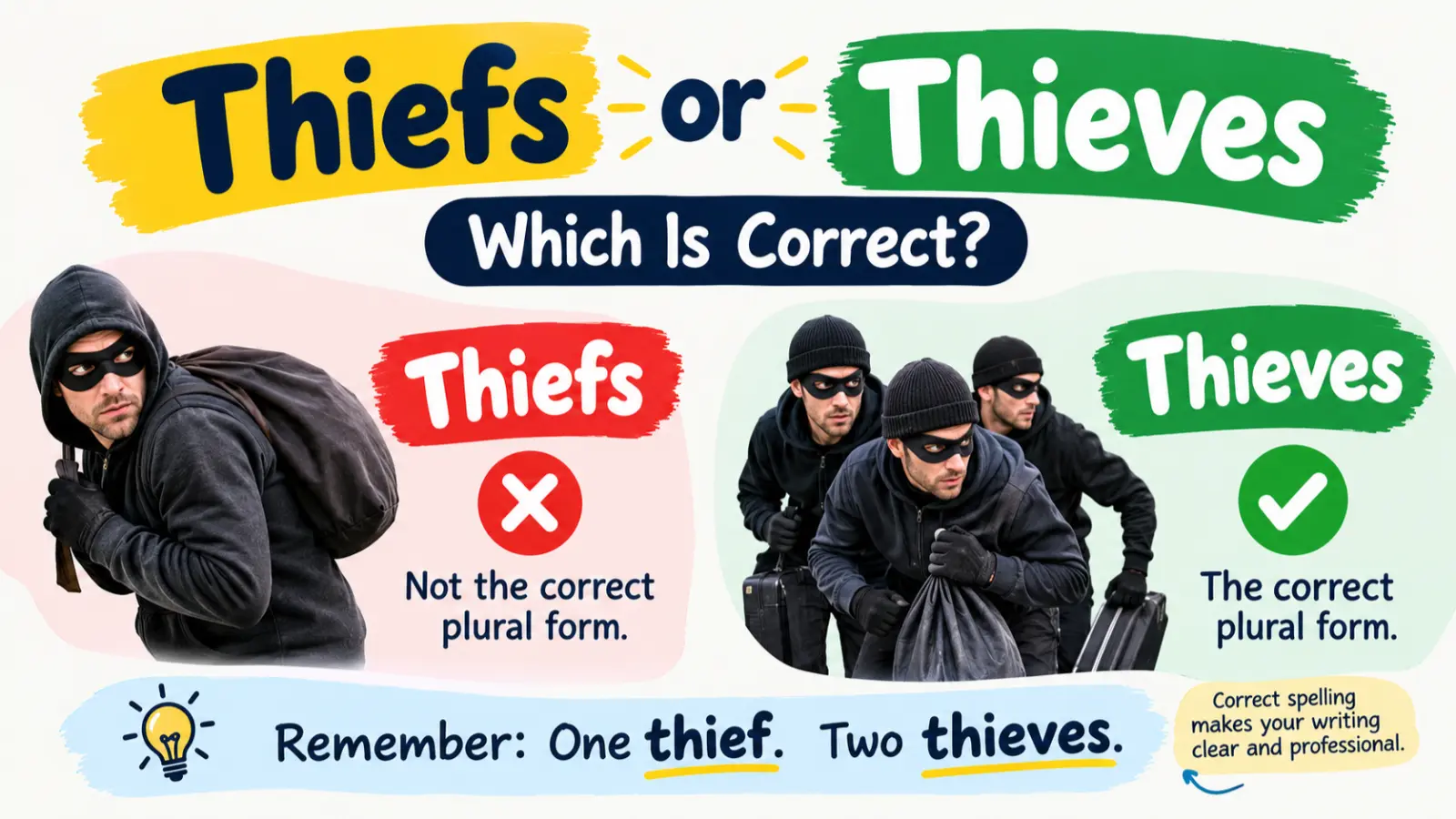
If you are unsure whether the plural of thief is thiefs or thieves, the correct spelling is thieves. The word thief follows an irregular plural pattern, so its plural form changes from -f to -ves.
Thiefs or Thieves is a common spelling confusion that many English learners and writers search for when talking about people who steal. The correct plural form of thief is thieves, while thiefs is not the standard spelling. This confusion happens because many English words simply add s to form their plural, but thief follows a different spelling pattern.
In this top trending guide, we will explain why thieves is correct, what thief means, and how to remember the spelling easily. You will also see clear examples to help you use thieves correctly in everyday writing, schoolwork, and professional communication.
Thiefs is not the standard plural form of thief. In normal English writing, use thieves when you mean more than one person who steals.
Quick Answer
Thieves is the correct plural of thief.
- One thief
- Two thieves
- Several thieves
- A group of thieves
Example:
The police arrested three thieves after the robbery.
Thief and Thieves Meaning
What Does Thief Mean?
A thief is a person who steals something from another person or place.
Examples:
- The thief stole my wallet.
- A thief entered the shop at night.
The word is singular because it refers to one person.
What Does Thieves Mean?
Thieves is the plural form of thief. It refers to two or more people who steal.
Examples:
- The police caught two thieves.
- The thieves escaped before the officers arrived.
The important change is from thief to thieves.

Why Is It Thieves Instead of Thiefs?
English has several nouns ending in -f or -fe that form their plurals with -ves.
For example:
| Singular | Plural |
|---|---|
| thief | thieves |
| wife | wives |
| life | lives |
| knife | knives |
| wolf | wolves |
| leaf | leaves |
| shelf | shelves |
This pattern explains why thiefs is not the standard plural spelling.
However, not every word ending in -f changes to -ves. For example:
- roof → roofs
- belief → beliefs
- chief → chiefs
- chef → chefs
So it is better to learn the plural form of each word rather than apply one rule to every -f word.
Grammar Rule for Thief
The word thief has an irregular plural form.
Singular: thief
Plural: thieves
The spelling changes in the plural:
thief → thieves
The final f changes to v, and -es is added.
This makes thieves different from a regular plural such as:
book → books
The plural thieves must be memorized because English plural patterns are not completely regular.
Thiefs vs Thieves
| Word | Correct? | Use |
|---|---|---|
| thief | Yes | One person who steals |
| thieves | Yes | More than one person who steals |
| thiefs | No | Not the standard plural |
| thiefes | No | Incorrect spelling |
The main point is simple: thief is singular, while thieves is plural.
Sentence Structure With Thief
Use thief with singular subjects.
Correct:
- The thief was arrested.
- A thief stole the phone.
- That thief ran away.
Use thieves with plural subjects.
Correct:
- The thieves were arrested.
- Two thieves stole the phones.
- Those thieves ran away.
Notice the verb change in these examples.
The thief was arrested.
The thieves were arrested.
The singular noun takes was, while the plural noun takes were.

Common Mistakes With Thiefs and Thieves
Writing Thiefs as the Plural
Incorrect:
The police caught three thiefs.
Correct:
The police caught three thieves.
The plural of thief is thieves, not thiefs.
Using a Singular Verb With Thieves
Incorrect:
The thieves was arrested.
Correct:
The thieves were arrested.
Because thieves is plural, use a plural verb such as were.
Using Thieves for One Person
Incorrect:
A thieves entered the house.
Correct:
A thief entered the house.
Use thief when talking about one person.
Adding an Extra S
Incorrect:
The thiefs were hiding.
Correct:
The thieves were hiding.
The plural spelling already ends in -ves.
Confusing Thieves With Thief’s
Thieves means more than one thief.
Thief’s usually shows possession.
Example:
- The thieves escaped.
- The thief’s bag was found outside.
These forms have different meanings.
Thieves in Formal and Professional Writing
Use thieves in formal writing when referring to multiple people who steal.
The word is suitable for:
- News reports
- Police reports
- Academic writing
- Legal discussions
- Business reports
- General communication
Example:
Police officials reported that several thieves entered the building overnight.
There is no need to replace thieves with a more complicated expression.

Thief vs Thieves in Everyday Conversation
The choice depends on the number of people you are describing.
One person:
I think that man is a thief.
More than one person:
The police believe the men are thieves.
One suspected person:
The thief took the bag.
Several suspected people:
The thieves took several bags.
The meaning becomes clear by matching the noun with the correct number.
Real-Life Examples of Thief and Thieves
In a Police Report
The police arrested two thieves after the investigation.
In a News Story
Several thieves reportedly entered the store during the night.
In Everyday Conversation
Someone said a thief stole his phone.
In a Story
The thief quietly opened the door and entered the house.
In a Warning
Keep your valuables safe because thieves may target crowded areas.
A Simple Memory Trick
Remember this pattern:
One thief → two thieves
Think of the f changing to v:
thie-f → thie-v-es
You can also connect it with familiar words:
wife → wives
knife → knives
life → lives
thief → thieves
This makes the unusual plural pattern easier to remember.
Is Thiefs Ever Correct?
In standard modern English, thiefs is not the accepted plural of thief.
When writing about more than one person who steals, use thieves.
For example:
Correct: The thieves escaped.
Incorrect: The thiefs escaped.
Thiefs or Thieves: Final Answer
Thieves is the correct plural form of thief.
Use thief for one person and thieves for two or more people.
The easiest form to remember is:
One thief.
Two thieves.
Although many English nouns form their plurals by adding -s, thief has an irregular plural spelling. Learning thief → thieves will help you avoid one of the most common spelling mistakes with this word.
Frequently Asked Questions
Is thiefs a correct word?
Thiefs is not the standard plural form of thief. The correct plural is thieves.
What is the plural of thief?
The plural of thief is thieves.
Is it two thiefs or two thieves?
The correct phrase is two thieves.
Why does thief change to thieves?
Thief has an irregular plural form. Its f changes to v, followed by -es, producing thieves.
What is the difference between thief and thieves?
Thief refers to one person who steals. Thieves refers to two or more people who steal.
Conclusion
The correct choice is thieves, not thiefs. Use thief when referring to one person and thieves when referring to more than one.
Remember the simple pattern:
Thief = one
Thieves = more than one
Using thieves correctly will make your spelling, grammar, and sentence structure more accurate.

Olivia Bennett is a grammar expert and language content writer at GrammarWize.com. She specializes in English grammar, word usage, spelling differences, and writing improvement. Through clear explanations and practical examples, Olivia helps students, professionals, and language learners communicate more effectively. Her goal is to make English grammar simple, accessible, and easy to apply in everyday writing.