The words gage and gauge look very similar, which often causes confusion among writers, students, and professionals. Many people assume one spelling is simply a typo of the other, but the truth is more interesting.
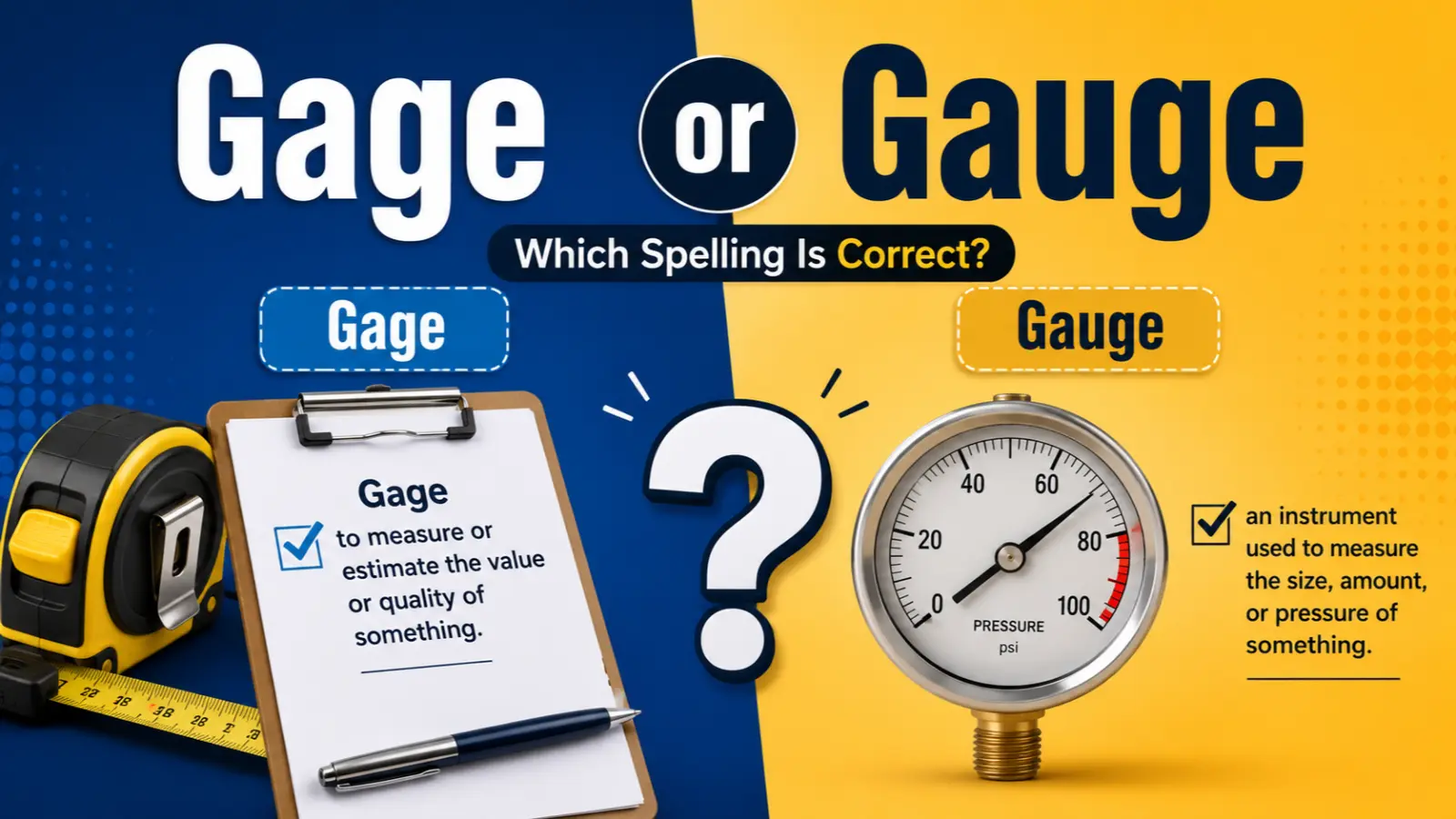
Gage or Gauge is a common spelling confusion that often leaves writers wondering which version is correct. While both words appear in English, they are not always interchangeable. Understanding the difference can help you use the right term in professional, academic, and everyday writing.
In this guide, you’ll learn the meanings, correct usage, and key differences between Gage and Gauge with clear examples. Use our handy copy button to quickly save examples and definitions for future reference. This simple comparison will help you avoid mistakes and write with greater confidence.
Both words exist in English, yet they are not always interchangeable. Understanding their meanings, history, and modern usage can help you choose the right spelling with confidence.
Quick Answer
Gauge is the standard and preferred spelling in modern English for most situations.
Gage is an older spelling that survives in specific contexts, proper names, legal history, and a few specialized uses.
For everyday writing, business communication, education, and professional documents, gauge is almost always the correct choice.
Meaning of Both Spellings
Gauge
Gauge is commonly used as a noun and a verb.
As a noun, it refers to a measuring instrument or a standard of measurement.
Examples:
- A fuel gauge shows how much gas remains.
- The engineer checked the pressure gauge.
- Railroad gauge refers to the distance between rails.
As a verb, it means to measure, estimate, or assess.
Examples:
- It is difficult to gauge public opinion.
- The manager tried to gauge customer satisfaction.
Gage
Gage is a legitimate English word, but its usage is much less common today.
Historically, it could mean:
- A pledge or guarantee.
- A challenge, especially in older literature.
- A security deposited as collateral.
In modern English, it most often appears in:
- Surnames and proper names.
- Historical texts.
- Certain technical or industry-specific references.
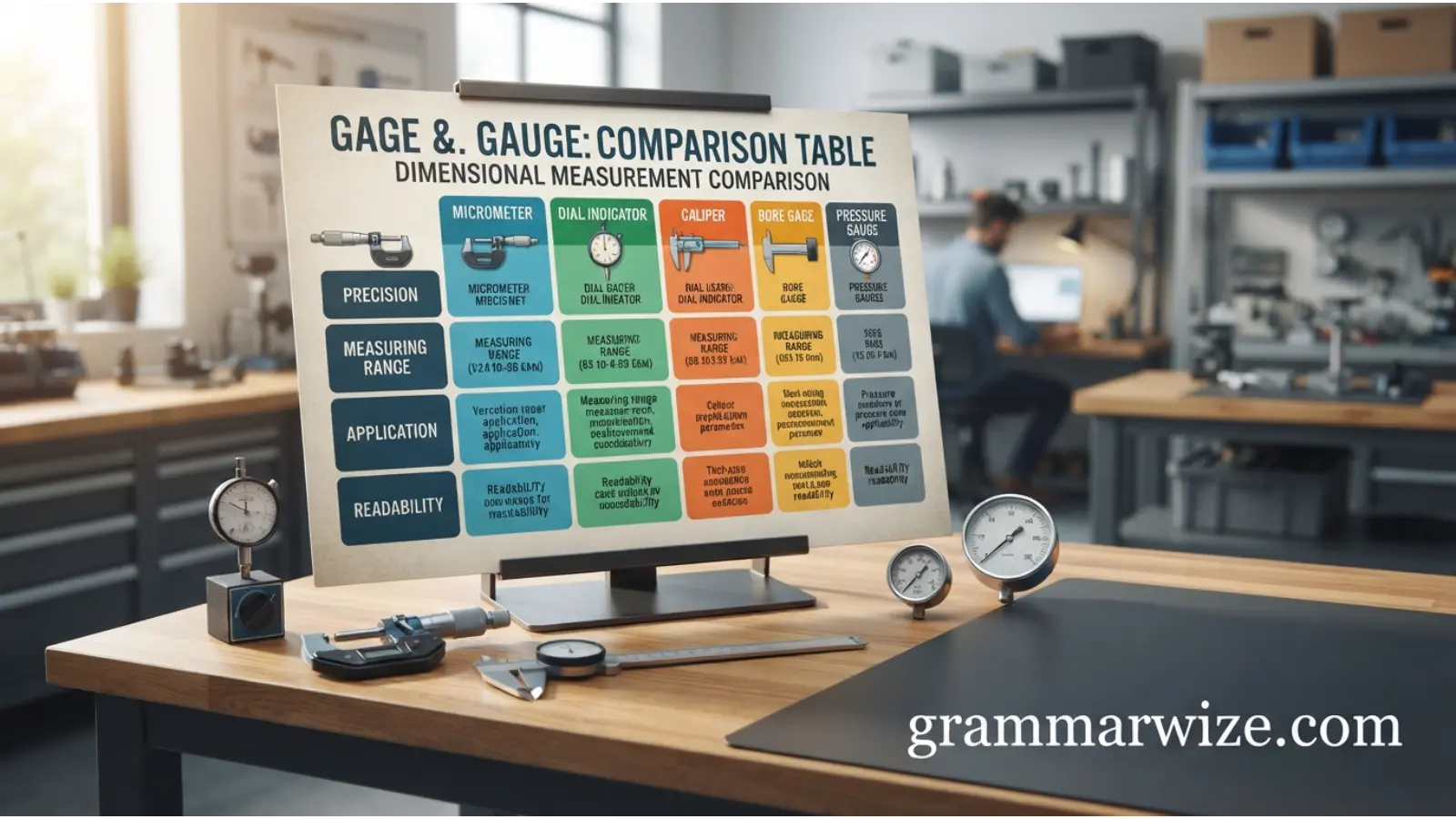
Comparison Table
| Feature | Gage | Gauge |
|---|---|---|
| Modern standard spelling | Rare | Yes |
| Used for measurement | Occasionally in specialized contexts | Yes |
| Used as a verb meaning measure | Rare | Yes |
| Dictionary preference | Secondary or historical | Primary |
| Common in professional writing | No | Yes |
| Seen in proper names | Frequently | Occasionally |
Origin
Both words share the same historical roots.
The term entered English through Old French and Middle English. Over time, English speakers gradually adopted gauge as the dominant spelling. As dictionaries standardized spelling conventions, gauge became the preferred form for measurement and estimation.
The spelling gage remained in limited historical and specialized use.
Why Confusion Exists
Several factors contribute to the confusion:
Shared History
Both spellings originated from the same linguistic source, making them historically connected.
Similar Pronunciation
They are pronounced the same way in modern English.
Industry Usage
Some industries and company names still use gage, causing people to believe both spellings are equally common.
Proper Names
Many people encounter Gage as a first name or surname, which reinforces the alternative spelling.
Dictionary Recommendations
Major dictionaries generally recommend gauge as the standard spelling.
Dictionary Consensus
- Gauge is listed as the primary spelling for measurement and estimation.
- Gage is usually marked as a variant, historical form, or specialized term.
For modern writing, dictionaries consistently favor gauge.
Real Life Examples

Correct Uses of Gauge
- The pilot checked the fuel gauge before takeoff.
- We need to gauge customer demand.
- The mechanic inspected the pressure gauge.
- It is hard to gauge the impact of the new policy.
Correct Uses of Gage
- The museum displayed an ancient gage used as a pledge.
- Gage is a common given name in North America.
- The document referred to a legal gage from the medieval period.
Common Mistakes

Mistake 1: Using Gage for Everyday Measurement
❌ Please gage the temperature.
✅ Please gauge the temperature.
Mistake 2: Using Gage in Business Writing
❌ We need to gage market demand.
✅ We need to gauge market demand.
Mistake 3: Assuming Gage Is Always Wrong
❌ Gage is never a real word.
✅ Gage is a real word, but it is used in limited situations.
Memory Trick
A simple way to remember the correct spelling:
Gauge contains “au,” and most modern dictionaries use “gauge” for measuring and estimating.
Think:
Gauge = Measure
When discussing measurements, estimates, opinions, or assessments, choose gauge.
Professional Writing Recommendation
If you are writing:
- Articles
- Academic papers
- Business emails
- Reports
- Marketing content
- Website copy
Use gauge.
Professional editors, publishers, style guides, and dictionaries overwhelmingly prefer gauge in modern English.
Only use gage when:
- Referring to a person’s name.
- Quoting historical texts.
- Discussing specialized legal or historical meanings.
- Following industry-specific terminology that officially uses the spelling.
Frequently Asked Questions
Is gage a real word?
Yes. Gage is a legitimate English word with historical and specialized meanings.
Which spelling is more common today?
Gauge is far more common in modern English.
Can gage and gauge be used interchangeably?
Not usually. Gauge is preferred for measurement and estimation, while gage has limited specialized uses.
Is gage incorrect in professional writing?
For measurement-related meanings, it is generally considered nonstandard. Gauge is the recommended choice.
Why do some companies use gage instead of gauge?
Some organizations keep the older spelling as part of their brand name, industry tradition, or historical identity.
Conclusion
This keyword falls under the category of Spelling Comparison.
Both gage and gauge are real English words, but they serve different purposes. Gauge is the standard modern spelling used for measuring, estimating, and assessing. Gage survives mainly in historical contexts, proper names, and a few specialized uses.
For almost all professional, academic, and everyday writing, gauge is the spelling you should choose. It is the form preferred by modern dictionaries, editors, and style guides.

Olivia Bennett is a grammar expert and language content writer at GrammarWize.com. She specializes in English grammar, word usage, spelling differences, and writing improvement. Through clear explanations and practical examples, Olivia helps students, professionals, and language learners communicate more effectively. Her goal is to make English grammar simple, accessible, and easy to apply in everyday writing.