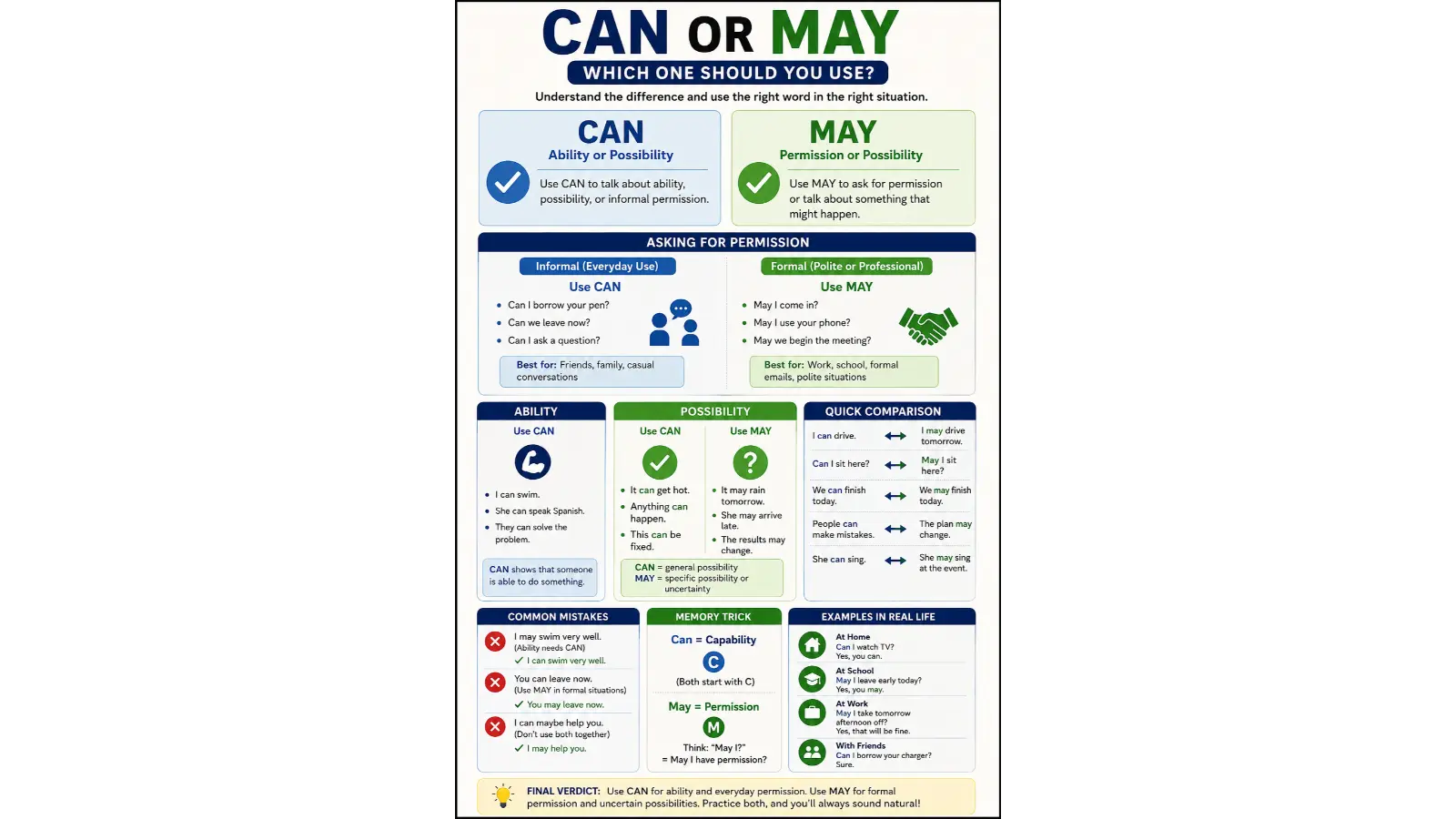
Many English learners struggle with can and may because both words are often used when asking for something. While they can sometimes appear in similar situations, they do not mean exactly the same thing.
Can or May are two common English words that many people confuse. Both can be used when asking for permission, but they do not always mean the same thing. Understanding the difference can help you speak and write English more accurately in school, work, and daily conversations.
In this guide, you will learn the meaning of Can or May, their grammar rules, common examples, and the correct situations to use each word. Use our convenient copy button to save examples instantly and improve your English skills faster. By the end, you will know exactly when to use can and when may is the better choice.
Understanding the difference between can or may helps you sound more natural, professional, and grammatically correct. This guide explains everything in simple English with practical examples.
What Is the Difference Between Can and May?

The main difference is simple:
- Can refers to ability or possibility.
- May refers to permission or possibility.
Quick Example
✅ I can swim. (I have the ability to swim.)
✅ May I leave early today? (I am asking for permission.)
Although both words are correct, they are used for different purposes.
Understanding Can
Can is a modal verb used to talk about:
Ability
It shows that someone is able to do something.
Examples:
- I can drive a car.
- She can speak Spanish.
- They can solve the problem.
Possibility
It can also show that something is possible.
Examples:
- It can get very hot in July.
- Accidents can happen.
- This machine can break down unexpectedly.
Informal Permission
In everyday conversation, many people use can when asking permission.
Examples:
- Can I borrow your pen?
- Can we leave now?
- Can I ask a question?
These sentences are common and acceptable in casual English.
Understanding May
May is mainly used for:
Permission
It is the traditional and more formal way to ask permission.
Examples:
- May I come in?
- May I use your phone?
- May we begin the meeting?
Possibility
It can also express that something might happen.
Examples:
- It may rain tomorrow.
- She may arrive late.
- The results may change.
In these examples, may means “perhaps” or “possibly.”
Can vs May for Permission

This is where most confusion happens.
Informal Situations
Use can in everyday speech.
Examples:
- Can I sit here?
- Can I leave early?
- Can we order now?
Formal Situations
Use may when speaking politely or professionally.
Examples:
- May I enter the office?
- May I ask a question?
- May I have a moment of your time?
Comparison
| Situation | Better Choice |
|---|---|
| Talking to friends | Can |
| Casual conversations | Can |
| Workplace meetings | May |
| Formal emails | May |
| Academic settings | May |
Can vs May for Possibility
Both words can express possibility, but the meaning changes slightly.
Can
Shows general possibility.
Examples:
- Driving at night can be dangerous.
- People can make mistakes.
- Winters can be cold here.
May
Shows a specific possibility or uncertainty.
Examples:
- It may snow tonight.
- He may call later.
- The project may take longer than expected.
Easy Rule
- Can = something is possible in general
- May = something might happen
Sentence Patterns You Should Know
Using Can
Subject + can + base verb
Examples:
- I can help.
- She can dance.
- We can finish today.
Using May
Subject + may + base verb
Examples:
- I may travel tomorrow.
- She may join us later.
- They may approve the proposal.
Asking Permission
Can + subject + base verb?
- Can I come in?
- Can we start?
May + subject + base verb?
- May I come in?
- May we start?
Why Teachers Often Correct “Can I?”
Many students hear this correction:
Student: “Can I go to the bathroom?”
Teacher: “I don’t know. Can you?”
The teacher is pointing out that can technically refers to ability.
The more traditional grammar form is:
“May I go to the bathroom?”
However, modern English speakers commonly use can when asking permission.
Common Mistakes With Can and May

Mistake 1: Using May for Ability
❌ I may swim very well.
✅ I can swim very well.
Ability requires can, not may.
Mistake 2: Using Can for Formal Requests
Less Formal:
✅ Can I speak with the manager?
More Formal:
✅ May I speak with the manager?
Mistake 3: Confusing Possibility and Permission
❌ You can leave now. (If permission is intended in a formal context)
✅ You may leave now.
Professional Writing and Workplace Usage
In business communication, may often sounds more professional.
Email Example
Formal:
May I request an extension for the deadline?
Less Formal:
Can I get an extension on the deadline?
Both are correct, but the first sounds more professional.
Workplace Examples
- Employees may work remotely on Fridays.
- May I schedule a meeting next week?
- Staff may access the system after approval.
Everyday Conversation Examples
At Home
Child: Can I watch TV?
Parent: Yes, you can.
In School
Student: May I leave early today?
Teacher: Yes, you may.
At Work
Employee: May I take tomorrow afternoon off?
Manager: Yes, that will be fine.
With Friends
Friend: Can I borrow your charger?
Friend: Sure.
A Simple Memory Trick
Remember this phrase:
Can = Capability
Both start with the letter C.
- Can = ability
- Capability = ability
And remember:
May = Permission
Think of:
May I? = May I have permission?
This quick association helps you choose the correct word.
Side-by-Side Examples
| Can | May |
|---|---|
| I can drive. | I may drive tomorrow. |
| She can sing. | She may sing at the event. |
| Can I sit here? | May I sit here? |
| People can make mistakes. | The plan may change. |
| We can finish today. | We may finish today. |
Which Word Sounds More Polite?
If politeness matters:
- May usually sounds more polite.
- Can sounds more casual and conversational.
Examples:
Casual: Can I ask you something?
Polite: May I ask you something?
When Native Speakers Prefer Can
In modern English, native speakers often use can in everyday situations.
Examples:
- Can I help you?
- Can I come along?
- Can I use your phone?
Even though may is technically more formal, can is extremely common.
Frequently Asked Questions
Is “Can I” grammatically correct?
Yes. Modern English accepts can I when asking permission, especially in casual situations.
Is “May I” more polite?
Yes. May I generally sounds more formal and respectful.
Can and may both mean possibility?
Yes, but differently. Can expresses general possibility, while may expresses uncertainty about a specific event.
Which word should I use in business emails?
May is usually the better choice because it sounds professional and polite.
Do native English speakers still use “may”?
Yes. It is common in formal speech, professional writing, schools, and official communication.
Conclusion
Can and may are both correct English words, but they serve different purposes.
- Use can for ability and everyday permission.
- Use may for formal permission and uncertain possibilities.
- In casual conversations, can is more common.
- In professional and formal settings, may often sounds more polished.
The easiest way to remember is:
Can = Ability
May = Permission or Possibility
Once you understand that simple distinction, choosing the right word becomes much easier.

Olivia Bennett is a grammar expert and language content writer at GrammarWize.com. She specializes in English grammar, word usage, spelling differences, and writing improvement. Through clear explanations and practical examples, Olivia helps students, professionals, and language learners communicate more effectively. Her goal is to make English grammar simple, accessible, and easy to apply in everyday writing.