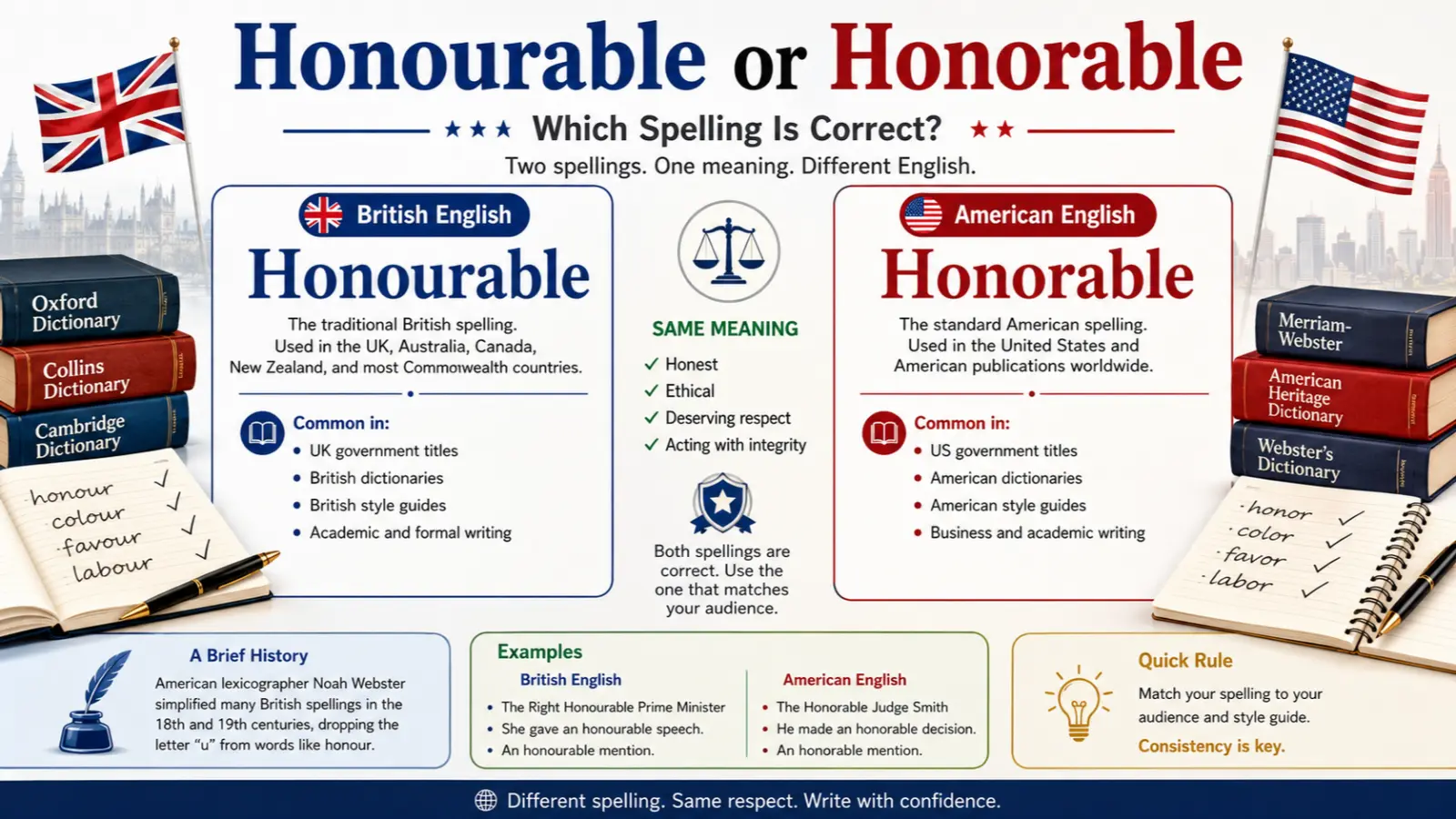
The words honourable and honorable have the same meaning. The difference is not grammar, pronunciation, or definition. The distinction comes from regional spelling conventions:
Honourable or Honorable is a common spelling question that often confuses English writers. Both words have the same meaning and describe someone who is honest, respected, and worthy of admiration. The difference comes from regional spelling preferences rather than meaning or usage.
In general, Honourable is the preferred spelling in British English, while Honorable is used in American English. Understanding when and where to use each version can help you write more accurately and professionally. This guide explains the differences, correct usage, examples, and tips to choose the right spelling with confidence.
- Honourable is the traditional British English spelling.
- Honorable is the standard American English spelling.
Both forms are correct when used in the appropriate regional context.
Many English learners and writers wonder if they should use honourable or honorable. The answer depends on the variety of English you are writing.
The word describes someone who is honest, ethical, respected, or worthy of honor. Although the meaning remains identical, the spelling changes according to regional writing standards.
Quick Answer
| Region | Preferred Spelling |
|---|---|
| United Kingdom | Honourable |
| Canada | Honourable (most common) |
| Australia | Honourable |
| New Zealand | Honourable |
| United States | Honorable |
Both spellings are accepted worldwide, but professional writing usually follows the spelling conventions of the target audience.
What Does Honourable or Honorable Mean?

The adjective means:
- Honest and ethical
- Deserving respect
- Acting with integrity
- Holding a respected position or title
Examples
- She is an honourable judge respected throughout the country.
- He made the honorable decision to admit his mistake.
- Their actions were considered both brave and honourable.
Why Do Two Spellings Exist?
The difference comes from the evolution of English spelling.
British English preserved many spellings influenced by French and Latin, including words ending in -our:
- honour
- colour
- favour
- labour
American English later simplified many of these spellings by dropping the letter u:
- honor
- color
- favor
- labor
As a result:
- honourable developed from honour
- honorable developed from honor
The History Behind the Spellings
During the late eighteenth and early nineteenth centuries, American lexicographer Noah Webster promoted spelling reforms designed to make English more consistent.
His dictionaries popularized spellings such as:
| British English | American English |
|---|---|
| honour | honor |
| colour | color |
| favour | favor |
| labour | labor |
Over time, these forms became the accepted standard in American publications and educational systems.
Which Spelling Do Major Dictionaries Recommend?
British Dictionaries
British dictionaries generally list honourable as the primary spelling.
Examples include:
- Oxford English Dictionary
- Cambridge Dictionary
- Collins English Dictionary
American Dictionaries
American dictionaries typically list honorable as the preferred form.
Examples include:
- Merriam-Webster
- American Heritage Dictionary
What Do Style Guides Say?
British Style Guides
Most British publishers and newspapers use:
Honourable
This includes many UK government publications, newspapers, and academic institutions.
American Style Guides
Leading American style guides prefer:
Honorable
Examples include:
- The Associated Press Stylebook
- The Chicago Manual of Style
Usage in Government and Official Titles
Official titles often follow national spelling standards.
United Kingdom
Examples:
- The Right Honourable Prime Minister
- The Honourable Member of Parliament
United States
Examples:
- The Honorable Judge Smith
- The Honorable Secretary of State
These forms are considered official and should not normally be altered.
Honourable vs Honorable in Academic Writing

Academic institutions usually recommend consistency.
Use Honourable If
- Writing for a UK university
- Following British English standards
- Publishing in British journals
Use Honorable If
- Writing for a US university
- Following American English standards
- Publishing in American journals
The most important rule is to remain consistent throughout the document.
Honourable vs Honorable in Business Writing

Business communication should match the audience.
For British Audiences
Use:
Honourable
Example:
We appreciate your honourable conduct during negotiations.
For American Audiences
Use:
Honorable
Example:
The company received recognition for its honorable business practices.
International Communication Guidelines
Global organizations often choose one English variety and apply it consistently.
Choose British English If
- Most readers are in Europe, Australia, New Zealand, or parts of Asia.
Choose American English If
- Most readers are in the United States.
- The company follows American corporate standards.
Consistency usually matters more than the specific spelling selected.
Real World Examples
British English
- An honourable agreement was reached.
- She received an honourable mention.
- The Right Honourable minister addressed Parliament.
American English
- An honorable agreement was reached.
- She received an honorable mention.
- The Honorable judge issued the ruling.
Current Usage Trends
Today, both spellings remain widely used.
Honourable
Common in:
- United Kingdom
- Australia
- New Zealand
- Many Commonwealth countries
Honorable
Dominant in:
- United States
- American media
- American academic publishing
Digital communication has increased exposure to both forms, but regional standards remain strong.
Common Mistakes to Avoid
Mixing Spellings
Incorrect:
The honorable minister acted with honourable intentions.
Correct:
The honourable minister acted with honourable intentions. (British English)
or
The honorable minister acted with honorable intentions. (American English)
Changing Official Titles
Government and legal titles should retain their official spelling.
Honourable and Honorable Compared
| Feature | Honourable | Honorable |
|---|---|---|
| Meaning | Same | Same |
| Pronunciation | Same | Same |
| British English | Preferred | Less common |
| American English | Rare | Preferred |
| Academic Writing | UK standard | US standard |
| Business Writing | UK audiences | US audiences |
| Official Titles | UK government usage | US government usage |
Frequently Asked Questions
Is honourable or honorable more correct?
Both are correct. The preferred spelling depends on the English variety being used.
Is honourable British English?
Yes. Honourable is the standard spelling in British English and most Commonwealth countries.
Is honorable American English?
Yes. Honorable is the standard spelling in American English.
Do they have different meanings?
No. Both words carry exactly the same meaning.
Which spelling should international businesses use?
Use the spelling that matches the audience or the organization’s chosen style guide.
Can I use both spellings in one document?
It is better to choose one spelling style and remain consistent throughout the document.
Conclusion
The debate between honourable and honorable is not about right versus wrong. Both spellings are accepted and convey the same meaning. The difference comes from regional English conventions.
Choose honourable when writing in British English and honorable when writing in American English. Academic institutions, publishers, businesses, and government organizations generally follow the spelling standards of their region. Maintaining consistency throughout your writing is the most important rule.
When used appropriately, both spellings are equally correct, professional, and widely understood around the world.

Olivia Bennett is a grammar expert and language content writer at GrammarWize.com. She specializes in English grammar, word usage, spelling differences, and writing improvement. Through clear explanations and practical examples, Olivia helps students, professionals, and language learners communicate more effectively. Her goal is to make English grammar simple, accessible, and easy to apply in everyday writing.