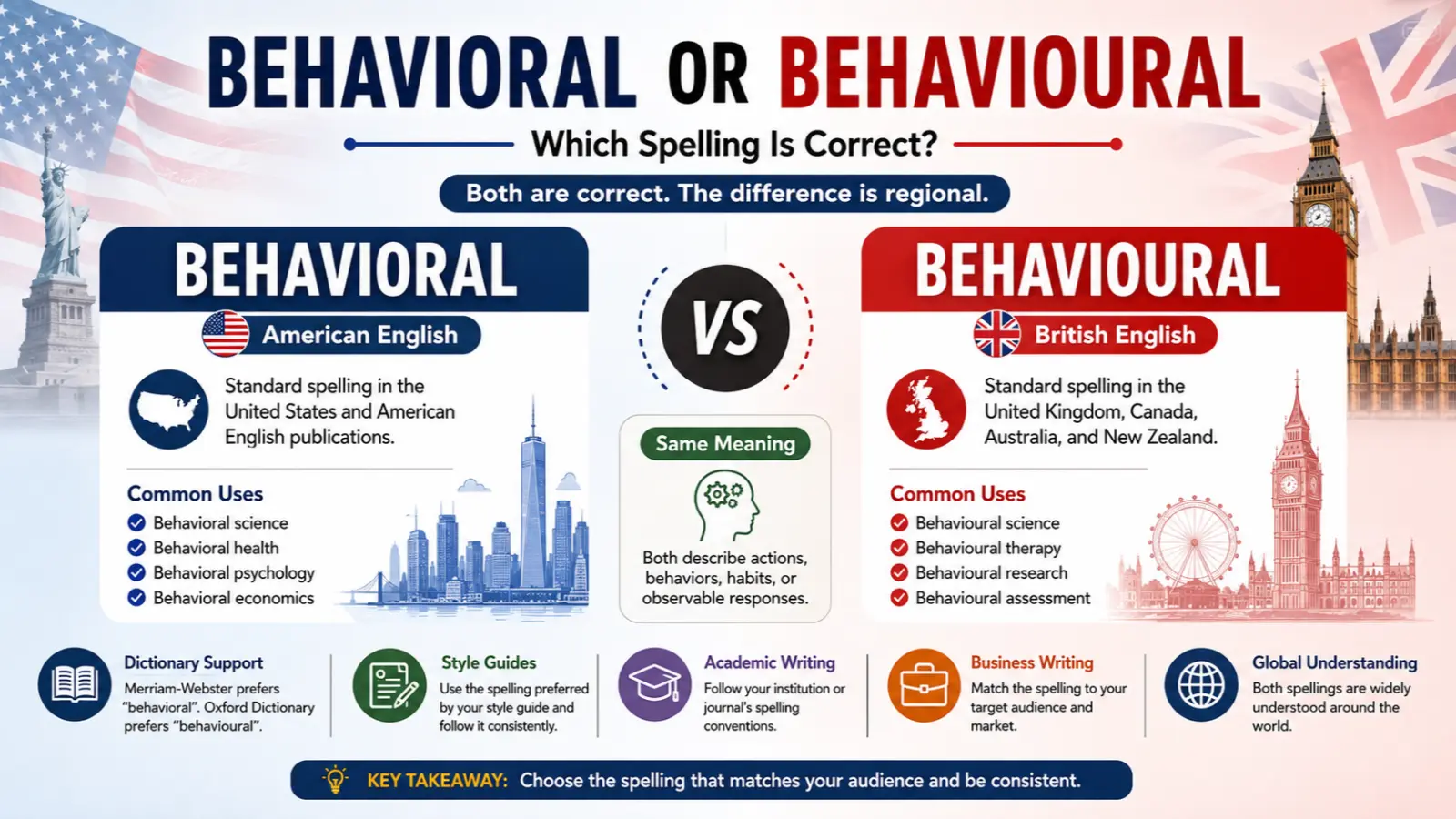
Many English learners, writers, editors, and professionals wonder about the difference between behavioral and behavioural. The answer is simple: both spellings are correct, but they are used in different regions of the English-speaking world.
Behavioral or Behavioural is a common spelling question that often confuses writers, students, marketers, and professionals. Both words have the same meaning and refer to actions, conduct, or patterns of behavior. The difference comes from regional English conventions, with one spelling preferred in American English and the other commonly used in British English.
The variation follows the same pattern as other words such as behavior/behaviour, color/colour, and favor/favour. Understanding which spelling to use can help maintain consistency in academic, professional, and published writing.
Quick Answer
| Spelling | Region | Correct? |
|---|---|---|
| Behavioral | United States | Yes |
| Behavioural | United Kingdom, Canada, Australia, New Zealand | Yes |
If you write for an American audience, use behavioral.
If you write for a British audience or countries that follow British English conventions, use behavioural.
What Does Behavioral or Behavioural Mean?
Both words are adjectives derived from the noun behavior/behaviour.

They describe something related to actions, conduct, habits, or observable responses.
Examples
- Behavioral science studies human actions.
- Behavioural therapy helps people change unhealthy habits.
- Researchers analyze behavioral patterns in consumers.
- Schools may develop behavioural policies for students.
The meaning remains exactly the same regardless of spelling.
Which Spelling Belongs to Which Region?
Behavioral
Behavioral is the standard spelling in American English.
Commonly used in:
- United States universities
- American newspapers
- Government publications
- U.S. business documents
- American psychological associations
Examples:
- Behavioral economics
- Behavioral health
- Behavioral analysis
- Behavioral psychology
Behavioural
Behavioural is the standard spelling in British English.
Commonly used in:
- United Kingdom publications
- Canadian publications
- Australian institutions
- New Zealand academic writing
- British government documents
Examples:
- Behavioural science
- Behavioural research
- Behavioural assessment
- Behavioural intervention
Why Are There Two Different Spellings?
The difference comes from the spelling reforms introduced by Noah Webster in the United States during the early nineteenth century.
Webster promoted simplified spellings to create a distinct American form of English.
As a result:
| British English | American English |
|---|---|
| Behaviour | Behavior |
| Colour | Color |
| Favourite | Favorite |
| Labour | Labor |
| Neighbour | Neighbor |
The adjective forms naturally followed the same pattern:
- Behaviour → Behavioural
- Behavior → Behavioral
Dictionary Recommendations
Major dictionaries recognize both spellings.
American Dictionaries
American dictionaries generally prefer:
- Behavioral
Examples include:
- Merriam Webster
- American Heritage Dictionary
- Dictionary.com
British Dictionaries
British dictionaries generally prefer:
- Behavioural
Examples include:
- Oxford English Dictionary
- Collins Dictionary
- Cambridge Dictionary
Most dictionaries list the alternative spelling as a regional variant rather than an incorrect form.
What Do Official Style Guides Recommend?
American Style Guides
The following style guides recommend behavioral:
- APA Style
- Chicago Manual of Style
- AP Stylebook
- MLA Style when using American English
British Style Guides
The following style guides recommend behavioural:
- Oxford Style Manual
- UK Government Style Guide
- Guardian Style Guide
- Cambridge style recommendations for British English
The key rule is consistency throughout the document.
Behavioral vs Behavioural in Academic Writing

Academic institutions usually follow the spelling conventions of their country.
In the United States
You will commonly see:
- Behavioral Science
- Behavioral Economics
- Behavioral Psychology
- Behavioral Health
In the United Kingdom
You will commonly see:
- Behavioural Science
- Behavioural Economics
- Behavioural Psychology
- Behavioural Health
Researchers submitting to journals should always follow the journal’s editorial guidelines.
Usage in Business Writing
Business communication should match the audience.
Use Behavioral When
- Writing for U.S. customers
- Publishing on American websites
- Preparing U.S. corporate reports
- Creating American marketing content
Use Behavioural When
- Writing for UK audiences
- Publishing in British markets
- Preparing documents for Commonwealth countries
- Creating content for UK organizations
Consistency improves professionalism and brand credibility.
Publishing Standards Around the World
United States
Preferred spelling:
Behavioral
United Kingdom
Preferred spelling:
Behavioural
Canada
Canadian publishers often follow British spelling conventions, making behavioural more common.
Australia and New Zealand
Most publications use:
Behavioural
International Publications
Many international organizations choose one style guide and apply it consistently across all content.
Real World Examples

American Usage
- Behavioral Health Services
- Behavioral Research Institute
- Behavioral Economics Program
- Behavioral Analytics Platform
British Usage
- Behavioural Insights Team
- Behavioural Research Centre
- Behavioural Support Services
- Behavioural Sciences Department
These examples show that both forms are actively used in professional settings.
Current Usage Trends
Modern search and publishing data show:
- Behavioral dominates in the United States.
- Behavioural remains dominant in the United Kingdom and many Commonwealth countries.
- International readers recognize both spellings.
- Academic databases contain millions of examples of each form.
Globalization has increased awareness of both spellings, but regional preferences remain strong.
Common Mistakes to Avoid
Mixing Styles
Incorrect:
- Our behavioural analysis uses behavioral models.
Correct:
- Our behavioural analysis uses behavioural models.
- Our behavioral analysis uses behavioral models.
Assuming One Is Wrong
Both spellings are accepted in standard English.
The choice depends on regional spelling conventions.
Should You Use Behavioral or Behavioural for SEO?
Choose the spelling that matches your target audience.
For U.S. Traffic
Use:
- Behavioral
For UK Traffic
Use:
- Behavioural
For Global Audiences
You may choose either spelling, but maintain consistency throughout the article.
Frequently Asked Questions
Is behavioral correct?
Yes. Behavioral is the standard American English spelling.
Is behavioural correct?
Yes. Behavioural is the standard British English spelling.
Which spelling is more common?
Behavioral is more common globally because of the size of the American publishing market, while behavioural remains standard in British English regions.
Do the words have different meanings?
No. Both words have the same meaning.
Which spelling should students use?
Use the spelling required by your school, university, journal, or style guide.
Can I use both spellings in one article?
No. Choose one spelling style and use it consistently.
Conclusion
The debate between behavioral and behavioural is not about right versus wrong. Both spellings are correct and widely accepted. The difference comes from regional English conventions.
Use behavioral when writing in American English and behavioural when following British English standards. Dictionaries, style guides, publishers, and universities all support this distinction. The most important rule is consistency. Once you choose a spelling style, apply it throughout your writing for a professional and polished result.

Olivia Bennett is a grammar expert and language content writer at GrammarWize.com. She specializes in English grammar, word usage, spelling differences, and writing improvement. Through clear explanations and practical examples, Olivia helps students, professionals, and language learners communicate more effectively. Her goal is to make English grammar simple, accessible, and easy to apply in everyday writing.