Many writers get confused when choosing between employees and employee’s. At first glance, they look almost identical, but they serve completely different grammatical purposes.
Employees or Employee’s is a common grammar question that confuses many writers. At first glance, these words look similar, but they serve different purposes in English. Understanding the difference can help you avoid mistakes in business writing, emails, reports, and everyday communication.
In this guide, you’ll learn when to use employees and when employee’s is the correct choice. We’ll explain the meaning of each term, provide clear examples, and share simple grammar rules to help you write with confidence. Knowing the difference between employees and employee’s can instantly improve the accuracy and professionalism of your writing.
The good news is that both forms are correct. The right choice depends on what you want to say. One refers to multiple workers, while the other shows ownership by a single worker. Learning this distinction can instantly improve your professional and academic writing.
Quick Answer
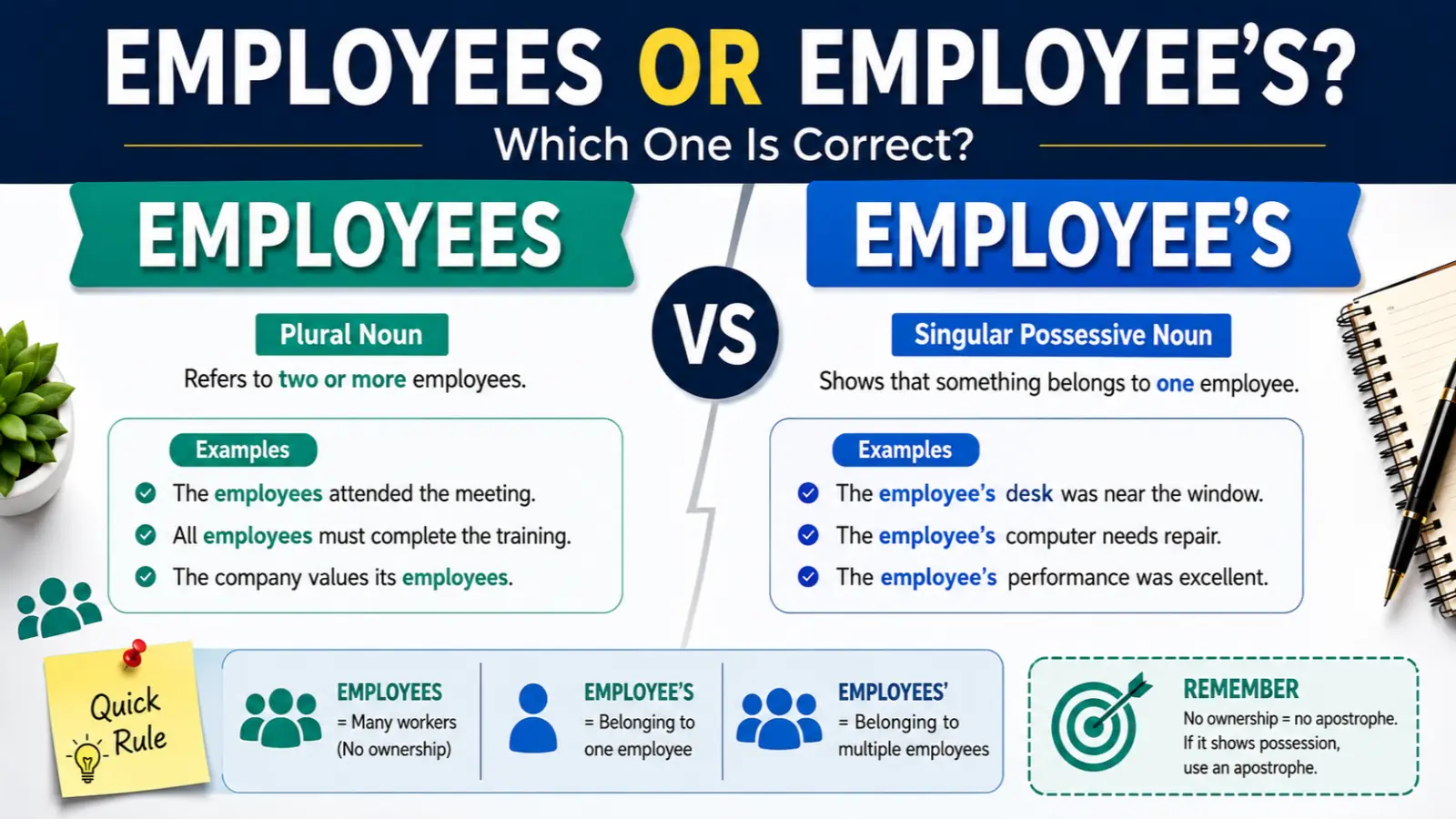
- Employees = more than one employee (plural noun).
- Employee’s = something belongs to one employee (singular possessive noun).
Examples
✅ The employees attended the meeting.
✅ The employee’s desk was near the window.
❌ The employee’s attended the meeting.
❌ The employees desk was near the window.
Meaning of Both Forms
Employees
“Employees” is the plural form of employee. It refers to two or more people who work for a company or organization.
Examples:
- The employees received a holiday bonus.
- All employees must complete the training.
- The company values its employees.
Employee’s
“Employee’s” is the singular possessive form of employee. It shows that something belongs to one employee.
Examples:
- The employee’s computer needs repair.
- The employee’s schedule changed yesterday.
- The employee’s performance was excellent.
Comparison Table

| Form | Meaning | Usage |
|---|---|---|
| Employees | More than one employee | Plural noun |
| Employee’s | Belonging to one employee | Singular possessive |
| Employees’ | Belonging to multiple employees | Plural possessive |
Example
- Employees submitted reports.
- Employee’s report was submitted.
- Employees’ reports were submitted.
Origin
The word employee comes from the French verb employer, meaning “to make use of” or “to engage in service.” English adopted the term in the nineteenth century to describe a person working for an employer.
The plural form employees follows standard English noun rules by adding s.
The possessive form employee’s follows the standard possessive rule of adding an apostrophe and s to a singular noun.
Why the Confusion Exists
Most confusion comes from the apostrophe.
Many people assume that adding an apostrophe automatically creates a plural form. In English grammar, apostrophes usually indicate possession, not plurality.
For example:
- Cats = more than one cat.
- Cat’s = belonging to one cat.
The same rule applies to employee:
- Employees = more than one employee.
- Employee’s = belonging to one employee.
Dictionary Recommendations
Major dictionaries and style guides recognize all three forms when used correctly:
- Employee = singular noun.
- Employees = plural noun.
- Employee’s = singular possessive.
- Employees’ = plural possessive.
Professional references consistently recommend choosing the form based on meaning rather than preference.
Real Life Examples

Employees
- Employees must wear identification badges.
- The employees celebrated the company’s anniversary.
- New employees attend orientation sessions.
Employee’s
- The employee’s ID badge was missing.
- The employee’s manager approved the request.
- The employee’s contract expires next month.
Employees’
- The employees’ break room was renovated.
- The employees’ feedback helped improve policies.
- The employees’ parking area was expanded.
Common Mistakes
Mistake 1
❌ The employee’s attended training.
✅ The employees attended training.
Reason: No ownership is being shown.
Mistake 2
❌ The employees desk is organized.
✅ The employee’s desk is organized.
Reason: The desk belongs to one employee.
Mistake 3
❌ The employees benefits package was updated.
✅ The employees’ benefits package was updated.
Reason: The benefits belong to multiple employees.
Memory Trick
Think about this simple rule:
No ownership = no apostrophe.
- Employees = many workers.
- Employee’s = one worker owns something.
- Employees’ = many workers own something.
If you can replace the phrase with belongs to, you probably need an apostrophe.
Example:
“The employee’s laptop”
= “The laptop belongs to the employee.”
Professional Writing Recommendation
In business writing, HR documents, reports, and workplace communication, use:
- Employees when referring to a group of workers.
- Employee’s when something belongs to one worker.
- Employees’ when something belongs to multiple workers.
Always double-check apostrophes because incorrect possessive forms can make professional documents appear careless.
FAQs:
Is employees or employee’s correct?
Both are correct. Employees is plural, while employee’s is singular possessive.
What does employee’s mean?
It means something belongs to one employee.
What does employees mean?
It refers to more than one employee.
Is employees’ different from employee’s?
Yes. Employee’s shows ownership by one employee. Employees’ shows ownership by multiple employees.
Which form is used in workplace policies?
Most workplace policies use employees when referring to staff members generally.
Can I use an apostrophe to make employee plural?
No. Apostrophes do not create regular plural nouns in English.
Conclusion
The choice between employees and employee’s is a grammar issue, not a spelling issue. Employees refers to multiple workers, while employee’s shows that something belongs to one worker. When ownership belongs to several workers, use employees’.
Remember the easiest rule: plural nouns usually do not need an apostrophe, but possessive nouns do. Following this rule will help you avoid one of the most common workplace writing mistakes.

Olivia Bennett is a grammar expert and language content writer at GrammarWize.com. She specializes in English grammar, word usage, spelling differences, and writing improvement. Through clear explanations and practical examples, Olivia helps students, professionals, and language learners communicate more effectively. Her goal is to make English grammar simple, accessible, and easy to apply in everyday writing.