Cueing and cuing are two spellings that often confuse writers, editors, students, and professionals. Since both forms appear in dictionaries and published writing, many people wonder if one is correct and the other is a mistake.
Cueing or Cuing is a common spelling question that confuses many writers, students, and professionals. Both forms are accepted in English, but their usage can vary depending on style guides, industries, and regional preferences. Understanding the difference can help you choose the most appropriate spelling for your audience and context.
In this guide, you’ll learn the meaning of Cueing or Cuing, discover when each spelling is used, and see practical examples that make the distinction easy to remember. By the end, you’ll know which form fits your writing and how to use it with confidence.
The good news is that both spellings are accepted in modern English. The choice usually depends on style preference, readability, and the dictionary or publication guide being followed. Understanding the difference can help you write more confidently and consistently.
Quick Answer
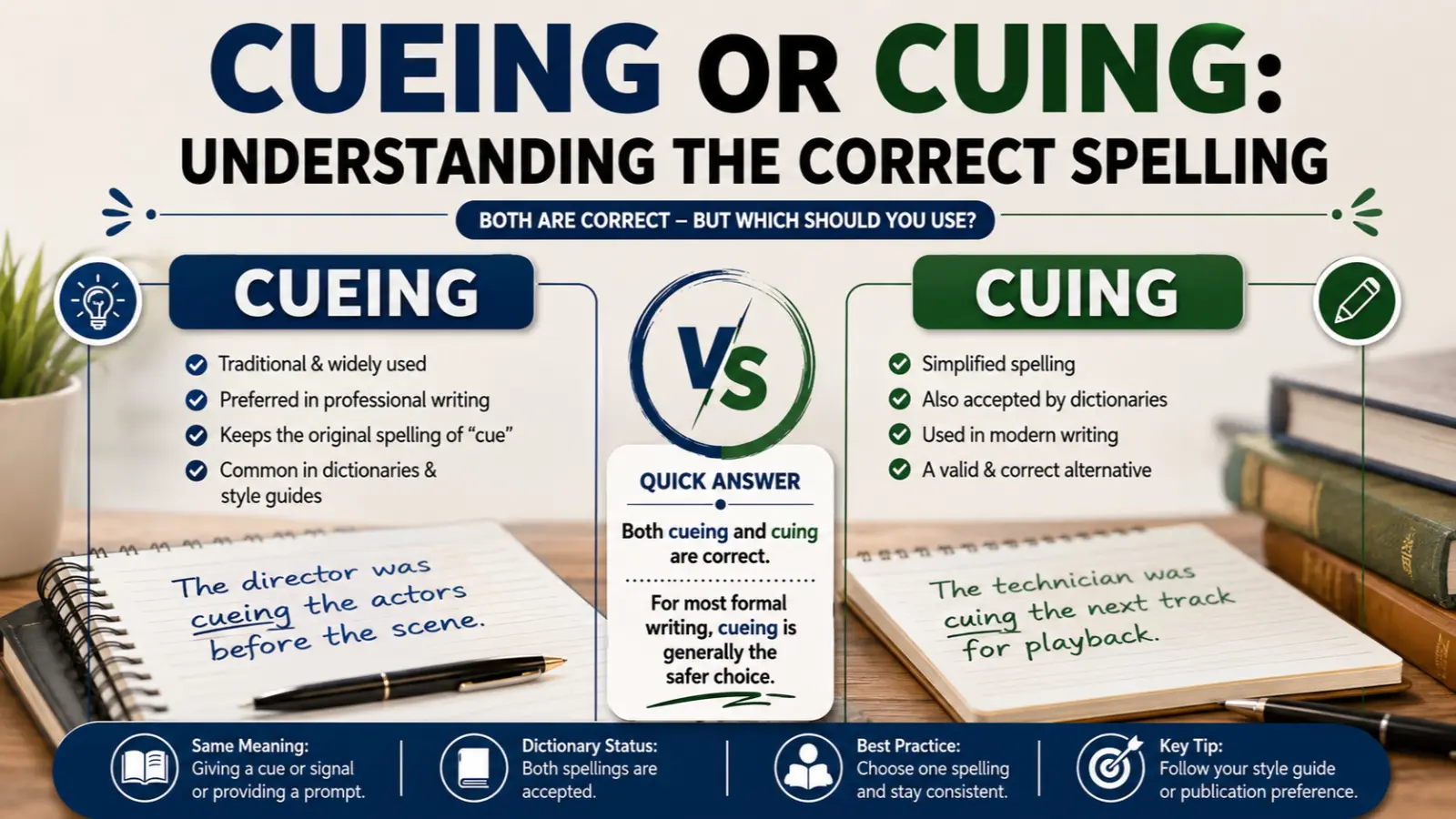
Both cueing and cuing are correct spellings of the present participle and gerund form of the verb cue.
- Cueing is traditionally more common and often preferred because it preserves the original spelling of cue.
- Cuing is a simplified spelling that many modern dictionaries also accept.
For most professional and formal writing, cueing is generally the safer choice.
Meaning of Both Spellings

The words cueing and cuing have exactly the same meaning.
They refer to:
- Giving a signal or prompt.
- Preparing audio, video, or music to start at a specific point.
- Providing guidance or hints to someone.
Examples
- The director was cueing the actors before each scene.
- The technician was cuing the next track for playback.
The meaning remains unchanged regardless of the spelling used.
Comparison Table
| Feature | Cueing | Cuing |
|---|---|---|
| Meaning | Giving a cue or signal | Giving a cue or signal |
| Correct Spelling | Yes | Yes |
| Traditional Form | Yes | No |
| Simplified Form | No | Yes |
| Common in Professional Writing | More common | Less common |
| Dictionary Accepted | Yes | Yes |
| Recommended for Consistency | Often preferred | Acceptable alternative |
Origin
The word cue entered English several centuries ago and became widely used in theater, billiards, and communication contexts.
When adding -ing, English spelling rules can create variations. Some writers preferred keeping the original word intact, producing cueing, while others favored a streamlined form, resulting in cuing.
Over time, both spellings gained acceptance and entered major dictionaries.
Why Confusion Exists
The confusion comes from the unusual spelling of the word cue itself.
Most English words ending in silent e simply drop the e before adding -ing:
- make → making
- move → moving
- write → writing
Following that pattern, many people expect:
- cue → cuing
However, removing the e creates the unusual letter combination cu, which some readers find less recognizable. To maintain clarity, many writers keep the e, producing cueing.
As a result, both forms continue to coexist.
Dictionary Recommendations
Major dictionaries generally recognize both spellings.
Dictionary Trends
- Cueing is often listed first or treated as the traditional spelling.
- Cuing is typically shown as a valid variant.
- Style guides and publishers may choose one form for consistency.
In formal documents, academic writing, and business communication, cueing tends to appear more frequently.
Real-Life Examples

Using Cueing
- The stage manager was cueing the performers from backstage.
- The teacher was cueing students with visual prompts.
- The DJ spent several minutes cueing the next song.
Using Cuing
- The operator was cuing the video clip.
- The coach was cuing players before the drill began.
- The sound engineer was cuing the recording.
All of these examples are grammatically correct.
Common Mistakes

Mixing Spellings in the Same Document
Incorrect:
- The technician was cueing the first track and later cuing another one.
Choose one style and use it consistently.
Assuming One Form Is Wrong
Many writers mistakenly believe cuing is an error. In reality, dictionaries recognize it as a legitimate variant.
Ignoring Style Guidelines
Organizations often have preferred spelling conventions. Check the required style guide before publishing.
Memory Trick
A simple way to remember the preferred professional spelling is:
Cueing keeps the entire word “cue” visible.
If you can still clearly see cue, the spelling is cueing.
This makes the word easier for many readers to recognize at a glance.
Professional Writing Recommendation
If you are writing:
- Business documents
- Academic papers
- Website content
- Professional reports
- Marketing materials
Cueing is usually the best choice because it is more familiar to readers and commonly preferred in edited publications.
Use cuing if:
- Your style guide specifically prefers it.
- You are following a publication that uses simplified spellings consistently.
The most important rule is consistency.
FAQs:
Is cueing correct?
Yes. Cueing is a fully correct and widely accepted spelling.
Is cuing correct?
Yes. Cuing is also correct and appears in major dictionaries as a variant spelling.
Which spelling is more common?
Cueing is generally more common in professional and edited writing.
Do cueing and cuing mean different things?
No. They have the same meaning and can be used interchangeably.
Which spelling should students use?
Students should usually use cueing unless a teacher or style guide requests otherwise.
Which spelling is best for business writing?
Cueing is often the preferred choice because it is more familiar and widely recognized.
Conclusion
The keyword cueing or cuing falls into the category of Spelling Comparison. Unlike many spelling debates where one version is incorrect, both forms are accepted in modern English. Cueing is the traditional and more commonly preferred spelling, while cuing is a recognized simplified variant.
For professional, academic, and online writing, cueing is generally the safest recommendation. However, whichever form you choose, consistency throughout your document matters more than the specific variant itself.

Olivia Bennett is a grammar expert and language content writer at GrammarWize.com. She specializes in English grammar, word usage, spelling differences, and writing improvement. Through clear explanations and practical examples, Olivia helps students, professionals, and language learners communicate more effectively. Her goal is to make English grammar simple, accessible, and easy to apply in everyday writing.