Onto or unto can look confusing because both words contain the same basic word, to. However, they do not serve the same purpose in modern English. Onto usually describes movement to a position on a surface, while unto is an older and more formal word that mainly appears in biblical, legal, and traditional writing.
Onto or Unto can confuse writers because both words look and sound similar, but they have different meanings and uses. Unto is an older and more formal word that often means “to” or “until,” especially in religious, literary, or traditional writing. Understanding this difference helps you choose the correct word for your sentence.
In everyday modern English, onto is much more common. You may see unto in older texts, formal expressions, and Bible passages. Learning when to use each word can prevent common grammar mistakes and make your writing clearer. This guide explains the meaning, usage, examples, and key differences between onto and unto.
Understanding this difference makes your writing clearer. In everyday English, onto is common and natural. Unto is much less common and can sound old fashioned in ordinary conversation.
Onto and Unto at a Glance
| Word | Main use | Common style | Example |
|---|---|---|---|
| Onto | Movement to a position on something | Modern and everyday | The cat jumped onto the table. |
| Unto | To, toward, or until | Archaic or formal | He gave the message unto the king. |
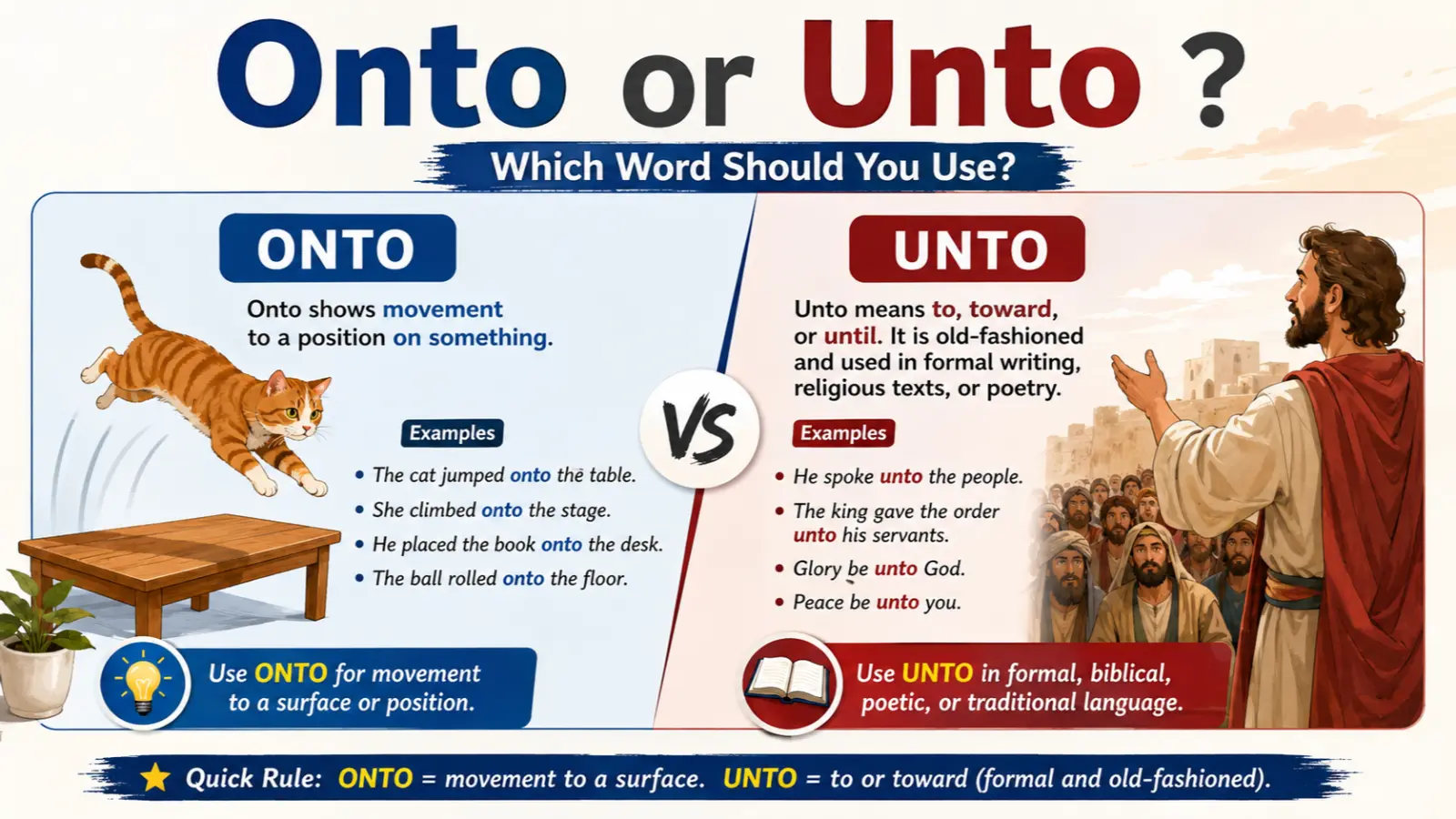
The easiest rule is simple: Use onto for movement toward or onto a surface. Use unto mainly when the context is biblical, legal, poetic, or deliberately old fashioned.
What Onto Means
Onto is a preposition that usually shows movement from one position to a position on something.
It often answers the question, Where did something move?
For example:
- The child climbed onto the bed.
- The bird flew onto the roof.
- She stepped onto the stage.
- The dog jumped onto the couch.
- He placed the book onto the desk.
In these sentences, something moves toward a particular position or surface.
Onto Can Also Show Contact
Onto can describe movement that results in contact with a surface.
For example:
The ball rolled onto the floor.
The ball moves and ends up on the floor.
Another example is:
She spilled water onto the carpet.
The water moves from one place and lands on the carpet.
What Unto Means
Unto is a preposition with meanings that are close to to, toward, or sometimes until.
It is uncommon in modern everyday English. You are more likely to see it in older religious texts, traditional expressions, historical writing, legal language, or deliberately formal writing.
For example:
- He spoke unto the people.
- The king gave the order unto his servants.
- They traveled unto the city.
- Peace be unto you.
In modern everyday English, these sentences would usually use to instead:
- He spoke to the people.
- The king gave the order to his servants.
- They traveled to the city.
- Peace be to you.
The word unto is not normally needed in casual modern writing.
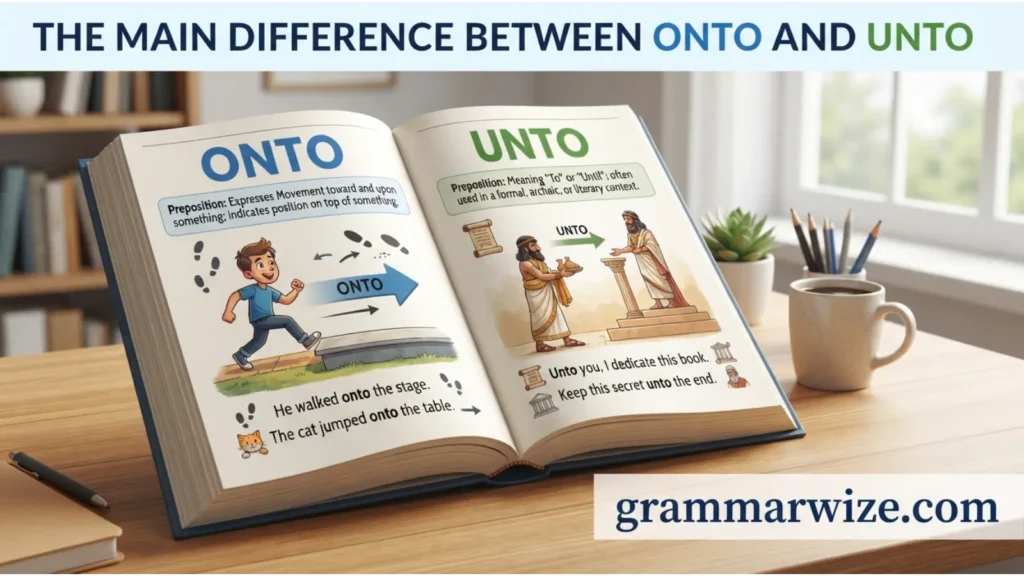
The Main Difference Between Onto and Unto
The biggest difference is their meaning and usage.
Onto commonly expresses movement to a position on something.
Unto generally means to or toward, but it has an old fashioned or highly formal tone.
Compare these examples:
The boy jumped onto the table.
This means the boy moved and ended up on the table.
The teacher spoke unto the students.
This means the teacher spoke to the students, but unto gives the sentence an old fashioned tone.
The two words should not normally be exchanged.

How to Use Onto Correctly
Use onto when an action involves movement toward a surface, position, or location.
Transfer to a Surface
The cat jumped onto the sofa.
Movement to a Higher Position
The climber stepped onto the platform.
Movement to a Specific Area
The children ran onto the field.
Putting Something on a Surface
She placed the keys onto the counter.
In many situations, modern English also allows on instead of onto.
For example:
She put the book on the table.
This is more natural than:
She put the book onto the table.
Both can be grammatically acceptable, but onto emphasizes movement toward the surface.

How to Use Unto Correctly
Use unto only when its traditional or formal tone fits the context.
It commonly appears in expressions influenced by older English.
For example:
The message was delivered unto the king.
In modern English, this would normally become:
The message was delivered to the king.
You may also encounter unto in religious texts and traditional phrases.
For example:
Glory be unto God.
Here, unto contributes to the traditional style of the expression.
Using unto in a casual conversation can sound unnatural.
For example, this sounds overly old fashioned:
I shall speak unto you tomorrow.
A natural modern version is:
I will speak to you tomorrow.
Onto or Unto in Sentence Structure
The grammatical structure helps you decide which word fits.
Common Structure With Onto
A typical structure is:
Subject + verb + onto + object
Examples:
- The cat jumped onto the chair.
- She walked onto the stage.
- The child climbed onto the roof.
- The bird landed onto the branch.
The object after onto is usually a surface, place, or position.
Common Structure With Unto
A common traditional structure is:
Subject + verb + unto + person or group
Examples:
- He spoke unto the crowd.
- The king sent word unto his people.
- She gave the letter unto him.
In modern English, to would usually replace unto.
Onto vs On
One common source of confusion is onto versus on.
Onto emphasizes movement.
The cat jumped onto the chair.
On often describes position.
The cat is on the chair.
Compare these:
The boy climbed onto the roof.
The boy moved to the roof.
The boy is on the roof.
The boy is already there.
This distinction is useful because onto often focuses on the change of position.
Onto vs To
Another important comparison is onto and to.
Use to for general movement toward a destination.
She walked to the store.
Use onto when the movement ends on a surface or position.
She climbed onto the roof.
The difference becomes clearer in these examples:
- He walked to the stage.
- He stepped onto the stage.
- She drove to the bridge.
- She climbed onto the bridge.
- We went to the platform.
- We jumped onto the platform.
The exact meaning depends on the action and destination.
Common Mistakes With Onto and Unto
Using Unto in Everyday Conversation
A common mistake is choosing unto simply because it sounds formal.
I am going unto the office.
This sounds unnatural in modern English.
Better:
I am going to the office.
Using Onto When You Mean To
Not every movement needs onto.
Incorrect or unnatural:
She went onto the store.
Better:
She went to the store.
A store is a destination here, not a surface that she moved onto.
Confusing Position With Movement
Compare:
The dog is on the bed.
This describes position.
The dog jumped onto the bed.
This describes movement to the bed.
Assuming Unto Is More Correct
Unto is not a more correct version of to. It is simply a different and much less common preposition.
Modern writing usually prefers simpler wording.
Professional and Academic Usage
In professional writing, onto is perfectly normal when the meaning requires it.
For example:
The data was transferred onto the new system.
The employee moved the files onto the shared drive.
The package was placed onto the loading platform.
However, unto is rarely appropriate in ordinary professional communication.
Instead of:
Please forward the document unto the manager.
Write:
Please forward the document to the manager.
Clear and modern wording is usually the best choice in business and academic writing.
Formal and Informal Usage
Onto works comfortably in both formal and informal English.
For example:
The researcher transferred the samples onto a clean surface.
It can also appear in casual speech:
The dog jumped onto my bed.
Unto has a very different style. It can appear in traditional, biblical, poetic, or intentionally old fashioned writing.
For example:
And he spoke unto them.
In a modern email, this would sound unusual:
I am writing unto you regarding your application.
A natural professional version is:
I am writing to you regarding your application.
Comparison Examples
Here are some quick examples to make the difference easier to remember.
Onto
The child climbed onto the chair.
Unto
The prophet spoke unto the people.
Onto
The bird landed onto the roof.
Unto
The king gave the message unto his servants.
Onto
She stepped onto the bus.
Unto
Peace be unto you.
Notice that onto usually relates to movement and position, while unto has a traditional sense similar to to.
Real Life Conversations
Modern conversations almost always favor onto and to instead of unto.
Natural Conversation
Person A: Where did the cat go?
Person B: It jumped onto the table.
Another Example
Person A: Did you get onto the bus?
Person B: Yes, I got onto it just before the doors closed.
Formal but Natural
Manager: Please move the files onto the shared drive.
Employee: Sure, I will do that now.
Using unto in these conversations would sound unnatural.
A Simple Memory Trick
Remember this:
Onto means movement to a surface or position.
Think:
ON + TO = onto
Something moves to a position on something.
For example:
The cat jumped onto the table.
For unto, remember:
UNTO sounds old fashioned and usually means TO or TOWARD.
Think of traditional or biblical language.
He spoke unto the people.
If you are writing a normal email, article, message, or school assignment, to will usually be the better choice.
Quick Test
Try choosing the correct word in each sentence.
- The dog jumped ___ the couch.
- She walked ___ the office.
- The speaker stepped ___ the stage.
- The prophet spoke ___ the people.
- He placed the phone ___ the table.
The answers are:
- onto
- to
- onto
- unto
- onto
The fourth sentence uses unto because it has a traditional style. In modern English, to would usually be preferred.
Frequently Asked Questions
Is onto a correct word?
Yes. Onto is a standard English preposition. It commonly describes movement to a position on a surface or object.
Is unto a correct word?
Yes. Unto is a legitimate English word. However, it is uncommon in modern everyday English and often has an old fashioned or formal tone.
Is unto the same as to?
They can have similar meanings in some contexts, but they are not interchangeable in every sentence. Unto is mainly associated with traditional, biblical, poetic, or formal language.
Should I use onto in professional writing?
Yes. Onto is completely acceptable in professional writing when it expresses the correct meaning.
Should I use unto in an email?
Usually, no. Modern emails normally use to instead of unto.
Is onto one word or two words?
Onto is normally written as one word when it functions as the preposition meaning movement to a position on something.
Is onto the same as on?
No. On commonly describes position, while onto often describes movement toward a position.
The book is on the desk.
She put the book onto the desk.
Can unto mean until?
In older English, unto can appear with meanings related to until or up to, although this usage is now uncommon. Modern English generally uses until, to, or another clearer expression.
Conclusion
Onto and unto are both real English words, but they have very different roles in modern writing.
Use onto when something moves to a position on a surface or object.
The cat jumped onto the sofa.
Use unto mainly in biblical, historical, poetic, legal, or deliberately traditional language.
He spoke unto the people.
For normal conversation, emails, websites, and professional writing, onto is common, while unto is usually replaced by to.
The easiest rule is: Onto is for movement to a position on something. Unto is an old fashioned form meaning to or toward.

Olivia Bennett is a grammar expert and language content writer at GrammarWize.com. She specializes in English grammar, word usage, spelling differences, and writing improvement. Through clear explanations and practical examples, Olivia helps students, professionals, and language learners communicate more effectively. Her goal is to make English grammar simple, accessible, and easy to apply in everyday writing.