Rather or Not is a common phrase people search when they are unsure about the correct wording. The confusion often comes from hearing “rather” and “whether” in similar sentence patterns. However, “rather or not” is usually not the standard expression for introducing two possible outcomes. In most cases, “whether or not” is the correct phrase.
Understanding this difference can help you write clearer and more natural English. In this guide, we will explain the meaning of rather or not, show when it works, and compare it with whether or not using simple examples. You will also learn an easy way to remember which phrase fits your sentence.
The word rather has a different meaning. It usually expresses preference, degree, or correction. Understanding this difference will help you avoid a common grammar mistake in both everyday and professional writing.
Quick Answer
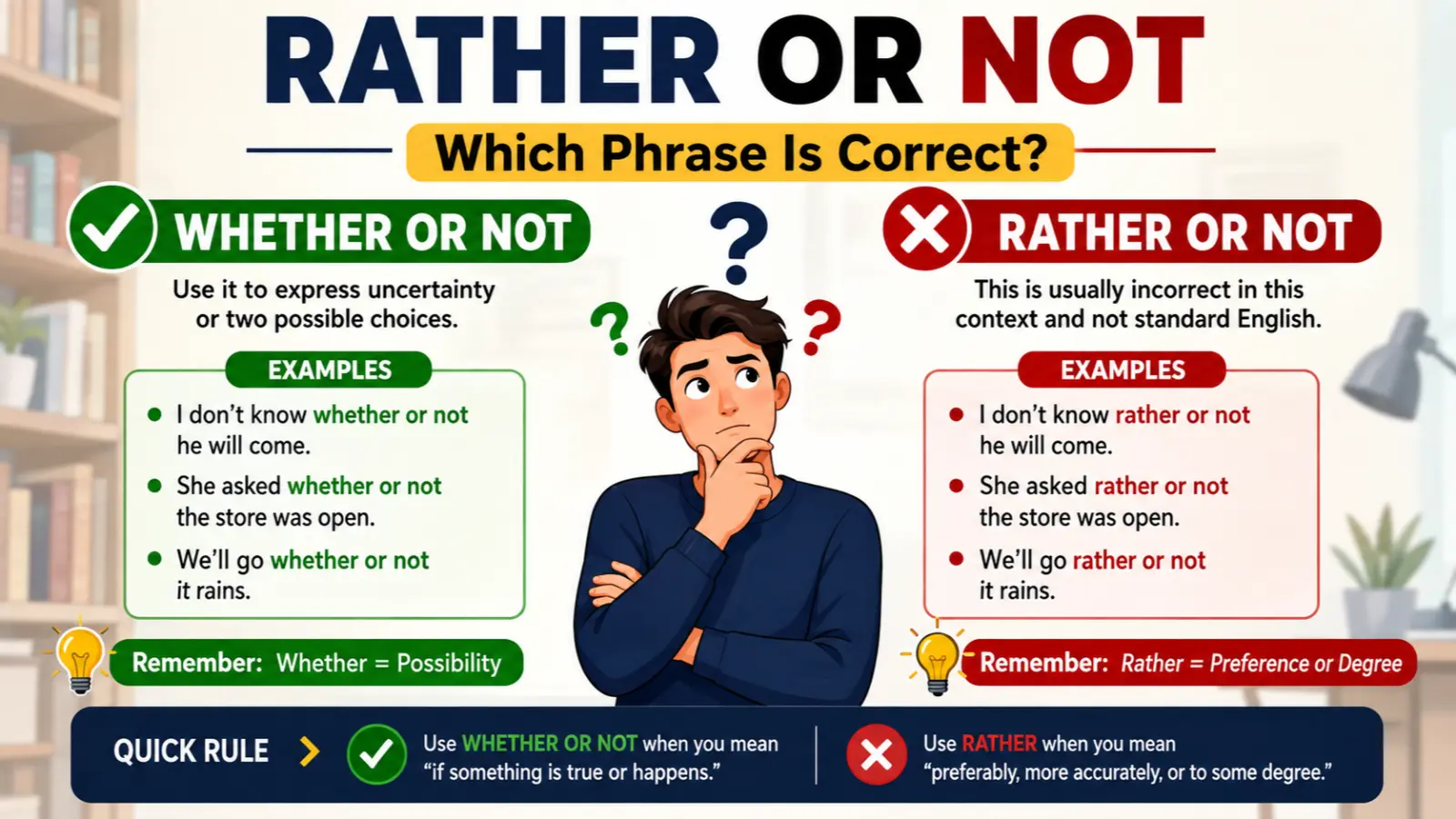
Rather or not is a common phrase people search when they are unsure about the correct expression. In standard English, “whether or not” is the correct phrase when you mean “if something is true or happens.”
Is Rather or Not Correct?
“Rather or not” is generally incorrect when you want to express two possibilities.
The correct phrase is:
“Whether or not”
For example:
- Correct: I do not know whether or not he will come.
- Incorrect: I do not know rather or not he will come.
Here, the phrase introduces two possible situations: he may come, or he may not come.
What Does Whether or Not Mean?
“Whether or not” means that there are two possible conditions or outcomes.
It is often used when someone is uncertain about something.
Examples:
- I cannot decide whether or not to go.
- She asked whether or not the store was open.
- We need to know whether or not they agreed.
- He wondered whether or not the plan would work.
A simple way to remember it is:
Whether = choice or possibility between alternatives.
What Does Rather Mean?
Rather is a real English word, but it does not normally replace the word used in the phrase above.
It can mean preferably, to some degree, or more accurately depending on the sentence.
Examples:
- I would rather stay home.
- The movie was rather interesting.
- It was Tuesday, or rather, Wednesday.
Notice that rather has its own grammatical job. It does not mean “if or if not.”
Rather vs Whether
The difference becomes easier when you look at their functions.
Whether introduces a choice, condition, or uncertainty.
- I do not know whether she is ready.
Rather can show preference or degree.
- I would rather stay home.
- The test was rather difficult.
So, replacing one with the other can completely change the meaning of a sentence.
Sentence Structure
The phrase “whether or not” can appear in several common sentence patterns.
After verbs of uncertainty
Use it after verbs such as know, ask, decide, wonder, determine, and check.
Examples:
- I need to know whether or not you are coming.
- She asked whether or not he was available.
- We must determine whether or not the product works.
Before an infinitive
You can also use the phrase before to + verb.
Examples:
- I cannot decide whether or not to stay.
- He is thinking about whether or not to apply.
- She has not decided whether or not to accept the offer.
With a full clause
The phrase can introduce a complete clause.
Examples:
- We will go whether or not it rains.
- He will attend whether or not his friends come.
- The company will continue whether or not sales increase.

Common Mistakes With Rather or Not
The biggest mistake is using rather when you mean whether.
Incorrect:
- I do not know rather or not she called.
Correct:
- I do not know whether or not she called.
Another mistake is using rather simply because it sounds similar in fast speech. Spoken English can make unfamiliar phrases harder to recognize, but the spelling and meaning remain different.

When Should You Use Rather?
Use rather when you want to express preference, degree, or correction.
Preference
- I would rather walk than drive.
- She would rather read a book.
Degree
- The weather is rather cold today.
- That question was rather difficult.
Correction
- It happened on Friday, or rather, Saturday.
- He is a manager, or rather, a team leader.
These uses are completely different from whether or not.
Professional and Formal Usage
In professional writing, use “whether or not” when you need to express uncertainty or two possible outcomes.
Examples:
- Please confirm whether or not you can attend the meeting.
- The team will review whether or not the proposal meets the requirements.
- We need to determine whether or not the information is accurate.
Using “rather or not” in these sentences would be a grammar and word choice error.
For polished business writing, always check the meaning before choosing between rather and whether.

Rather or Not vs Whether or Not Examples
| Incorrect | Correct |
|---|---|
| I wonder rather or not he knows. | I wonder whether or not he knows. |
| Tell me rather or not you agree. | Tell me whether or not you agree. |
| We need to decide rather or not to continue. | We need to decide whether or not to continue. |
| She asked rather or not I was ready. | She asked whether or not I was ready. |
Easy Memory Trick
Remember this simple rule:
Whether = two possibilities.
Rather = preference or degree.
Think of whether as asking about an alternative:
- Is it happening, or is it not happening?
Think of rather as choosing what you prefer:
- I would rather do this.
This quick distinction can prevent the most common mistake.
Real Life Conversations
Here are some natural examples from everyday speech.
Person A: Are you coming to the party?
Person B: I am not sure whether or not I can come.
Another example:
Person A: Do you want to drive?
Person B: I would rather take the train.
These examples show the difference clearly. The first sentence deals with uncertainty. The second expresses a preference.
Quick Comparison
Whether or not
- Used for possibilities.
- Shows uncertainty or alternatives.
- Common after verbs such as know and decide.
- Suitable for formal and informal writing.
Rather
- Shows preference or degree.
- Can introduce a correction.
- Often appears with “would.”
- Cannot normally replace “whether” in the phrase “whether or not.”
Frequently Asked Questions
Is rather or not grammatically correct?
Usually, no. If you mean “if something happens or does not happen,” use whether or not.
Is whether or not the correct phrase?
Yes. Whether or not is the standard phrase for expressing two possibilities or uncertainty.
Can I say rather instead of whether?
No, not when the meaning involves two alternatives. Rather and whether have different grammatical functions.
Is rather or not used in informal English?
You may hear or see it as a mistake, but it is not the standard form for this meaning. Use whether or not in both casual and professional writing.
Is whether or not formal?
Yes. It is completely acceptable in formal writing, business communication, academic writing, and everyday English.
What is the easiest way to remember the difference?
Use whether for alternatives and rather for preference or degree.
Conclusion
“Rather or not” is not the standard phrase when you mean “if something is true or not.” The correct expression is “whether or not.”
Use whether or not for possibilities, uncertainty, and alternatives. Use rather for preference, degree, or correction. Once you understand this basic difference, the two words become much easier to use correctly.

Olivia Bennett is a grammar expert and language content writer at GrammarWize.com. She specializes in English grammar, word usage, spelling differences, and writing improvement. Through clear explanations and practical examples, Olivia helps students, professionals, and language learners communicate more effectively. Her goal is to make English grammar simple, accessible, and easy to apply in everyday writing.