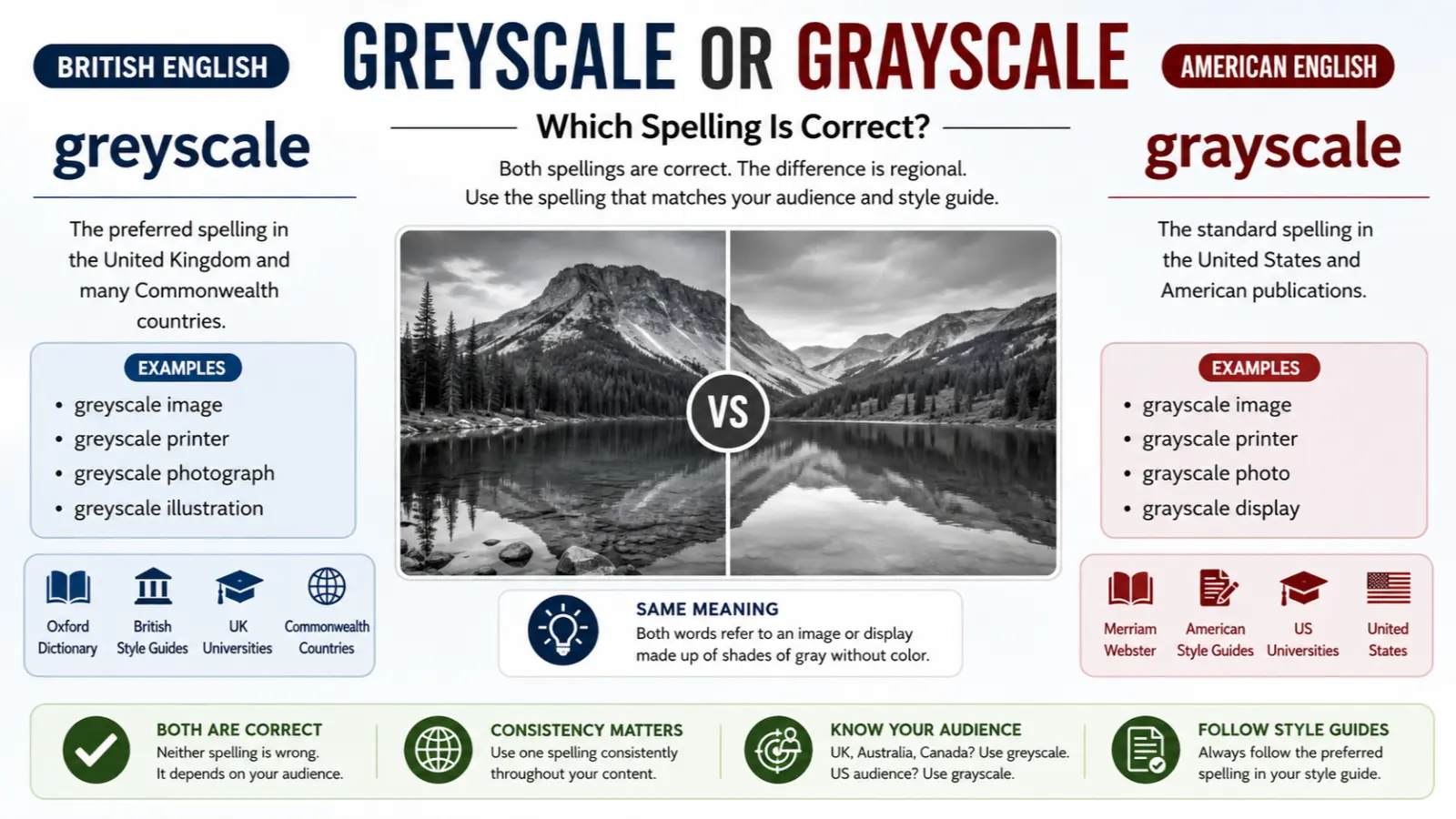
The words greyscale and grayscale both refer to the same concept: an image made entirely from shades of gray, without color. The difference is not in meaning but in regional spelling.
Greyscale or Grayscale is a common spelling confusion that often leaves writers unsure about the correct term. Both words describe images, designs, or tones that use shades of gray instead of colors, but their usage depends on regional spelling preferences. Understanding the difference helps you choose the right form for your writing.
This guide explains Greyscale or Grayscale with clear examples, meaning, and usage tips. Learn the correct spelling and use the term confidently in everyday writing, design, photography, and digital media.
- Greyscale is the preferred spelling in British English.
- Grayscale is the standard spelling in American English.
Neither spelling is incorrect. The right choice depends on your audience and the style guide you follow.
Quick Answer
| Spelling | Region | Correct |
|---|---|---|
| Greyscale | British English | ✅ Yes |
| Grayscale | American English | ✅ Yes |
Use greyscale when writing for readers in the United Kingdom and many Commonwealth countries. Use grayscale for audiences in the United States.

Why Are There Two Spellings?
The difference comes from the spelling of the adjective grey and gray.
- Grey has been the traditional spelling in British English for centuries.
- Gray became the preferred spelling in American English after spelling reforms and standardization in the United States.
Since greyscale and grayscale are formed from these base words, they naturally follow the regional spelling convention.
British English Usage
British publishers, universities, and organizations generally prefer greyscale.
Examples:
- The printer produces high quality greyscale images.
- Convert the photograph to greyscale before printing.
- The report includes several greyscale diagrams.
If your content follows British English, this is the recommended spelling.
American English Usage
American publications, software documentation, and educational materials almost always use grayscale.
Examples:
- The image was converted to grayscale.
- Grayscale printing reduces ink usage.
- The designer adjusted the grayscale settings.
For US audiences, grayscale is the standard choice.
Dictionary Recommendations
Major dictionaries recognize both spellings.
- Oxford English Dictionary lists both forms according to regional English.
- Cambridge Dictionary follows British spelling conventions while acknowledging American usage.
- Merriam-Webster primarily uses grayscale, reflecting American English.
- Collins Dictionary includes both spellings with regional guidance.
The meaning remains identical in every major dictionary.

What Do Style Guides Recommend?
Most editorial style guides advise writers to stay consistent with the chosen variety of English.
British Style
- Use greyscale
- Also use grey, colour, favour, and organise
American Style
- Use grayscale
- Also use gray, color, favor, and organize
Consistency matters more than the specific spelling itself.
Publishing Standards
Professional publishers usually match the spelling to the publication’s language preference.
- UK newspapers and magazines generally use greyscale.
- US publishers almost always use grayscale.
- International publishers often follow a house style for consistency.
Changing between both spellings within one document is usually avoided.
Academic Writing
In academic work, follow your institution’s required English style.
- British universities typically expect greyscale.
- American universities generally require grayscale.
When submitting research, use one spelling consistently throughout the paper.
Business Writing
Business documents should reflect the audience.
Choose greyscale if your customers are mainly in:
- United Kingdom
- Ireland
- Australia
- New Zealand
Choose grayscale if your audience is primarily in:
- United States
For international businesses, follow your company’s editorial style guide.
International Communication
When writing for a global audience, either spelling is acceptable if used consistently.
Many multinational companies select one version for all documentation to maintain a consistent brand voice.

Real World Examples
British English
- Greyscale image
- Greyscale printer
- Greyscale photograph
- Greyscale illustration
American English
- Grayscale image
- Grayscale printer
- Grayscale photo
- Grayscale display
The meaning is exactly the same in every example.
History of the Spellings
The word grey has been used in English since the Middle Ages and became the dominant spelling in Britain.
The spelling gray gained popularity in North America during the eighteenth and nineteenth centuries as American English developed its own conventions.
As digital imaging became common, the compound terms greyscale and grayscale naturally followed these regional spelling patterns.
Current Trends
Today, grayscale appears more frequently online because much of the world’s software, technology documentation, and digital content originates in the United States.
However, greyscale remains the preferred spelling in British publications, educational resources, and many Commonwealth countries.
Both spellings continue to be widely accepted.
Common Mistakes to Avoid
- Mixing greyscale and grayscale in the same document.
- Assuming one spelling is universally incorrect.
- Changing spelling without considering the target audience.
- Ignoring your organization’s editorial style guide.
Frequently Asked Questions
Is greyscale correct?
Yes. Greyscale is the standard British English spelling.
Is grayscale correct?
Yes. Grayscale is the standard American English spelling.
Which spelling should I use?
Use the version that matches your audience or your publication’s style guide.
Do both words have the same meaning?
Yes. They both describe images that contain only shades of gray without color.
Which spelling is more common online?
Grayscale is generally more common because much of the technology industry uses American English.
Conclusion
Both greyscale and grayscale are correct spellings. The only difference is regional English usage.
Choose greyscale for British English and grayscale for American English. If you’re writing for an international audience, either spelling is acceptable as long as you remain consistent throughout your content.

Olivia Bennett is a grammar expert and language content writer at GrammarWize.com. She specializes in English grammar, word usage, spelling differences, and writing improvement. Through clear explanations and practical examples, Olivia helps students, professionals, and language learners communicate more effectively. Her goal is to make English grammar simple, accessible, and easy to apply in everyday writing.