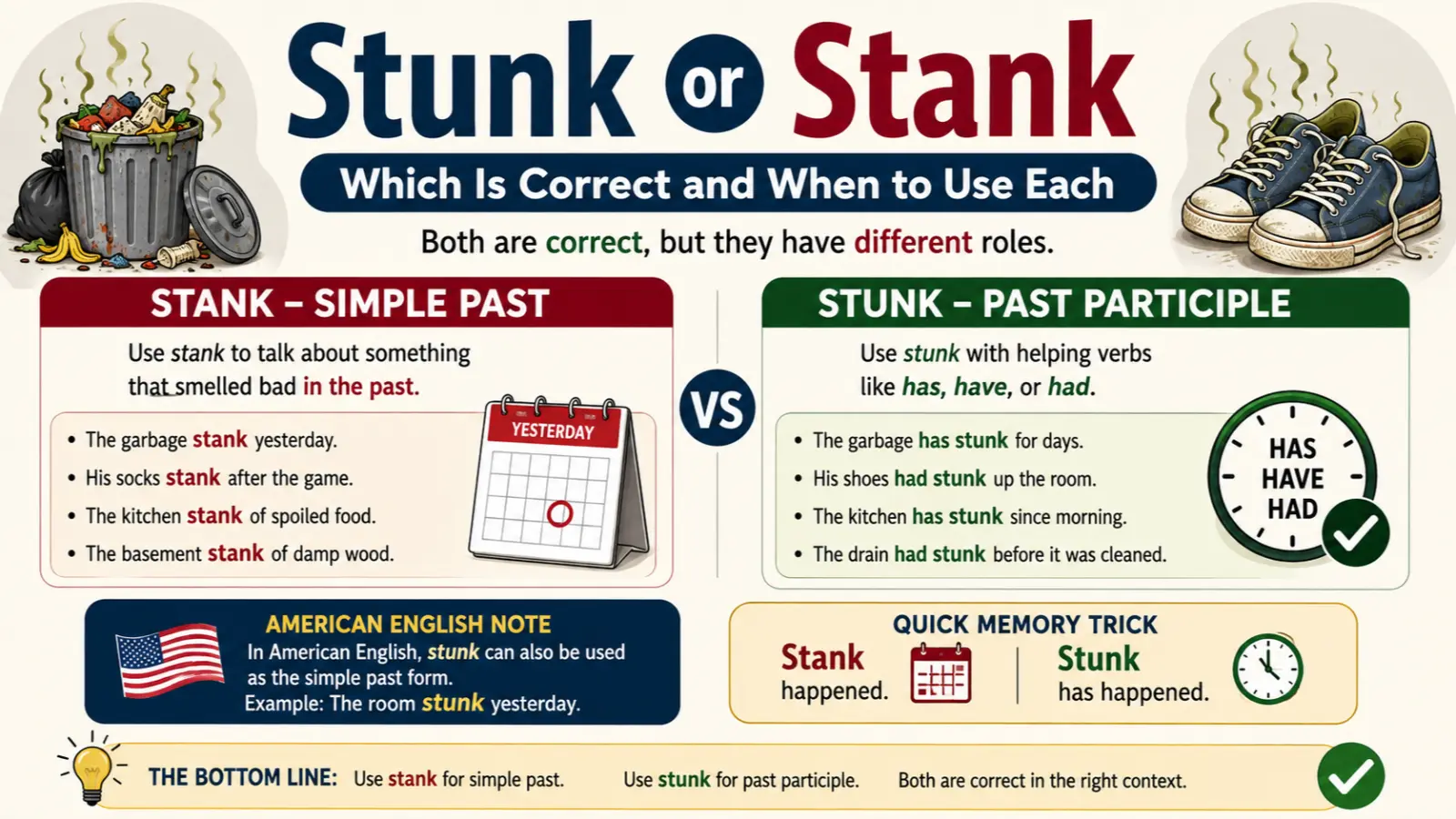
Stunk or stank are both correct forms of the irregular verb stink, but they do not always work in the same sentence. The main difference comes from their grammatical role.
Stunk or Stank can be confusing because both forms relate to the past tense of stink. The difference depends on grammar, usage, and the type of English being used. Stank is commonly used as the simple past tense, while stunk is usually used as the past participle with helping verbs such as has, have, or had. For example, you can say, “The garbage stank yesterday,” or “The garbage has stunk for days.”
Understanding this difference makes your writing clearer and more natural. In this guide, we will explain the meaning, correct usage, examples, and easy ways to remember stunk vs stank. By the end, you will know exactly when to use each form.
Use stank as the simple past form and stunk as the past participle. However, American English also allows stunk as a past tense form, which creates much of the confusion.
Quick Answer
Both stank and stunk are correct.
Use stank as the traditional simple past form.
- The garbage stank yesterday.
- His shoes stank after the game.
Use stunk as the past participle, usually with a helping verb.
- The garbage has stunk for days.
- His shoes had stunk up the room.
In American English, stunk can also appear as the simple past form. Cambridge specifically lists stank and, in US and Australian English, stunk as past tense forms.

Meaning of Stank
Stank is the simple past form of stink. It describes something that smelled very unpleasant at a completed time in the past.
Examples:
- The kitchen stank of spoiled food.
- His clothes stank after the hike.
- The basement stank of damp wood.
- The trash stank in the summer heat.
Oxford lists stank as the past tense of stink.

Meaning of Stunk
Stunk is the past participle of stink. It commonly appears with helping verbs such as has, have, or had.
Examples:
- The room has stunk since yesterday.
- The fish had stunk up the refrigerator.
- His shoes have stunk for hours.
- The drain had stunk before it was cleaned.
Oxford identifies stunk as the past participle of stink.
American English also uses stunk as a simple past form. Cambridge lists both stank and stunk for the American past tense.
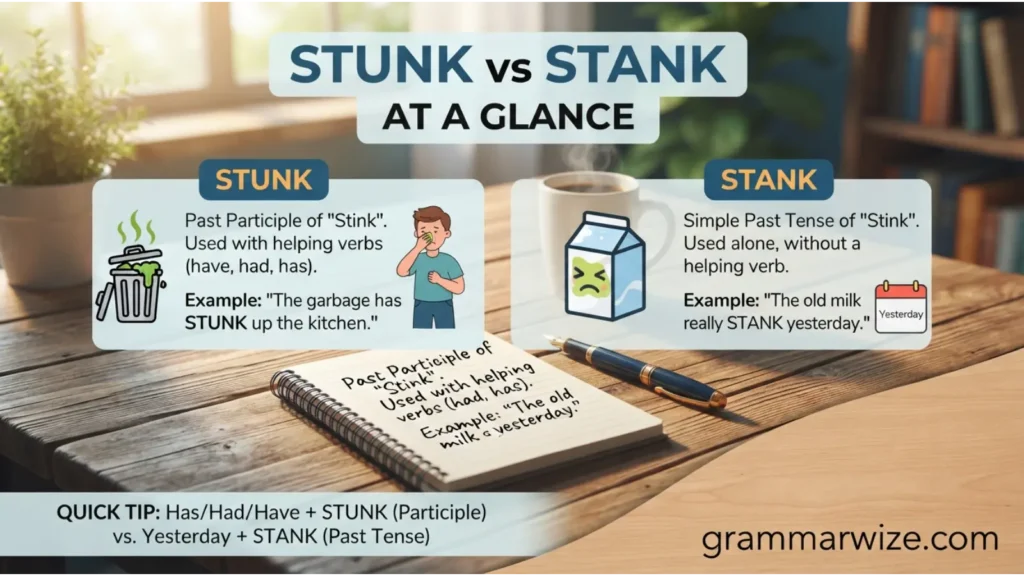
Stunk vs Stank at a Glance
| Word | Main grammatical role | Example |
|---|---|---|
| stank | Simple past | The room stank of smoke. |
| stunk | Past participle | The room had stunk for hours. |
| stunk | Simple past in some American usage | The room stunk after the spill. |
The safest general rule is simple: stank for simple past and stunk for past participle.
Why the Confusion Exists
The confusion comes from the unusual verb forms of stink.
Unlike regular verbs, stink does not form its past tense by simply adding ed. Its forms are:
- Present: stink
- Simple past: stank
- Past participle: stunk
- Present participle: stinking
Oxford lists both stank and stunk as past forms, while it identifies stunk as the past participle.
The situation becomes even more confusing because American English commonly accepts stunk as a past tense form.
Dictionary Recommendations
Major dictionaries confirm that both words are legitimate.
Oxford lists stank as the past tense of stink and stunk as its past participle. Oxford also lists stunk as an alternative past simple form.
Cambridge gives stank as the past tense and notes that stunk is also used as a past tense form in American and Australian English. It lists stunk as the past participle.
This means neither spelling should be treated as a misspelling.
Real Life Examples
When Stank Is Best
Use stank when describing a completed past event.
- The garbage stank yesterday.
- The old fridge stank badly.
- His socks stank after practice.
- The hallway stank of smoke.
- The pond stank during the heatwave.
When Stunk Is Best
Use stunk after a helping verb.
- The garbage has stunk all week.
- The fridge had stunk before we replaced it.
- His socks have stunk since the game.
- The hallway had stunk for hours.
- The pond has stunk since the algae appeared.
When American English Uses Stunk as Past Tense
You may also see sentences like these:
- The garbage stunk yesterday.
- His shoes stunk after the game.
- The room stunk of smoke.
This usage is recognized by major dictionaries, especially for American English.
Origin of Stink, Stank, and Stunk
The verb stink has very old Germanic roots. Oxford traces it to Old English stincan and connects it with related Germanic words, including Dutch and German forms.
The unusual vowel changes in stink, stank, and stunk come from the older pattern of irregular English verb formation.
Similar patterns appear in verbs such as sing, sang, and sung.
Common Mistakes
Using Stank After Has or Have
Incorrect:
- The room has stank for hours.
Better:
- The room has stunk for hours.
After has, have, or had, use the past participle stunk.
Assuming Stunk Is Always Wrong
Some writers incorrectly treat stunk as a spelling mistake.
That is not accurate. Major dictionaries recognize stunk as the past participle and also record it as a past tense form in American English.
Using Stank as a Past Participle
Avoid constructions such as:
- The room has stank.
Use:
- The room has stunk.
A Simple Memory Trick
Think of stank as matching other simple past forms like:
- stink → stank
- drink → drank
- sing → sang
Think of stunk as the form that often follows a helping verb:
- has stunk
- have stunk
- had stunk
A quick memory rule is:
Stank happened. Stunk has happened.
Professional Writing Recommendation
For formal and professional writing, stank is the clearest choice for the simple past tense.
For example:
- The storage area stank of chemicals.
Use stunk when the sentence requires a past participle:
- The storage area had stunk of chemicals for several days.
American writers may encounter or use stunk as the simple past, and dictionaries recognize this usage. Still, stank provides a straightforward distinction between the simple past and past participle forms.
FAQs:
Is stank a correct word?
Yes. Stank is the simple past form of stink and is widely recognized by major dictionaries.
Is stunk a correct word?
Yes. Stunk is the past participle of stink. American English also uses it as a past tense form.
Is stank or stunk correct?
Both are correct, but their usual grammatical roles differ. Stank is the standard simple past form, while stunk is the past participle.
Can I say the room stunk?
Yes. This construction is accepted, especially in American English. Cambridge lists stunk as an American past tense form of stink.
Is it the room stank or the room stunk?
Both can be correct. The room stank is the traditional simple past construction. The room stunk is also accepted in American English.
Should I write had stank or had stunk?
Use had stunk because had requires the past participle.
What is the past tense of stink?
Stank is the traditional past tense. Stunk is also used as the past tense in American English and some other varieties.
What is the past participle of stink?
The past participle is stunk.
Conclusion
Stank and stunk are both correct, but they normally serve different grammatical purposes. Use stank for the simple past and stunk for the past participle.
American English also permits stunk as a simple past form. For clear professional writing, using stank for simple past and stunk after has, have, or had is an easy and reliable approach.

Olivia Bennett is a grammar expert and language content writer at GrammarWize.com. She specializes in English grammar, word usage, spelling differences, and writing improvement. Through clear explanations and practical examples, Olivia helps students, professionals, and language learners communicate more effectively. Her goal is to make English grammar simple, accessible, and easy to apply in everyday writing.