Complimented or complemented can be confusing because both words sound similar and have related-looking spellings. However, they have different meanings and should be used in different situations.
Complimented or Complemented can be confusing because both words sound almost the same but have different meanings. Complimented means praised or admired, while complemented means completed, matched, or enhanced something. Knowing this simple difference can help you choose the correct word in your writing.
In this guide, you will learn the meanings, examples, and correct usage of complimented and complemented. You will also discover an easy way to remember which spelling fits your sentence.
Complimented relates to praise or admiration, while complemented means completed, enhanced, or matched something well. Learning this simple difference can help you choose the right word in emails, schoolwork, and professional writing.
Quick Answer
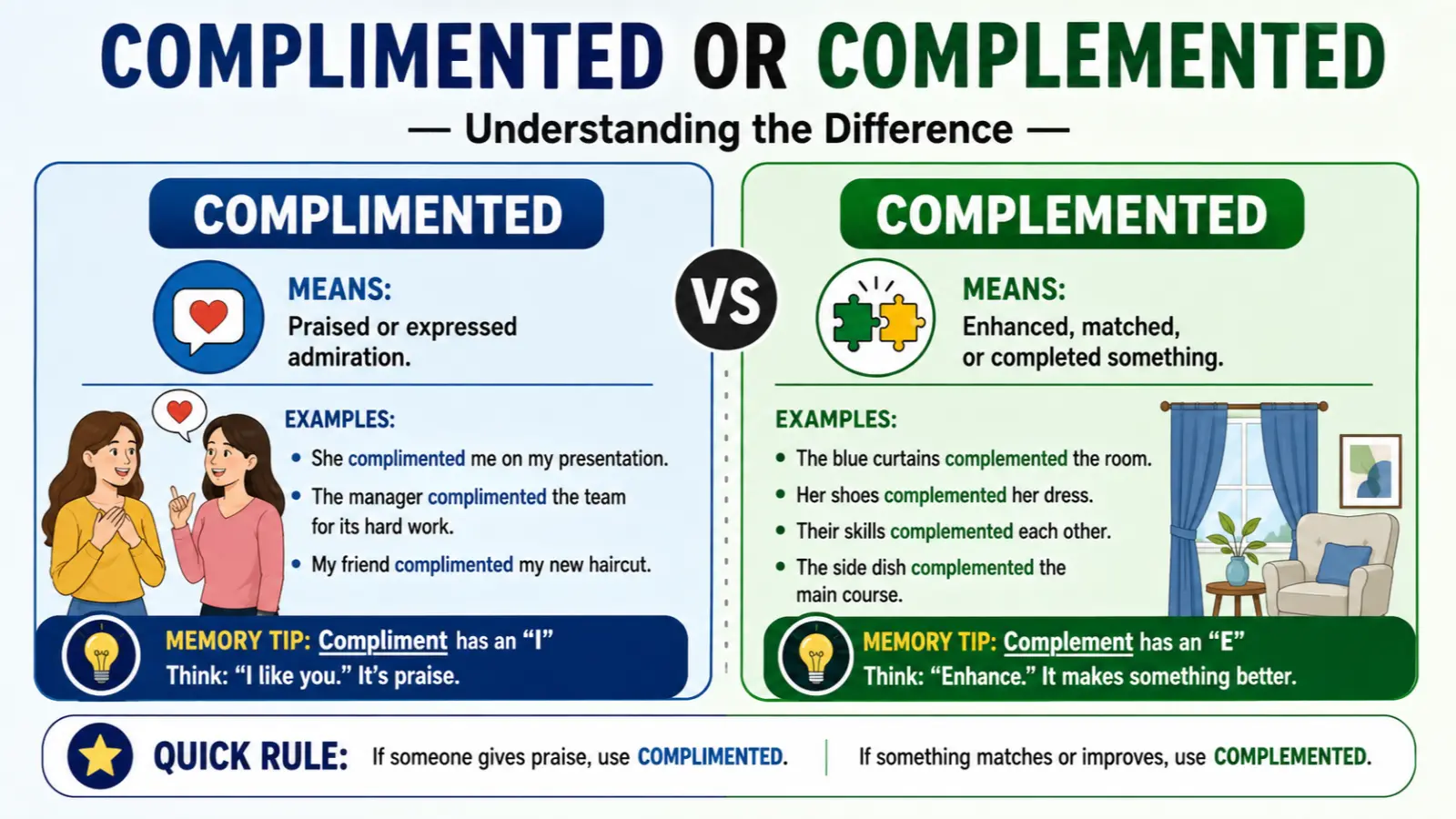
Complimented is correct when you mean praised someone or said something nice about them.
- She complimented me on my presentation.
- The manager complimented the team for its hard work.
Complemented is correct when you mean completed, improved, or matched something.
- The blue curtains complemented the room.
- His skills complemented those of his business partner.
What Does Complimented Mean?
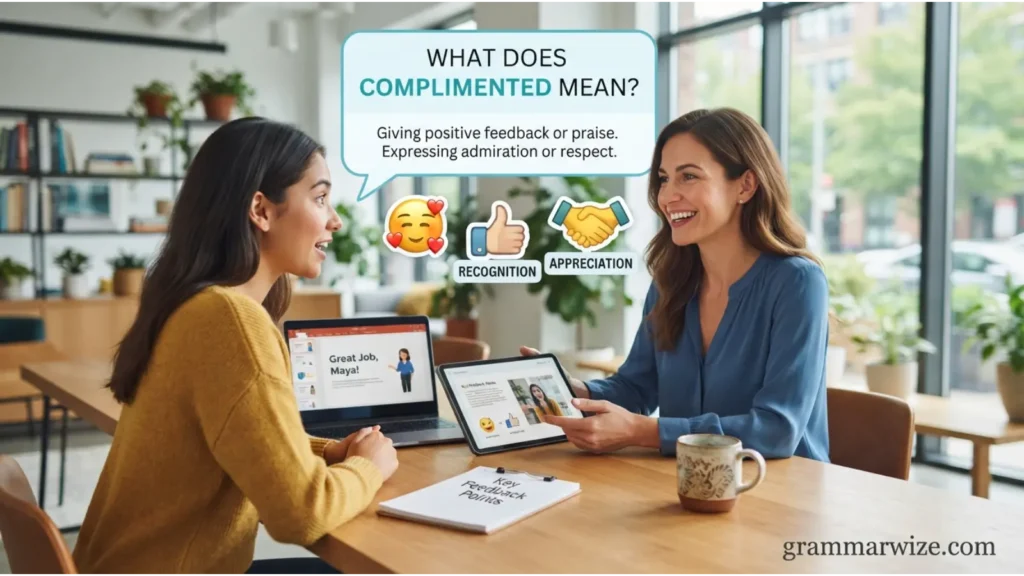
Complimented is the past tense of compliment. It means praised someone or expressed admiration for something.
A compliment can focus on a person’s appearance, skills, behavior, work, or achievements.
Examples:
- Maria complimented James on his new suit.
- My teacher complimented my writing.
- The customer complimented the chef.
- She complimented him on his excellent presentation.
Easy meaning
Think of complimented as praised.
If someone says something positive about you, they have complimented you.
What Does Complemented Mean?
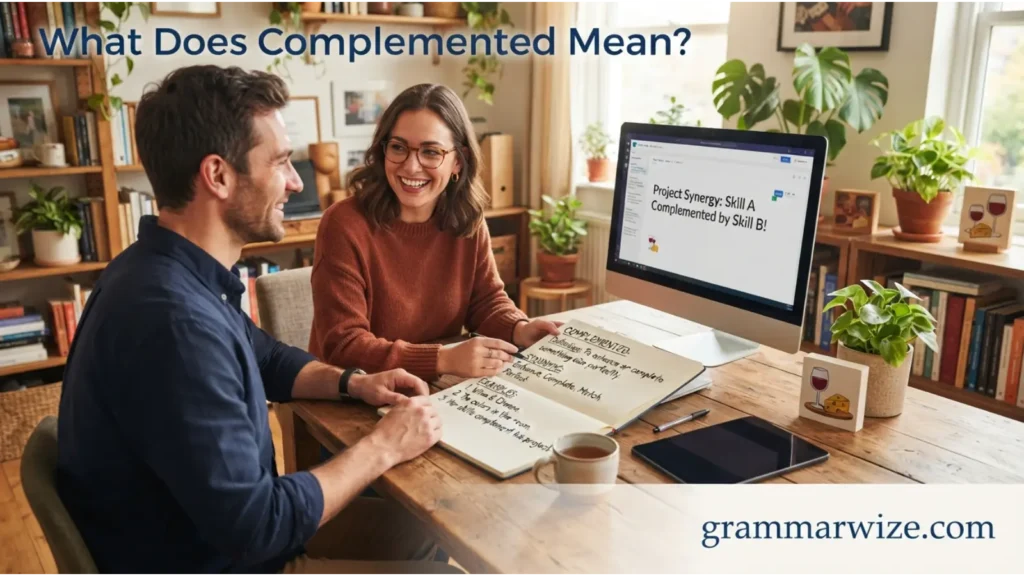
Complemented is the past tense of complement. It means something completed, enhanced, or worked well with something else.
The word often describes colors, designs, skills, ideas, qualities, or objects that fit together effectively.
Examples:
- The shoes complemented her dress.
- The sauce complemented the main dish.
- Their different skills complemented each other.
- The artwork complemented the room’s design.
Easy meaning
Think of complemented as matched or enhanced.
If one thing makes another thing better or more complete, it complemented it.
Complimented vs Complemented
| Word | Meaning | Example |
|---|---|---|
| Complimented | Praised or expressed admiration | She complimented my work. |
| Complemented | Enhanced, matched, or completed | The colors complemented each other. |
The key difference is simple:
Complimented = praised.
Complemented = matched, enhanced, or completed.
Why Do People Confuse These Words?
The confusion comes from their almost identical spelling and pronunciation. Both words are pronounced the same way in standard English, making them homophones.
Their related nouns also look similar:
- Compliment means praise.
- Complement means something that completes or enhances another thing.
The single vowel difference changes the meaning completely.
A Simple Way to Remember the Difference
Use this memory trick:
Compliment has an “I” for “I like you.”
A compliment is something positive that you say about someone.
Complement has an “E” for “Enhance.”
Something complements another thing when it improves, matches, or completes it.
For example:
- She complimented my jacket. → She praised it.
- The jacket complemented my outfit. → It matched the outfit.

Real Life Examples
Complimented
- The coach complimented the players after the game.
- She complimented her friend on the beautiful painting.
- My boss complimented me on my performance.
- He complimented the waiter on the excellent service.
Complemented
- The wooden table complemented the modern chairs.
- Her necklace complemented her dress.
- The two speakers complemented each other’s ideas.
- The side dish complemented the main course.
Common Mistakes
A common mistake is using complimented when describing things that match or enhance each other.
Incorrect: The curtains complimented the furniture.
Correct: The curtains complemented the furniture.
Another mistake is using complemented when someone gives praise.
Incorrect: My teacher complemented my essay.
Correct: My teacher complimented my essay.
Professional Writing Recommendation
Choose complimented when the subject gives praise.
Choose complemented when one person, object, quality, or idea enhances another.
In professional writing, using the correct form prevents ambiguity and makes your meaning clear.
For example:
The director complimented the employee on her performance.
Here, the director praised the employee.
The employee’s technical skills complemented the team’s creative abilities.
Here, the skills worked well together.
Frequently Asked Questions
Is complimented or complemented correct?
Both are correct words, but they have different meanings. Complimented means praised, while complemented means matched, enhanced, or completed.
Is it compliment or complement someone?
Use compliment when you mean to praise someone.
Example: I complimented her on her presentation.
Is it complemented by or complimented by?
Both phrases can be correct, depending on the meaning.
Complimented by means praised by someone.
Complemented by means enhanced or matched by something.
Are complimented and complemented homophones?
Yes. They have the same pronunciation in standard English but different spellings and meanings.
How can I remember the difference?
Remember compliment = praise and complement = enhance or complete.
Conclusion
Complimented and complemented are both correct spellings, but they serve different purposes. Use complimented when someone gives praise. Use complemented when something matches, enhances, or completes something else.
The easiest rule is to remember complimented = praised and complemented = enhanced or matched. This distinction will help you use both words confidently in everyday and professional writing.

Olivia Bennett is a grammar expert and language content writer at GrammarWize.com. She specializes in English grammar, word usage, spelling differences, and writing improvement. Through clear explanations and practical examples, Olivia helps students, professionals, and language learners communicate more effectively. Her goal is to make English grammar simple, accessible, and easy to apply in everyday writing.