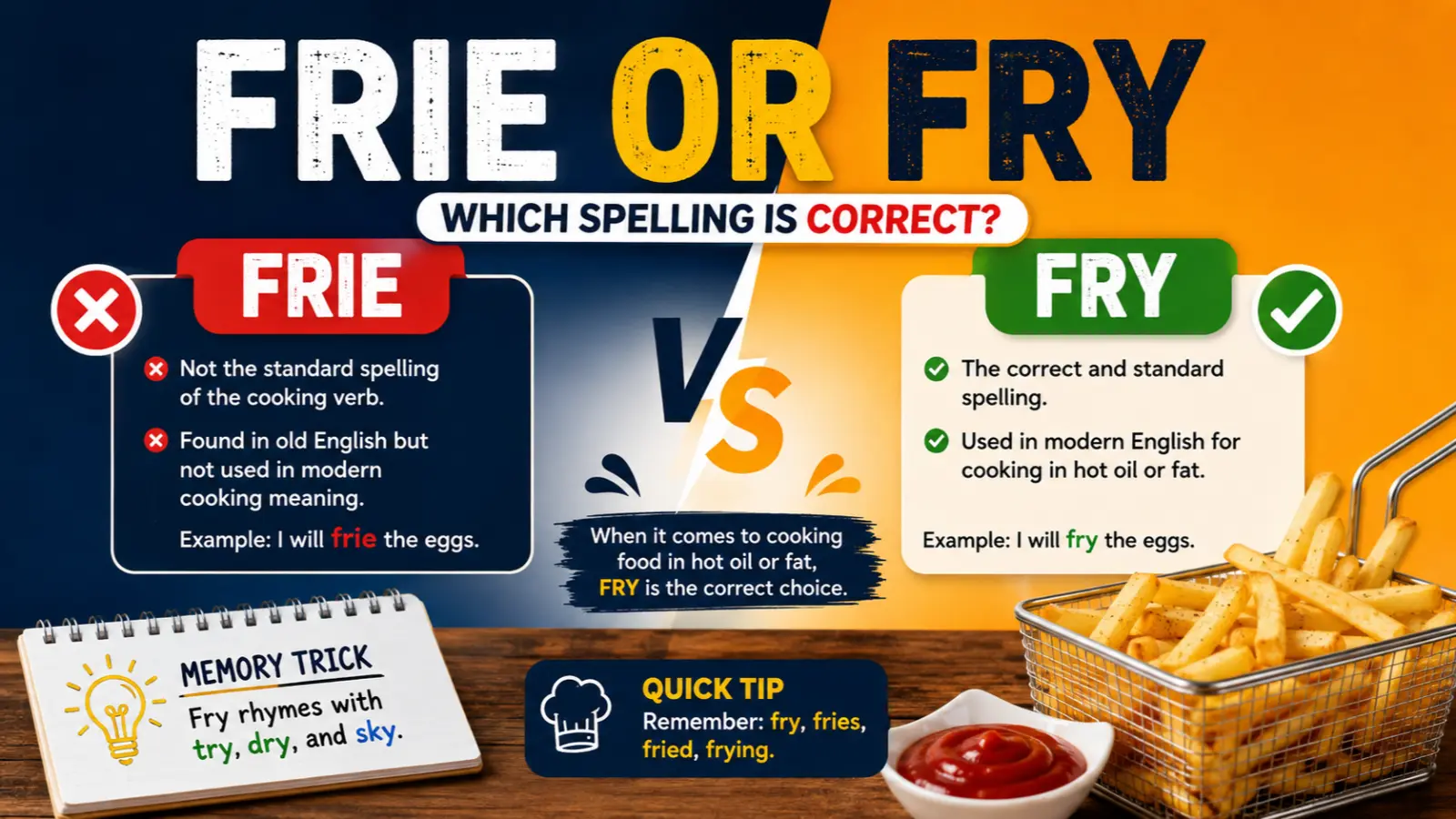
Frie or fry can be confusing because both spellings look and sound similar. However, when you mean cooking food in hot oil or fat, fry is the correct modern English spelling.
Frie or Fry can be confusing because these words look and sound similar, but they are not used in the same way. In most cases, fry is the correct word when talking about cooking food in hot oil or heat. “Frie” is generally considered a misspelling.
Understanding the difference between Frie or Fry can help you avoid common spelling mistakes in everyday writing. In this guide, we will explain the correct spelling, meaning, usage, and examples in simple English.
The spelling frie is not the standard spelling for the cooking verb. Major dictionaries such as Merriam Webster and American Heritage Dictionary list fry with meanings related to cooking food.
Quick Answer
Fry is the correct spelling when you mean to cook food in hot oil, fat, or another heated cooking medium.
Frie is not the standard modern spelling of this verb.
For example:
- Correct: I will fry the eggs.
- Incorrect: I will frie the eggs.
- Correct: She likes to fry chicken.
- Incorrect: She likes to frie chicken.
The word fry is also used as a noun, as in French fry and fish fry.
What Does Fry Mean?
Fry is a verb that means to cook food over heat, usually in oil or fat. It can describe cooking in a pan, on a griddle, or through another frying method.
Examples include:
- Fry the onions until they turn golden.
- He will fry some eggs for breakfast.
- We usually fry potatoes in vegetable oil.
- She fried the chicken for dinner.
The word can also work as a noun. For example, a fish fry describes a gathering where fried food is prepared and eaten. Fries can refer to fried potato strips.
Is Frie a Correct English Word?
Frie is not the standard spelling of the cooking verb in modern English.
If you want to say that food is being cooked in hot oil or fat, use fry.
There is an interesting historical detail, though. Frie has appeared in older forms of English and can also appear in historical or specialized dictionary records with meanings connected to young fish or fish eggs. Wiktionary records frie as a Middle English form, while modern English uses fry for the common cooking sense.
Therefore, modern writers should not use frie as an alternative spelling of fry.
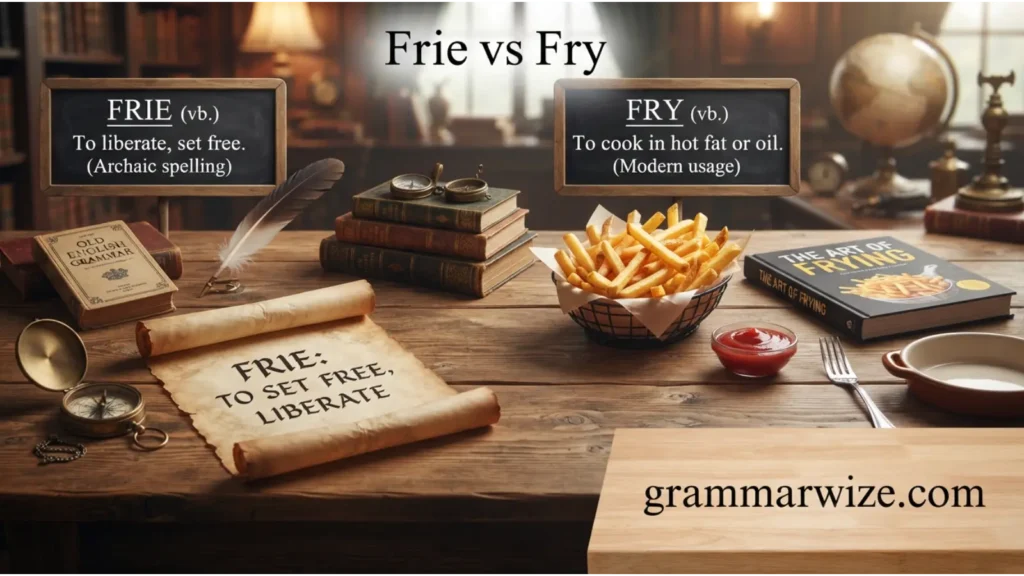
Frie vs Fry Comparison
| Word | Standard modern English | Meaning | Example |
|---|---|---|---|
| Fry | Yes | To cook food in hot oil or fat | I will fry the eggs. |
| Frie | No, for this meaning | Not the standard spelling of the cooking verb | I will frie the eggs. |
The safest choice in everyday, academic, business, and professional writing is fry.
Origin of Fry
The history of fry goes back many centuries. Merriam Webster traces the cooking verb to Middle English frien, from Anglo French frire, and ultimately to Latin frigere, meaning to roast.
American Heritage Dictionary also traces the verb through Middle English and Old French to Latin roots.
This long history explains why fry has remained established in English instead of changing to frie.
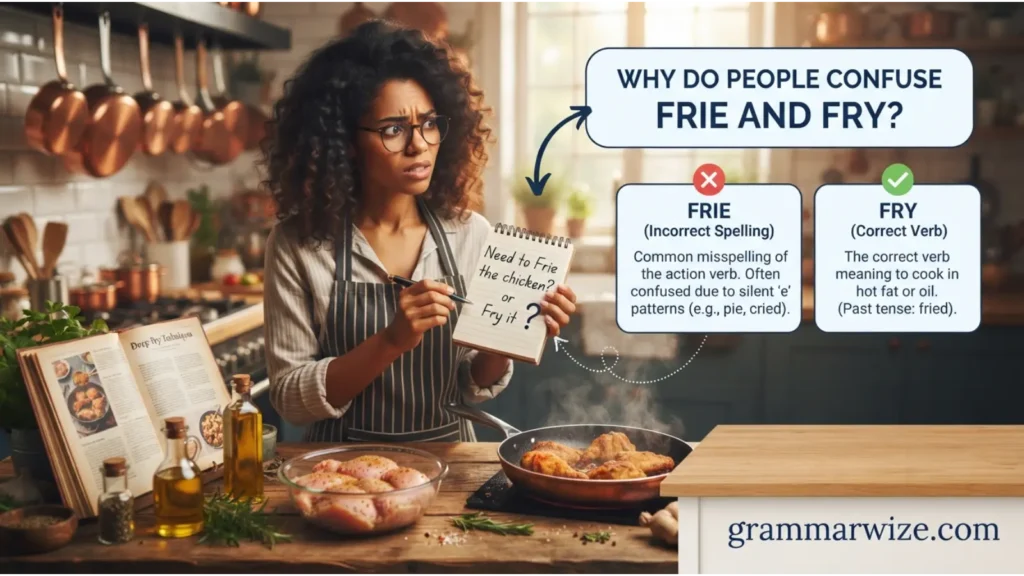
Why Do People Confuse Frie and Fry?
The confusion mainly comes from the pronunciation of fry.
Fry is pronounced like “fr-eye.” Some writers may expect the final sound to require ie, especially because English contains many words ending in ie.
For example, words such as tie, lie, and pie use ie. That spelling pattern can make frie look reasonable.
However, English spelling does not always follow one simple pattern. The established spelling of the cooking word is fry.
Another useful clue is the related word fried:
- fry
- fries
- fried
- frying
Remembering this word family can make the spelling easier.
Dictionary Recommendations
Merriam Webster lists fry as a verb meaning to cook in a pan or on a griddle using heat, often with fat or oil. It also lists related noun meanings such as fries and fish fry.
American Heritage Dictionary likewise lists fry as the standard verb for cooking food over direct heat in hot oil or fat.
These dictionary entries support fry as the standard modern spelling for the cooking meaning.
Fry in Real Life
You will commonly see fry in recipes, restaurant menus, cooking instructions, and everyday conversation.
Here are some natural examples:
Cooking
- Fry the onions for five minutes.
- Fry the potatoes until crispy.
- Fry the chicken in hot oil.
Everyday conversation
- Can you fry an egg for me?
- I usually fry vegetables for dinner.
- We decided to fry some fish.
Food descriptions
- The restaurant serves fish and fries.
- I ordered a burger with fries.
- They are preparing food for a fish fry.
Merriam Webster’s current examples also show fry, fried, and frying in ordinary cooking contexts.

Common Mistakes
A common mistake is adding ie to the end of fry.
Incorrect:
I am going to frie the potatoes.
Correct:
I am going to fry the potatoes.
Another mistake is assuming that frie is the base form because fried contains the letters ie.
The correct relationship is:
fry → fried → frying
It is not:
frie → fried → friing
Remembering the base word helps prevent this error.
Fry and Its Related Forms
Knowing the different forms of the word makes the spelling easier.
| Form | Example |
|---|---|
| Fry | I fry eggs every morning. |
| Fries | She fries the potatoes. |
| Fried | We ate fried chicken. |
| Frying | He is frying onions. |
Notice that fried and frying do not change the base spelling into frie.
Memory Trick
Use this simple trick:
Fry rhymes with try, dry, and sky.
Think of the sentence:
“I fry, then I try.”
This helps you remember that the cooking word ends in y, not ie.
You can also connect it with French fries. The word fries comes from fry, making the correct spelling easier to recall. Merriam Webster lists fries as the plural form of the noun fry.
Professional Writing Recommendation
Use fry in all standard modern English writing when you mean cooking food.
This includes:
- School assignments.
- Business writing.
- Recipes.
- Food blogs.
- Menus.
- News articles.
- Emails.
- Social media posts.
- Academic writing.
Avoid frie when referring to the cooking process. Using the standard spelling keeps your writing clear and professional.
Frequently Asked Questions
Is frie or fry correct?
Fry is correct when you mean to cook food in hot oil or fat. Frie is not the standard modern spelling for this meaning.
Is frie a word?
Frie appears in historical English records, including Middle English, but it is not the standard modern spelling of the cooking verb fry.
How do you spell fry in the past tense?
The past tense of fry is fried.
Example: She fried the eggs.
Is fried spelled with frie?
Yes, fried contains ie, but its base verb is fry.
The forms are:
fry → fried → frying
Is fry used in British English?
Yes. Fry is the standard spelling in both British and American English for the cooking verb.
What is the plural of fry?
For the food meaning, the plural is commonly fries, as in French fries. For young fish, fry can itself function as a plural noun.
Why does fry become fried?
The spelling changes when the past tense ending is added. The final y changes to ie before the d, producing fried.
Can I use frie in a recipe?
No. For a modern English recipe, use fry.
Correct: Fry the onions until soft.
Incorrect: Frie the onions until soft.
Conclusion
When comparing frie or fry, the correct choice for modern English is fry. Use it when you mean to cook food in hot oil, fat, or another heated cooking medium.
The spelling frie may appear in historical English contexts, but it is not the standard modern spelling of the cooking verb. Remember fry, fries, fried, and frying to avoid this common mistake.
For recipes, schoolwork, professional documents, and everyday writing, choose fry.

Olivia Bennett is a grammar expert and language content writer at GrammarWize.com. She specializes in English grammar, word usage, spelling differences, and writing improvement. Through clear explanations and practical examples, Olivia helps students, professionals, and language learners communicate more effectively. Her goal is to make English grammar simple, accessible, and easy to apply in everyday writing.