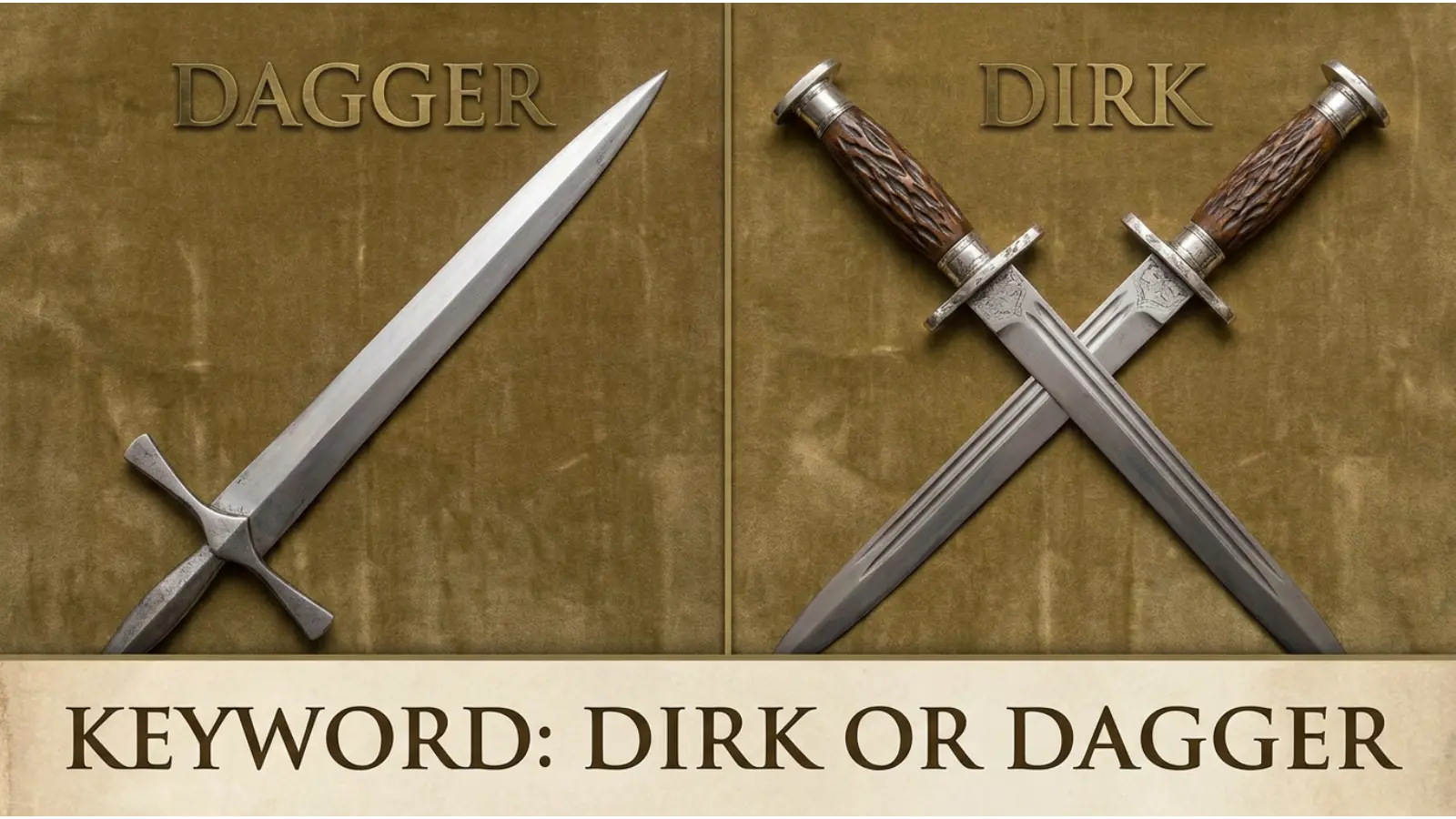
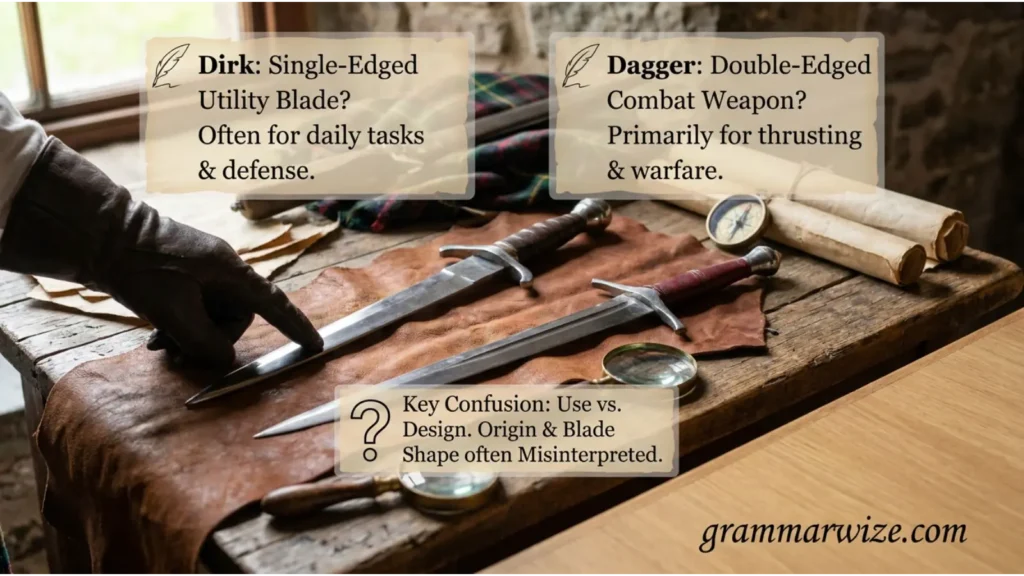
Dirk or dagger can be confusing because both words describe short-bladed weapons. However, they have different historical meanings and typical uses. A dagger is a general term for a short stabbing weapon, while a dirk usually refers to a specific type associated with Scottish history and military use.
Dirk or Dagger is a trending spelling comparison that often confuses readers because both words describe short, pointed weapons. While they share some similarities, a dirk and a dagger have different historical meanings and uses.
Understanding the difference can help you choose the correct word in articles, books, historical writing, and everyday English. This guide explains Dirk or Dagger, their meanings, key differences, and the right way to use each term.
Understanding the distinction helps you choose the right word in historical writing, fiction, descriptions, and everyday discussions. A dirk can be a type of dagger, but not every dagger is a dirk.
Quick Answer
Dagger is the broader term for a short-bladed stabbing weapon.
Dirk usually describes a particular long, narrow dagger, especially one historically associated with Scotland.
Example:
- The knight carried a dagger at his belt.
- The Scottish soldier wore a dirk.

What Does Dirk Mean?
A dirk is a type of short-bladed weapon traditionally associated with Scotland. Historical dirks often had a relatively long, narrow blade and were carried by Highland soldiers.
The word is strongly connected with Scottish military and Highland culture.
Examples:
- The Highland warrior carried a dirk.
- The museum displayed an antique Scottish dirk.
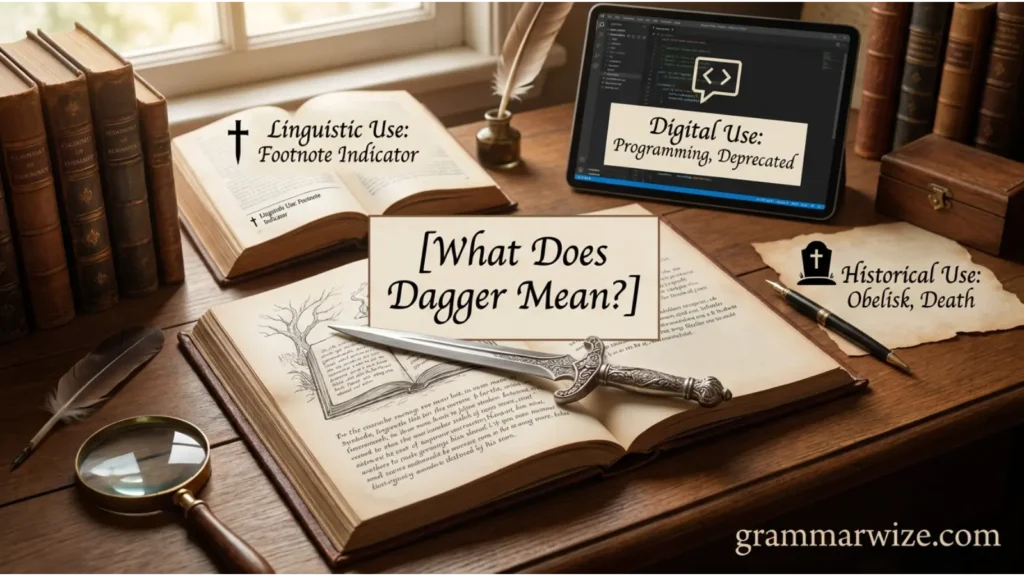
What Does Dagger Mean?
A dagger is a general word for a short-bladed weapon designed mainly for stabbing. Daggers have appeared in many cultures and historical periods.
Unlike dirk, the word does not point to one particular national or historical tradition.
Examples:
- The character pulled a dagger from his belt.
- The museum displayed a medieval dagger.
Dirk vs Dagger: Key Differences
| Feature | Dirk | Dagger |
|---|---|---|
| Meaning | A specific type of short-bladed weapon | A broad term for a short-bladed weapon |
| Historical connection | Strongly associated with Scotland | Found across many cultures |
| Typical blade | Often long and narrow | Varies by design |
| Usage | Mainly historical and specialized | Common general term |
| Scope | More specific | More general |
Where Did Dirk Come From?
Dirk has a long connection with Scottish history. The term became associated with the Scottish Highland dirk, which developed into an important weapon and symbol of Highland military culture.
Historical examples can vary in shape and size, so modern descriptions should consider the period being discussed.
Where Did Dagger Come From?
Dagger is a much broader historical term. Short stabbing weapons have existed for thousands of years, and different cultures developed their own dagger designs.
The word became established in English as a general name for this class of weapon.
Why Do People Confuse Dirk and Dagger?
The main reason is their overlapping meaning. A dirk is essentially a specialized form of dagger, so descriptions can sometimes use the words loosely.
The confusion also comes from historical illustrations and fictional stories. A short weapon may be labeled a dagger even when its design or historical context would make dirk more precise.
Dictionary Recommendation
Use dagger when you need a general word for a short stabbing weapon.
Use dirk when the weapon has the specific historical or cultural characteristics associated with that term.
For formal writing, choose the word that best matches the historical context rather than using them as automatic synonyms.
Real Life Examples
Historical Writing
Correct: The Highland soldier carried a dirk.
This wording highlights the weapon’s Scottish historical context.
General Description
Correct: The character carried a dagger.
This works when the exact type of short blade is not important.
Museum Description
Correct: The collection contains a Scottish dirk.
The specific term gives readers more historical information.
Fiction
Correct: The thief hid a dagger beneath his coat.
The broader word works naturally when the weapon type is not historically specific.
General Conversation
Correct: The artifact appears to be a dagger.
Use the broader term when you do not know the exact weapon type.
Common Mistakes
- Treating dirk and dagger as completely identical terms.
- Calling every dagger a dirk.
- Using dirk without a relevant historical or cultural context.
- Assuming the two words always describe the same blade design.
- Using dagger when a historical source specifically identifies the weapon as a dirk.
Memory Trick
Think of dagger as the general category.
Think of dirk as the specific Scottish type.
A simple way to remember it is:
Every dirk can be described as a dagger, but every Stiletto is not a dirk.
Professional Writing Recommendation
Choose dagger for general descriptions because readers are more familiar with it.
Choose dirk when discussing Scottish history, Highland warriors, historical weapons, or a specific weapon identified as a dirk.
If accuracy matters, avoid switching between the two terms simply for variety. The historical context should determine your choice.
FAQs:
Is a dirk the same as a dagger?
Not exactly. A dirk is a specific type of short-bladed weapon, while Stiletto is the broader term.
Is a dirk a type of dagger?
Yes. A dirk can be considered a specialized type of dagger.
Which word is more common, dirk or Stiletto?
Dagger is much more common in general English. Dirk appears more often in historical or specialized contexts.
Is dirk only a Scottish word?
The term is strongly associated with Scottish history, especially the Highland dirk, although its broader historical usage has varied.
Should I use dirk or Stiletto in historical writing?
Use dirk when the weapon specifically matches the historical type. Otherwise, dagger may be more appropriate.
Conclusion
Dirk and dagger are both correct words, but they have different levels of specificity. Dagger is the general term for a short-bladed stabbing weapon, while dirk usually identifies a particular weapon with strong Scottish historical associations. When describing a specific historical weapon, dirk may be the more accurate choice. For general writing, dagger is usually the safer and clearer term.

Olivia Bennett is a grammar expert and language content writer at GrammarWize.com. She specializes in English grammar, word usage, spelling differences, and writing improvement. Through clear explanations and practical examples, Olivia helps students, professionals, and language learners communicate more effectively. Her goal is to make English grammar simple, accessible, and easy to apply in everyday writing.